
The Gulf’s Escalation Paradox
Why Diplomacy Is Accelerating as the Risks of a Wider War Continue to Mount
By Roberto Pucciano
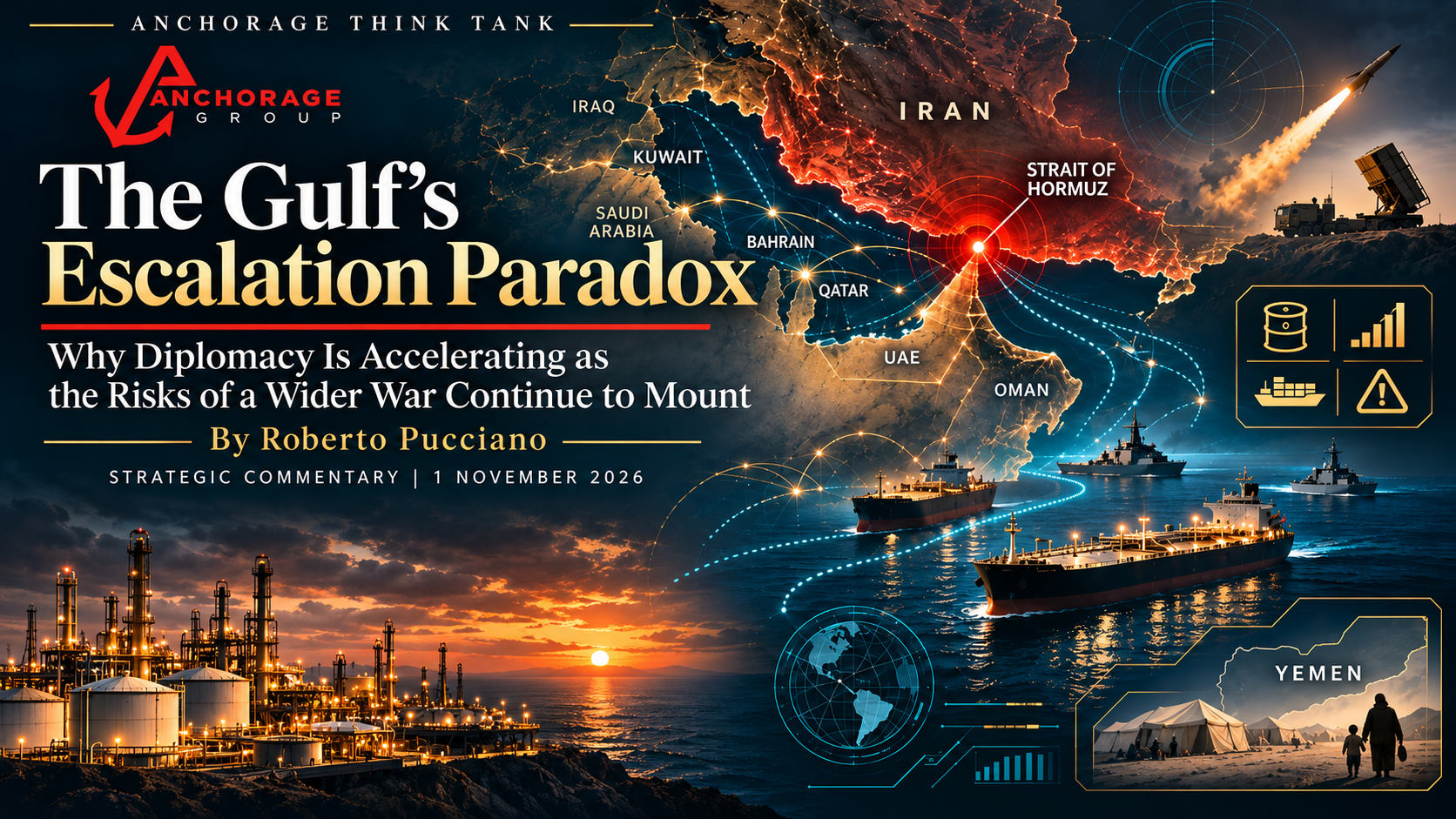
The final days of October have exposed a growing contradiction in the confrontation between Iran and the United States. As regional governments intensify diplomatic efforts to prevent renewed military operations, Tehran is expanding its declared deterrence posture. Maritime insecurity persists, and the conflict’s humanitarian consequences continue to deepen. The central challenge is no longer simply how to avert another round of fighting, but whether the parties can build a political framework that can prevent its recurrence.
- The Contradiction at the Heart of the Crisis
The developments between 29 October and 1 November 2026 reveal a troubling paradox in the evolving confrontation among Iran, the United States and their regional partners.
Diplomatic engagement is intensifying just as military rhetoric grows broader, and the security of essential regional infrastructure remains in doubt.
The principal developments are substantial.
Qatari mediators have continued consultations with Iranian officials, including meetings in Tehran and Doha. Washington has publicly acknowledged that direct and indirect diplomatic contacts remain active. Iran’s Supreme Leader has instructed the country’s armed forces to prepare for retaliation with no geographic limits. Saudi Arabia continues to report missile and drone threats, while commercial shipping through the Strait of Hormuz remains vulnerable to attack.
Meanwhile, the United Nations has confirmed the death of a member of its human rights staff while detained by the Houthi authorities in Yemen, prompting renewed attention to the humanitarian consequences of the wider confrontation.
These events do not establish that another war is inevitable.
They do, however, show the growing difficulty of separating diplomatic negotiations from military coercion.
Washington seeks to preserve its military options while pursuing a negotiated settlement.
Tehran seeks to demonstrate that renewed attacks on Iranian territory would have consequences extending far beyond its borders.
The Gulf states, meanwhile, must reconcile their dependence on external security partnerships with their exposure to the economic and civilian consequences of regional escalation.
The result is an increasingly complex environment in which the incentives to negotiate are rising alongside the risks of strategic miscalculation.
- Iran’s Expanding Deterrence Doctrine
The most significant political-military development took place on 31 October.
Following consultations with senior military commanders, Iran’s Supreme Leader, Mojtaba Khamenei, instructed the armed forces to prepare an immediate and effective response to any renewed American or Israeli attack, explicitly rejecting any geographical restrictions on potential retaliation.
According to the official Iranian statement, military authorities were also instructed to update their list of potential targets to include a wider range of American and Israeli assets.
The declaration is strategically important, though its operational implications remain uncertain.
It does not independently establish a new military capability, an imminent decision to attack, or a revision of existing operational plans.
Rather, it represents an explicit attempt to broaden the perceived consequences of military action against Iran.
The distinction matters.
Deterrence is not determined solely by a state’s destructive capabilities. It also depends on an adversary’s expectations about the circumstances, geographical scope, and intensity of possible retaliation.
By declaring that its response would not be geographically constrained, Tehran is seeking to influence calculations in Washington and Israel and to signal to regional governments that the consequences of renewed confrontation could extend to their territories.
This poses a particular dilemma for countries hosting American military installations.
Their security relationships with Washington remain strategically important, yet their proximity to Iran and the concentration of critical economic infrastructure expose them to the consequences of retaliation.
The broader the declared scope of deterrence, the more complex crisis management becomes.
Ambiguity may increase the perceived costs of military action, but excessive ambiguity can also heighten the risk of misunderstanding intentions.
Iran’s latest statement therefore highlights the tension between deterrent credibility and escalation control.
A threat intended to discourage military action may simultaneously prompt defensive mobilisation, contingency planning and further military preparations among the intended adversaries.
The strategic question is whether Tehran can strengthen deterrence without creating conditions that make renewed confrontation harder to avoid.
- Washington’s Diplomatic Opening: Negotiations Have Not Stopped
Tehran’s developments were accompanied by an important clarification from Washington.
Speaking at the conclusion of the G20 foreign ministers’ meeting in Atlanta on 31 October, US Secretary of State Marco Rubio confirmed that diplomatic contacts with Iran had continued throughout the confrontation.
According to Rubio, those exchanges have occurred both directly and through intermediaries.
He also stated that President Donald Trump had not decided whether to authorise renewed military operations against Iran and still preferred a diplomatic solution.
This clarification is significant.
It establishes that diplomatic engagement should not be understood merely as a future possibility contingent upon a cessation of military pressure.
A negotiating channel already exists, even if the parties remain divided on the substance and sequencing of a settlement.
Rubio’s remarks also highlight the central tension in Washington’s approach.
The United States continues to emphasise its ability to achieve military objectives while maintaining that a negotiated outcome remains preferable.
Such a position is not inherently contradictory. Military pressure and diplomacy have often operated simultaneously in international relations.
The difficulty arises when the credibility of coercive threats begins to erode the confidence necessary for agreement.
Negotiations require parties to believe that commitments will be honoured.
Military escalation, by contrast, can encourage each side to retain the capacity to reverse concessions or to retaliate against perceived violations.
The challenge for Washington is therefore not merely to maintain military superiority.
It is to establish whether that superiority can support a credible negotiating framework rather than perpetuating a cycle of confrontation.
- Qatar, Iran and the Problem of Diplomatic Sequencing
Qatar’s renewed mediation efforts offer the clearest evidence of the region’s determination to prevent further escalation.
Following extensive consultations in Tehran on 30 October, Iranian representatives continued discussions with Qatari mediators in Doha.
The exchanges reportedly addressed the reopening of the Strait of Hormuz, sanctions relief, nuclear verification, and possible reciprocal commitments.
The existence of these discussions indicates diplomatic engagement, not a negotiated breakthrough.
The central obstacle remains the order of concessions.
Tehran seeks credible assurances on sanctions relief and broader security arrangements.
Washington continues to regard verifiable commitments on Iran’s nuclear activities and maritime access as essential to any durable agreement.
Both parties consequently seek guarantees before undertaking actions that the other party considers prerequisites for progress.
This presents a familiar diplomatic dilemma.
The concessions necessary to establish trust are difficult to make in the absence of trust.
Regional mediation can reduce this problem by providing mechanisms for communication, verification and gradual implementation.
Qatar’s position is particularly relevant because its relationships with both Washington and Tehran offer opportunities for engagement that direct bilateral negotiations may not always provide.
However, mediation cannot resolve fundamental differences in strategic objectives.
Nor can it guarantee that political commitments will endure renewed military incidents.
The broader significance of the Qatari initiative lies in its attempt to turn diplomatic communication into a structured process that can reduce uncertainty.
Whether that process can produce enforceable arrangements remains uncertain.
- The Gulf States: Between Security Guarantees and Economic Exposure
The latest developments also highlight a growing divide between the strategic priorities of the United States and the immediate security interests of its regional partners.
Saudi Arabia, Qatar, Oman, the United Arab Emirates and other Gulf states share concerns over Iran’s military capabilities and regional influence.
Yet their exposure to renewed confrontation differs substantially from Washington’s.
The United States has the ability to project military power across considerable geographical distances.
The Gulf states must manage the consequences within their own borders.
Their airports, energy installations, ports, financial centres and logistics networks are embedded in the geographical environment where retaliation could occur.
For these governments, successful security policy cannot be measured solely by the military degradation of an adversary.
It must also preserve economic activity, civilian confidence and the operation of essential infrastructure.
This distinction is especially important for Saudi Arabia.
The kingdom continues to report interceptions of missiles and unmanned aerial vehicles attributed to Houthi operations, although responsibility for individual incidents remains disputed and some operational claims have not been independently verified.
Even successful interceptions can incur significant costs.
Permanent surveillance, missile-defence readiness, infrastructure protection and commercial uncertainty require substantial financial and institutional resources.
The effects are not limited to defence budgets.
International aviation, tourism, logistics and foreign investment all depend on confidence in a stable operating environment.
The strategic challenge is therefore broader than merely preventing individual attacks.
It is intended to reduce the political and military incentives that sustain repeated threats.
This explains why Gulf governments have increasingly pursued diplomatic engagement alongside defensive cooperation.
The objective is not necessarily to replace American security guarantees.
It is to reduce the region’s exposure to decisions and confrontations over which its governments exercise only partial control.
- The Hormuz and the Bab al-Mandab: The Internationalisation of Maritime Insecurity
The continued insecurity of the Strait of Hormuz illustrates how regional confrontation can have consequences far beyond the immediate participants.
During the final days of October, UK Maritime Trade Operations issued several notices regarding attacks or suspicious incidents involving commercial vessels.
On 29 October, the organisation received reports of tankers struck by unidentified projectiles and of a vessel observed on fire in the strait.
On 30 October, UKMTO reported another incident about forty nautical miles south of Iran’s Lavan Island, in which a vessel was struck by an unidentified projectile, triggering a fire.
The crew was reported to be safe, and no environmental damage had been established at the time of the initial notice.
A separate report published on 30 October concerned an earlier incident reported after the event.
These incidents should not automatically be attributed to the same perpetrators.
Nor do they independently verify the accuracy of Iranian claims about the number of ships allegedly struck by naval mines.
Their collective significance nevertheless extends beyond the damage sustained by individual vessels.
Commercial shipping depends on predictable operating conditions.
When attacks recur, uncertainty affects route planning, insurance, energy transport, and investment decisions.
The impact is not limited to the vessels directly targeted.
A sufficiently uncertain maritime environment can impose costs on the wider commercial system.
The problem is compounded by the diversity of potential threats, ranging from missiles and unmanned systems to small craft and close-range attacks.
No single defensive capability can address every scenario.
The security of the Hormuz consequently depends on a combination of naval protection, intelligence cooperation, incident investigation and political arrangements that reduce the incentives for disruption.
The situation also underscores why the Bab al-Mandab must remain part of the broader strategic assessment.
Although the latest reporting does not indicate a comparable escalation there, the two waterways together influence the continuity of trade between the Gulf, the Indian Ocean, the Red Sea and the Mediterranean.
Disruption affecting both would have consequences extending well beyond regional energy markets.
The resulting challenge is not merely maritime.
It concerns the resilience of essential international economic networks.
- Yemen and the Humanitarian Cost of Strategic Competition
The deterioration of conditions in Yemen remains one of the most troubling aspects of the regional crisis.
The situation in Taiz illustrates the consequences of prolonged conflict for civilian infrastructure and for humanitarian access.
Restrictions on supply routes, shortages of essential commodities and the destruction of transport infrastructure have placed further pressure on an already vulnerable population.
Recent investigations by Human Rights Watch have documented serious concerns about the obstruction and destruction of infrastructure serving the city.
The consequences extend beyond immediate shortages.
When roads, water systems and medical supply chains become inaccessible, the capacity of civilian communities to sustain everyday life gradually deteriorates.
The United Nations confirmed an especially grave development on 31 October.
The Secretary-General condemned the death of Mohammad el Shami, an employee of the Office of the United Nations High Commissioner for Human Rights, while he was detained by the Houthi authorities.
El Shami had been detained since 6 June 2024.
According to the United Nations, the circumstances surrounding his death remain unclear, and repeated requests for information about his condition while in detention have not been answered.
The Secretary-General called for an immediate, impartial, and thorough investigation.
The United Nations also confirmed that this was the second death of a UN employee in Houthi custody, after the death of a World Food Programme staff member in February 2025.
It expressed continuing concern for 70 UN personnel, five former employees, and other humanitarian and civil-society workers who remain detained.
These are established institutional statements.
They do not establish the precise cause of El Shami’s death or the criminal responsibility of those involved.
Nevertheless, the event raises fundamental questions about the protection of humanitarian personnel and the ability of international organisations to operate independently in conflict zones.
The wider significance is both political and humanitarian.
Any regional agreement that reduces attacks on Saudi Arabia while leaving Yemen’s internal conflict and humanitarian restrictions unresolved would constitute only a partial settlement.
The Houthis have their own political objectives, territorial interests and organisational structures.
Their relationship with Iran is strategically important, but it does not diminish their independent role in Yemen’s conflict.
A durable regional security arrangement must therefore address Yemen’s domestic political fragmentation, humanitarian access and the protection of civilians on their own terms.
Humanitarian security cannot remain a secondary consideration in broader negotiations on military deterrence.
- The G20 and the Limits of International Economic Governance
The G20 foreign ministers’ meeting in Atlanta on 30 and 31 October added an important international dimension to these developments.
The meeting concluded without achieving comprehensive consensus on major geopolitical disputes.
Instead of a jointly negotiated communiqué, the American presidency issued a Chair’s Statement summarising the principal issues discussed.
The document explicitly identified energy security, supply-chain resilience and geopolitical tensions related to the Straits of Hormuz and the Bab al-Mandab.
It also emphasised the importance of secure, uninterrupted energy flows, safe navigation of international waterways, and the protection of critical infrastructure.
These references are significant.
They demonstrate that maritime insecurity in the Gulf is no longer solely a regional military question.
It has become a concern directly linked to international economic stability.
Energy consumers, shipping companies, insurers, manufacturers and financial institutions are all exposed to the consequences of disruption.
However, the meeting also highlighted the limitations of existing multilateral arrangements.
Recognition of shared economic vulnerabilities does not automatically lead to agreement on the political or military measures needed to address them.
The participating governments have overlapping commercial interests but divergent strategic relationships.
Their positions on Iran, Russia, China and the United States are not interchangeable.
The Chair’s Statement therefore recognises a common problem rather than creating a binding security mechanism.
This distinction is fundamental.
The challenge is not a lack of awareness that global economic networks need protection.
It is the lack of sufficient political agreement on how that protection should be organised and enforced.
The Gulf crisis exposes this institutional weakness with particular clarity.
- The Escalation Paradox: Deterrence Without Political Stability
The developments since 28 October reveal three interconnected strategic dilemmas.
The first concerns deterrence.
Iran’s expanded retaliatory rhetoric is intended to raise the perceived costs of renewed attacks.
Yet the same rhetoric may encourage further military preparations and create uncertainty among neighbouring governments.
The second concerns diplomacy.
Regional mediators are working to establish conditions for negotiation, but the principal parties remain divided on the sequencing, credibility, and verification of commitments.
The third concerns resilience.
Gulf governments increasingly recognise that military protection alone cannot guarantee the uninterrupted functioning of the economic systems on which their prosperity depends.
These dilemmas reinforce each other.
As military threats intensify, the incentive to pursue diplomacy grows.
As negotiations remain unresolved, the principal parties seek to strengthen their military positions.
As military preparedness expands, commercial and humanitarian systems become increasingly exposed to uncertainty.
The danger does not arise solely from a deliberate decision to initiate a wider war.
It also arises from the possibility that conflicting signals, institutional fragmentation and the absence of credible guarantees could lead to escalation through miscalculation.
This is why the distinction between military capability and political security is important.
A state may possess overwhelming conventional military superiority but be unable to guarantee the uninterrupted operation of essential economic networks.
Conversely, an actor capable of sustaining disruption may be unable to translate that capability into a stable political advantage.
The capacity to endure confrontation should therefore not be confused with the capacity to shape a sustainable regional order.
The central strategic objective must be to reduce the incentives for continued instability, rather than simply to increase the costs imposed on adversaries.
- Conclusion: From Strategic Endurance to Regional Order
The final days of October and the developments confirmed on 1 November have not led to a diplomatic breakthrough.
Nor have they established that renewed military confrontation is inevitable.
They have, however, revealed the growing limitations of a regional security system that relies on military deterrence without sufficiently developed political mechanisms for managing confrontation.
Iran’s expanded deterrence language underscores the continuing importance of asymmetric pressure.
Washington’s acknowledgement of sustained diplomatic engagement shows that channels for negotiation remain open.
The Qatari mediation effort shows regional governments’ willingness to facilitate an agreement despite profound differences between the principal parties.
The ongoing insecurity in the Hormuz demonstrates how regional confrontation can impose substantial costs on the wider international economy.
The humanitarian situation in Yemen shows why strategic calculations cannot be separated from the protection of civilian life.
Taken together, these developments suggest the region is approaching a critical political question.
Can military deterrence, diplomatic engagement and economic resilience be integrated into a functional security framework?
Such an arrangement would require more than a temporary halt to military operations.
It would require credible commitments, functioning verification mechanisms, protection of essential infrastructure, secure maritime access, and institutions capable of managing disputes before they escalate.
For Washington, the challenge is to reconcile military superiority with the political constraints on coercion.
For Tehran, the question is whether strategic endurance can be translated into a sustainable diplomatic outcome rather than prolonged isolation and insecurity.
For the Gulf states, the aim is to preserve indispensable security partnerships while reducing their exposure to the strategic decisions of external powers.
And for the international community, it is to recognise that the stability of essential economic networks cannot indefinitely remain dependent on fragile regional deterrence arrangements.
The decisive question is no longer simply whether the parties can prevent the next round of military escalation.
It is whether they can construct a regional order in which the next escalation becomes progressively less likely — and in which security is measured not merely by the ability to withstand confrontation, but by the capacity to make its recurrence unnecessary.
Selected Sources and Editorial References
Iranian deterrence and diplomacy
- Reuters, 31 October 2026 — Statement by Iran’s Supreme Leader concerning retaliation without geographical limitations.
- Axios, 31 October 2026 — Iranian military leadership consultations and diplomatic contacts.
- US Department of State, 31 October 2026 — Secretary Marco Rubio’s press availability at the G20 Foreign Ministers’ Meeting in Atlanta.
- Reuters and Associated Press, 30–31 October 2026 — Regional mediation and diplomatic exchanges concerning Iran and the United States.
Regional and maritime security
- UK Maritime Trade Operations, Warnings 185-26 to 190-26, 29–31 October 2026 — Reported attacks and suspicious maritime incidents.
- Reuters, late October 2026 — Saudi coalition interception announcements and Houthi responses.
Yemen and humanitarian developments
- United Nations Secretary-General, statement of 31 October 2026 — Death of Mohammad el Shami in Houthi custody and demand for an independent investigation.
- United Nations Office of the High Commissioner for Human Rights, 31 October–1 November 2026 — Detained UN personnel and humanitarian protection.
- Human Rights Watch, 26–29 October 2026 — Investigations concerning civilian infrastructure and humanitarian access in Taiz.
International economic governance
- G20 Foreign Ministers’ Meeting, Atlanta, 31 October 2026 — Official Chair’s Statement on energy security, supply-chain resilience and international waterways.
- Associated Press, 31 October 2026 — G20 meeting outcomes and the absence of consensus on major geopolitical questions.
Methodological Note
This commentary distinguishes official statements, documented incidents, reported diplomatic initiatives, allegations by parties to the conflict and the author’s strategic interpretations.
Statements of military intent do not independently establish operational preparations or capabilities. Reported maritime incidents are not attributed to particular actors where supporting evidence remains insufficient. Diplomatic proposals are not presented as binding agreements, and humanitarian allegations are distinguished from independently established facts.
Editorial cut-off: 1 November 2026, 13:00 CET.
© 2026 Anchorage Think Tank. All rights reserved.


CEO ANCHORAGE GROUP
Roberto Pucciano
Roberto.Pucciano@anchoragegroup.org
ANCHORAGE THINK TANK
STRATEGIC COMMENTARY | 28 OCTOBER 2026
Diplomacy Under Fire
The Gulf’s Expanding Security Perimeter and the Limits of Regional Deterrence
By Roberto Pucciano
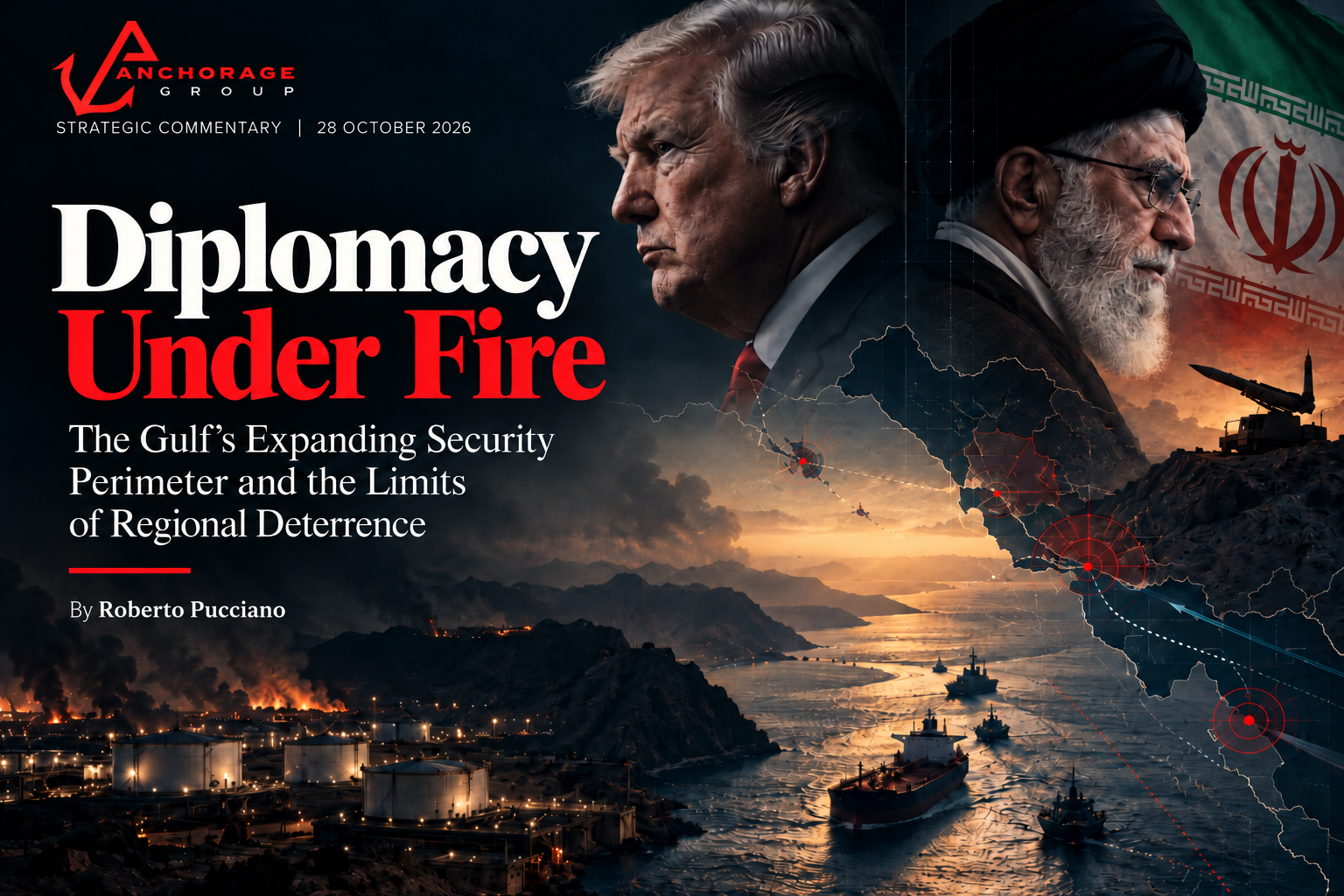
As diplomatic efforts to prevent a renewed confrontation between Iran and the United States gather momentum, attacks on Saudi infrastructure, emerging intelligence relationships and the widening conflict in Yemen reveal the limits of military deterrence. The challenge is no longer simply to prevent escalation but to establish a regional security framework capable of withstanding escalation.
- A Conflict Entering a Different Strategic Phase
The confrontation between Iran, the United States, and their respective regional partners is entering a phase in which military pressure and diplomatic engagement are unfolding simultaneously rather than sequentially.
The assumption that negotiations begin only when military operations subside has become increasingly difficult to maintain. Instead, diplomacy is proceeding while critical infrastructure remains vulnerable, maritime commerce is disrupted, and regional governments are expanding their defensive commitments.
The events in late October illustrate this contradiction.
Saudi Arabia has held high-level diplomatic consultations with Iran amid renewed attacks attributed to the Houthis. Egypt has authorised military assistance to the kingdom. Regional governments are exploring arrangements to reopen the Strait of Hormuz and prevent renewed war between Tehran and Washington.
Meanwhile, an Associated Press investigation published on 27 October raises serious questions about whether Russian satellite intelligence has enhanced the targeting capabilities of Iranian-aligned armed groups.
These developments point towards a broader strategic transformation.
The Gulf confrontation can no longer be adequately understood as a bilateral dispute between Washington and Tehran, nor exclusively as a contest between Iranian military capabilities and Western technological superiority.
It increasingly involves interconnected systems across regional defence, external intelligence, economic vulnerability and diplomatic bargaining.
The central question is whether these systems can be integrated into a stable political framework before their interactions lead to further escalation.
- The Paradox of Negotiating Under Fire
The diplomatic initiatives reported on 28 October suggest that regional governments are seeking to build a broader settlement on three interdependent questions: maritime access, Iranian sanctions relief and regional security guarantees.
According to The Guardian, Iran has indicated a willingness to shorten its proposed timetable for reopening the Strait of Hormuz from seven days to four days following the lifting of sanctions.
Washington, however, continues to seek further commitments regarding Iran’s nuclear activities, including the possibility of renewed international inspections.
The difference between the positions remains significant.
For Tehran, the reopening of Hormuz could serve as a potential negotiating instrument. For Washington, restoring maritime access without securing broader nuclear and security commitments could leave the underlying sources of instability unaddressed.
These positions reveal a fundamental asymmetry within the diplomatic process.
Iran does not necessarily need to achieve conventional military superiority to influence the terms of negotiation. Its ability to threaten maritime access, create economic uncertainty and maintain pressure through aligned armed groups can provide bargaining leverage.
Yet leverage should not be confused with diplomatic success.
The capacity to impose costs may bring adversaries to the negotiating table, but it does not automatically secure an agreement acceptable to all parties.
Equally, the United States may possess overwhelming conventional capabilities without being able to guarantee the uninterrupted operation of the region’s maritime and energy infrastructure.
This is the central paradox of the present confrontation: the actors best placed to sustain military pressure may be unable to translate that pressure into a durable political settlement.
- Saudi Arabia’s Dual Strategy: Defence and Diplomatic Engagement
The high-level consultations in Tehran on 26 October marked an important diplomatic development.
Saudi Defence Minister Prince Khalid bin Salman joined talks with representatives from Pakistan and Türkiye, including Pakistan’s army chief and Türkiye’s intelligence leadership.
The consultations reflected growing regional concern about the consequences of further escalation.
In Saudi Arabia, the strategic logic is increasingly clear.
Riyadh must maintain credible defensive capabilities while preserving communication channels with the country whose regional influence remains central to the conflict.
This does not necessarily signal a fundamental political rapprochement between Saudi Arabia and Iran.
Rather, it reflects recognition that deterrence and diplomacy serve distinct yet complementary purposes.
Defensive capabilities can reduce immediate vulnerability. Diplomatic channels can address the political conditions that give rise to recurring threats.
Neither is sufficient on its own.
Saudi Arabia’s situation is particularly complex because the kingdom is simultaneously pursuing an ambitious economic transformation programme.
Its international aviation network, energy infrastructure, logistics corridors and investment ambitions depend on the perception that the country can offer a stable operating environment.
Repeated attacks or credible threats against these systems therefore impose costs that extend beyond immediate physical damage.
Even successful interceptions can create uncertainty for airlines, investors, insurers and international commercial partners.
The strategic problem is consequently broader than the number of missiles intercepted.
It concerns the capacity to maintain economic normality under persistent military pressure.
- The Vulnerability of Alternative Energy Infrastructure
The renewed threats to Saudi Arabia’s East–West oil pipeline underscore one of the conflict’s most consequential vulnerabilities.
The pipeline provides an important alternative route for Saudi crude exports, allowing oil to reach the Red Sea without passing through the Strait of Hormuz.
Its strategic value has increased as maritime disruptions have complicated access to Gulf export routes.
However, alternative infrastructure does not automatically confer resilience if the alternative itself becomes vulnerable to attack.
On 26 October, the Houthis claimed to have targeted pumping stations on the East–West pipeline and King Khalid International Airport in Riyadh.
Those claims must be distinguished from independently verified damage. At the time of the relevant reporting, Saudi authorities had not confirmed any new damage to the pipeline resulting from the claimed operation.
Nevertheless, the choice of claimed targets is revealing.
An adversary seeking to increase pressure on Saudi Arabia need not interrupt every export route simultaneously. The credible threat of attacks on several critical nodes can complicate operational planning, raise insurance and security costs, and undermine confidence in alternative logistics arrangements.
The resulting vulnerability is systemic rather than purely physical.
Infrastructure diversification is essential, but diversification alone is insufficient if different routes remain exposed to overlapping threats.
For Saudi Arabia and other Gulf states, the lesson is that energy security cannot be separated from air defence, maritime protection, intelligence capabilities and regional diplomacy.
- The Emerging Intelligence Dimension of Asymmetric Warfare
A potentially significant new dimension emerged on 27 October.
An Associated Press investigation examined evidence suggesting that Russian reconnaissance satellite activity may have supported attacks by Iranian-aligned armed groups on Saudi infrastructure and military installations.
The investigation drew on analysis by the Geneva-based intelligence company AURORAH, which examined 40 missile and drone attacks carried out between 1 July and 19 October 2026.
The company reported a recurring pattern of Russian government and military satellite activity around the geographical areas that were subsequently targeted.
Among the incidents examined were attacks on Saudi Arabia’s East–West oil pipeline and King Fahd Air Base.
The report also cited Saudi officials, intelligence analysts and a senior Houthi figure, who described arrangements by which Iranian intermediaries allegedly supplied satellite-derived intelligence to aligned armed groups.
These findings require careful interpretation.
The observed satellite activity does not, by itself, establish that Russian authorities intentionally provided targeting information for specific attacks. Nor does it independently prove the mechanisms by which intelligence may have been transmitted.
Allegations concerning Chinese capabilities likewise require further independent corroboration.
Nevertheless, the investigation raises a strategically important question: whether access to external intelligence is increasingly compensating for the conventional military limitations of non-state armed groups.
The implications could be substantial.
Missiles and unmanned aerial systems provide relatively inexpensive means of attack. However, their operational effectiveness can depend heavily on the quality of targeting information, surveillance and mission planning.
If non-state actors gain access to sophisticated intelligence networks, the relationship between military investment and destructive potential shifts.
A comparatively inexpensive weapon may threaten infrastructure that costs billions of dollars to construct, maintain and defend.
Such asymmetry is not new. What may be changing is the sophistication of the intelligence ecosystem that supports it.
This development also complicates conventional assessments of strategic responsibility.
If intelligence from external powers materially contributes to attacks by regional armed groups, the conflict becomes more deeply embedded in wider geopolitical competition.
The implications extend beyond Iran and Saudi Arabia alone.
They concern the relationships between Russia, China, the United States and the broader international security architecture.
The available evidence does not establish a centrally coordinated great-power campaign. However, it does justify closer scrutiny of the international networks through which regional military capabilities may be enhanced.
- Egypt and the Expansion of the Regional Defensive Perimeter
Egypt’s parliamentary decision on 26 October marks another important development.
The Egyptian House of Representatives authorised President Abdel Fattah el-Sisi to provide military assistance to Saudi Arabia if Riyadh requests it.
The measure was approved by the two-thirds majority required by the Constitution.
President el-Sisi has indicated that any Egyptian military involvement would be defensive, aimed at protecting Saudi territory and borders rather than conducting offensive operations inside Yemen.
The authorisation, by itself, does not establish that Egyptian forces have been deployed.
Its importance is both political and strategic.
Egypt’s direct interests extend beyond its relationship with Saudi Arabia.
The security of the Red Sea and the Bab al-Mandab affects access to the Suez Canal, one of Egypt’s most important sources of foreign-currency revenue and a vital component of its international economic position.
Consequently, threats originating in Yemen can impose economic costs on Cairo even when Egyptian territory is not directly attacked.
The parliamentary mandate reflects the growing difficulty of distinguishing Gulf security from Red Sea security.
It also illustrates an emerging pattern of regional defensive coordination among countries with different political systems, military capabilities, and strategic priorities.
However, broader military cooperation raises difficult questions.
How should responsibilities be divided among participating states? What conditions would trigger military involvement? How can defensive commitments be structured to prevent uncontrolled escalation? And how should external partners participate without undermining regional political ownership?
The expansion of defensive coordination is therefore not equivalent to establishing a coherent regional security architecture.
That architecture would require agreed objectives, operational procedures, political oversight, and mechanisms for managing disputes among participating governments.
Without these elements, multiplying defensive commitments could increase complexity without a corresponding improvement in stability.
- Yemen: The Humanitarian Limits of Strategic Competition
The conflict in Yemen remains central to these developments, not merely because of the Houthis’ military capabilities, but because of the war’s consequences for the civilian population.
On 26 October, Human Rights Watch published an investigation into the destruction of sections of the Hayjat al-Abd road, a vital supply route to the city of Taiz.
The organisation examined satellite imagery, verified photographs and video footage, and conducted interviews about the incident on 18 October.
Human Rights Watch concluded that Houthi forces had used explosives to damage the road.
It also warned that deliberately disabling infrastructure essential to civilian survival could constitute a war crime, depending on the applicable legal conditions and the intent of the operation.
This assessment is not a judicial determination of criminal liability.
Its significance lies in the evidence of the destruction of critical civilian infrastructure and the foreseeable humanitarian consequences.
The World Food Programme had already reported that more than 600,000 people in Taiz depended on humanitarian assistance that its teams could not reach.
Restrictions on the movement of food, medicine and fuel further intensify the suffering of a population already living in prolonged insecurity.
These developments highlight a fundamental weakness in approaches that treat Yemen primarily as an extension of the Iran-Saudi Arabia confrontation.
The Houthis have their own political objectives, territorial ambitions and organisational interests.
Their relationship with Iran is strategically important, but it does not diminish their autonomy as an armed and political actor.
Any durable regional settlement must therefore address Yemen’s internal political fragmentation and humanitarian needs rather than assume that a Tehran-Riyadh agreement would automatically resolve the conflict.
An arrangement that reduces attacks on Saudi Arabia while leaving Yemen’s political and humanitarian crises unresolved would constitute a limited achievement.
It could reduce one source of regional instability without eliminating the conditions that might give rise to future violence.
The protection of civilians, humanitarian access and the functioning of essential infrastructure must therefore become central components of any proposed diplomatic framework.
- Hormuz and Bab al-Mandab: Two Different but Connected Vulnerabilities
The Strait of Hormuz and the Bab al-Mandab occupy distinct geographical positions and face different operational threats.
Nevertheless, both are critical to the international trading system.
Hormuz links the Gulf’s energy exporters to global markets.
Bab al-Mandab links the Indian Ocean to the Red Sea and, ultimately, to the Suez Canal.
Disruption at either location can affect shipping schedules, insurance premiums, freight costs, and commercial confidence.
Disruption in both magnifies those effects.
The United Kingdom Maritime Trade Operations reporting system has recorded repeated attacks on commercial vessels in the Strait of Hormuz in October.
A report dated 23 October described a tanker struck by an unidentified projectile while transiting outbound, leaving the vessel disabled. The crew was reported to be safe.
On 26 October, UKMTO recorded third-party reports of a vessel on fire southeast of Al-Faw, Iraq. The cause and consequences were not established in the initial notice.
Such reports should not be automatically attributed to a particular state or armed group without supporting evidence.
Their significance, however, extends beyond the individual incidents.
Commercial shipping depends on predictable conditions.
When uncertainty becomes persistent, even vessels not directly attacked may face higher operating costs and altered routes.
The strategic importance of maritime security therefore cannot be measured solely by the number of attacks or damaged vessels.
It must also be assessed by considering the broader economic consequences of uncertainty.
For the Gulf states, ensuring freedom of navigation requires more than naval patrols alone.
It requires intelligence coordination, credible deterrence, diplomatic crisis-management mechanisms, and arrangements to maintain commercial confidence during periods of heightened tension.
- The Limits of Military Superiority
These developments reinforce a central lesson from contemporary strategic competition: military superiority does not necessarily translate into political control.
The United States and its partners retain major advantages in conventional military capabilities, advanced technology, surveillance, and force projection.
Those advantages remain significant.
Yet an adversary need not defeat a superior military force to impose significant strategic costs.
It may instead seek to exploit vulnerabilities in complex economic systems, threaten essential infrastructure, disrupt maritime access and prolong political uncertainty.
The relationship between military capabilities and strategic outcomes is therefore increasingly indirect.
A state can possess overwhelming defensive capacity while remaining vulnerable to persistent economic pressure.
Conversely, a weaker actor can demonstrate disruptive capabilities without the resources required to establish a stable political order.
This distinction is particularly relevant to Iran.
Tehran’s strategic endurance may create opportunities to influence the terms of negotiation, but endurance alone cannot resolve its economic difficulties, restore international confidence or guarantee favourable diplomatic outcomes.
Similarly, the Houthis’ capacity to impose costs does not demonstrate their ability to deliver a sustainable political settlement in Yemen.
The strategic challenge is not merely to avoid military defeat.
It is to create political conditions under which continued confrontation becomes less attractive than cooperation.
- Towards a Regional Security Settlement
The diplomatic initiatives currently under discussion suggest that some regional governments recognise the limitations of existing arrangements.
A durable settlement would need to address several interrelated requirements.
First, maritime access must be safeguarded through credible and sustainable security guarantees.
Second, the protection of critical infrastructure must become a regional concern rather than a set of exclusively national responsibilities.
Third, diplomatic arrangements involving Iran must include mechanisms for verification, implementation and dispute resolution.
Fourth, Yemen’s political and humanitarian problems must be addressed on their own terms.
Finally, the role of external powers must be clearly understood.
Regional governments have legitimate reasons to diversify their security relationships. Yet diversification should not replace coherent institutions.
The involvement of additional partners may strengthen regional resilience, but it can also introduce competing strategic objectives.
A sustainable security framework would therefore need to accommodate relationships with the United States and other major powers without allowing their broader rivalries to dictate every regional outcome.
The concept of a regional non-aggression arrangement, reportedly one of the proposals under consideration, merits serious attention.
However, a declaration of non-aggression would have limited practical value unless accompanied by credible commitments on maritime access, attacks on civilian infrastructure, armed-group activity, and mechanisms for addressing alleged violations.
The essential requirement is not merely a diplomatic declaration.
It is an operational framework that can reduce uncertainty, manage crises and create incentives for sustained compliance.
- Conclusion: The Difference Between Endurance and Order
The events of 27 and 28 October illuminate the central contradiction in the current confrontation.
Military pressure continues as diplomatic initiatives expand.
Regional governments are strengthening defensive ties while engaging in negotiations with Iran.
New evidence raises questions about the possible involvement of external intelligence capabilities in attacks on critical infrastructure.
Meanwhile, civilians in Yemen continue to bear consequences that cannot be resolved by regional power calculations alone.
These developments suggest that the conflict is evolving beyond a conventional contest of military power.
It increasingly concerns the ability of states and armed groups to influence the functioning of interconnected economic, security and political systems.
Iran’s strategic endurance may yield diplomatic leverage. The Houthis’ asymmetric capabilities may exact disproportionate costs relative to their conventional strength. External intelligence relationships may further complicate the regional military balance.
Yet none of these dynamics necessarily leads to a stable outcome.
There is an important distinction between demonstrating that an adversary cannot secure a decisive victory and establishing the conditions for sustainable peace.
For the United States and its regional partners, the challenge is to translate military capabilities into reliable security without assuming that superior force can resolve every political dispute.
For Iran, the challenge is to determine whether the leverage gained through confrontation can be translated into an agreement that addresses its economic and security interests without perpetuating regional instability.
For the Gulf states, the priority is to build institutions capable of preserving economic continuity and political autonomy amid uncertainty.
And for Yemen, any meaningful settlement must ultimately be judged by whether it reduces violence and restores the conditions necessary for civilian life.
The emerging diplomatic initiatives offer an opportunity, but no guarantee, that the region can move towards such an arrangement.
The decisive question is no longer simply which actor can endure the confrontation the longest.
It is whether the parties can convert the costs of prolonged confrontation into incentives for a regional order that makes continued escalation less necessary, less profitable and less likely to occur.
Selected Sources and Editorial References
- Associated Press, 27 October 2026. Investigation by Sarah El Deeb and Samy Magdy into Russian reconnaissance satellite activity and alleged intelligence assistance to Iranian-aligned armed groups. The satellite correlations and source allegations should not be presented as conclusive proof of Russian operational direction.
- The Guardian, 28 October 2026. Reporting on Gulf-led diplomatic initiatives, Iran’s reported four-day Hormuz proposal, sanctions negotiations, nuclear inspections and regional security arrangements.
- Reuters, 26 October 2026. Reporting on Egyptian parliamentary authorisation of military support for Saudi Arabia. The authorisation does not establish an actual deployment.
- Human Rights Watch, 26 October 2026. Investigation into damage to the Hayjat al-Abd road and the humanitarian consequences for Taiz.
- World Food Programme, 14 October 2026. Humanitarian-access assessment concerning Taiz, as cited by Human Rights Watch.
- UK Maritime Trade Operations, October 2026. Official maritime incident notices, including warnings 181-26, 182-26 and suspicious-activity notice 183-26.
Methodological Note
This commentary distinguishes independently documented events, official statements, investigative findings, allegations by parties to the conflict, and the author’s strategic interpretations.
The reported link between Russian satellite intelligence and intelligence remains a significant investigative finding that requires further corroboration. Diplomatic proposals should not be construed as agreements, and operational claims about military strikes should not be treated as established facts without independent verification.
Editorial cut-off: 28 October 2026.
© 2026 Anchorage Think Tank. All rights reserved.
CEO ANCHORAGE GROUP
Roberto Pucciano
Roberto.Pucciano@anchoragegroup.org
ANCHORAGE THINK TANK
THE NETWORKED SUPERPOWER SERIES
Paper No. 5 | October 2026
The Gulf’s New Geography of Power
Energy, Capital and Strategic Autonomy in a Fragmenting World
By Roberto Pucciano
Revised Edition — 12 October 2026
Executive Summary
The Gulf is emerging as one of the most consequential intersections of economic and geopolitical power in the contemporary international system.
Its importance can no longer be explained solely by oil reserves, hydrocarbon production or the military protection traditionally provided by the United States. The region now occupies a pivotal position within overlapping networks spanning energy, sovereign capital, international finance, logistics, technology, infrastructure and diplomacy.
Saudi Arabia, the United Arab Emirates, Qatar, Oman, Kuwait and Bahrain are pursuing distinct national strategies. Yet their combined position creates a regional concentration of assets and connections whose significance extends far beyond conventional measures of population, territory or military power.
This paper defines the Gulf as a Strategic Nexus: a geographically concentrated system of interconnected states, institutions and commercial networks whose combined importance gives it substantial influence over the functioning of the international economy.
The region’s power does not depend on a unified sovereign authority. It derives from the concentration of indispensable connections.
Yet this emerging influence harbours a profound contradiction.
The same geographic concentration that makes the Gulf central to international commerce also leaves its economic transformation vulnerable to regional insecurity.
The escalation in October 2026 has made this vulnerability unmistakable.
Repeated attacks on Saudi aviation infrastructure, threats to maritime navigation, disruption of international transport, and renewed military operations in Yemen demonstrate that economic connectivity can become a strategic vulnerability when the security environment deteriorates.
The crisis has also accelerated efforts to develop a more diversified regional security framework. Cooperation among Saudi Arabia, Pakistan and Turkey, diplomatic coordination among the R4 countries, and a renewed Emirati emphasis on collective Gulf security suggest that the region is exploring arrangements that extend beyond its traditional reliance on bilateral American security relationships.
These developments should not be mistaken for the emergence of a fully integrated regional defence system.
They do, however, indicate a possible transformation in the institutional organisation of Gulf security.
The region’s central strategic challenge is therefore Resilience.
The question is no longer simply whether Gulf states can accumulate capital, build infrastructure or attract international investment.
It is whether they can convert these achievements into durable economic and geopolitical capabilities that endure under sustained pressure.
This paper argues that the Gulf’s future position in the international order will depend on its ability to transform network centrality into strategic autonomy without allowing geographic concentration to become a systemic vulnerability.
1. Introduction: The Gulf Beyond Oil
For much of the twentieth century, the Gulf’s geopolitical importance was understood through a relatively simple equation.
The region possessed enormous hydrocarbon reserves. Industrial economies depended on these resources. External powers therefore had compelling reasons to preserve access to them.
Energy generated wealth, which financed state development, and external security relationships helped protect the resulting political order.
This framework was never complete.
The Gulf was also shaped by dynastic politics, religious institutions, maritime trade, regional rivalries, and the strategic interests of external powers.
Nevertheless, oil remained the organising principle across most international assessments.
That approach is now insufficient.
The Gulf’s governments are seeking to reposition their economies within an international system undergoing several simultaneous transformations.
The energy transition is reshaping expectations about future hydrocarbon demand.
Technological competition is increasing the importance of computing infrastructure, artificial intelligence, semiconductors and electricity.
Geopolitical fragmentation is prompting governments and corporations to diversify supply chains, investment relationships and strategic partnerships.
Meanwhile, Asia’s growing economic importance is reshaping international trade and capital flows.
The Gulf lies at the intersection of these developments.
Its governments possess financial resources, infrastructure ambitions and diplomatic relationships that enable them to participate in several international systems simultaneously.
The Gulf may influence international networks without controlling the conditions under which they operate.
That distinction is fundamental to understanding its emerging position.
2. From Energy Producers to Network Powers
The Gulf’s economic transformation is often described as a diversification away from oil.
The phrase captures an important objective, but it understates the scale of the strategic change.
Diversification is not merely a process of developing additional sectors.
It is an attempt to reposition national economies within international networks spanning production, finance, technology and commerce.
Saudi Arabia’s industrial ambitions, the UAE’s financial and logistics platforms, Qatar’s international energy relationships and Oman’s maritime infrastructure reflect distinct approaches to this transformation.
The underlying objective is similar: to reduce dependence on a single source of national income while increasing the number of international activities in which each state holds an important position.
This creates opportunities for new forms of influence.
A state that controls significant energy exports has leverage over supply.
A state that manages internationally connected ports affects trade.
A state whose sovereign investment institutions provide substantial capital to global companies gains access to partnerships and commercial opportunities.
A state that hosts major technology infrastructure may become important for international computing and data systems.
These forms of influence depend on connections.
It must be assessed by examining the durability and strategic significance of the networks those investments create.
3. The Strategic Nexus: A New Form of Regional Power
The Gulf is not a unified geopolitical actor.
The Gulf Cooperation Council provides an institutional framework for consultation and cooperation, yet its members retain distinct foreign policies, economic priorities and security relationships.
Saudi Arabia and the UAE compete for investment, regional headquarters, logistics activity and international influence.
Qatar has developed its own diplomatic and energy strategies.
Oman has traditionally emphasised mediation and strategic balance.
Kuwait and Bahrain operate under distinct domestic and regional constraints.
These differences prevent the Gulf from being regarded as a single sovereign power.
Yet they do not diminish the region’s collective importance.
The Gulf’s international influence stems from the concentration of complementary and competing networks within a relatively limited geographic area.
This paper defines this configuration as a Strategic Nexus.
A Strategic Nexus has three characteristics.
First, it holds an important position across several international systems simultaneously.
Second, the networks concentrated within it exert influence beyond the capabilities of any individual participant.
Third, the continued operation of those networks depends on security, institutional confidence and cooperation across political boundaries.
The Gulf meets these conditions.
Its energy exports remain significant globally.
Its sovereign investors participate in international financial markets.
Its airlines and ports connect continents.
Its governments maintain relationships with the United States, China, India, Europe and other key actors.
Indeed, indispensability may increase the incentives for adversaries to threaten the networks on which it depends.
4. Energy Remains the Foundation
Despite ambitions for economic diversification, hydrocarbons remain central to the Gulf’s international position.
Oil and natural gas continue to generate substantial public revenue, support external balances, and finance economic transformation.
They also give the region influence over international energy markets.
Saudi Arabia’s production capacity and role in global oil-market coordination remain key elements of its strategic position.
Qatar’s liquefied natural gas exports link it to major consuming economies.
The UAE, Kuwait and Oman also maintain significant energy interests.
The region’s energy relationships increasingly extend beyond the traditional Western-centred framework.
Asian economies are major consumers of hydrocarbons from the Gulf.
China, India, Japan and South Korea therefore have substantial interests in the stability of the Gulf’s energy supply.
This creates a broad international constituency for regional security.
Yet energy interdependence does not automatically lead to political alignment.
Major consumers may share an interest in an uninterrupted supply while disagreeing over military intervention, sanctions, regional diplomacy or the legitimacy of competing security arrangements.
The Gulf’s energy influence is therefore substantial yet conditional.
It depends on production, transport, market access and the ability to maintain confidence in future supply.
The 2026 conflict illustrates the limits of viewing energy power solely through reserves and production capacity.
Resources have geopolitical value only when they can reach markets.
The security of transport infrastructure is therefore inseparable from the strategic value of the resources themselves.
5. The Energy Transition and the Persistence of Hydrocarbon Power
The global energy transition poses a strategic dilemma for the Gulf.
A successful transition towards lower-carbon energy systems could gradually reduce the long-term importance of oil in some sectors.
At the same time, hydrocarbons remain essential to the functioning of the modern international economy.
The timing and geography of the transition remain uncertain.
Different countries have different industrial structures, energy requirements and financial capabilities.
Consequently, the Gulf faces neither an immediate decline in hydrocarbon demand nor a guarantee that current demand patterns will persist indefinitely.
Its governments must prepare for several possible futures.
They must preserve the competitiveness of existing energy industries while investing in new economic activities.
They must finance diversification without assuming hydrocarbon revenues will remain permanently abundant.
And they must develop institutions capable of supporting productive economic activity beyond resource extraction.
This is more difficult than merely accumulating financial assets.
The decisive question is whether energy wealth can be converted into competitive industries, skilled employment, technological capabilities and sustainable public finances.
The transition from resource wealth to productive capability is a defining challenge for the Gulf’s development strategy.
6. Sovereign Capital as Geopolitical Infrastructure
The Gulf’s sovereign investment institutions have become key participants in international capital markets.
Their influence extends beyond portfolio diversification.
Large sovereign investors can finance infrastructure, participate in major corporate transactions, support technological development, and establish relationships with governments and businesses across multiple regions.
Capital can therefore serve as a form of geopolitical infrastructure.
It links national development strategies to international companies, financial institutions and technological ecosystems.
These relationships may generate access, influence and commercial opportunities.
They may also help Gulf governments diversify their external partnerships.
But the possession of financial capital should not be confused with the possession of productive capabilities.
A sovereign investment fund can acquire an ownership stake in a technology company without creating an equivalent domestic technological ecosystem.
A government can announce a major industrial investment without guaranteeing that the project will be commercially competitive.
A state can finance infrastructure abroad without gaining control over the political conditions under which that infrastructure operates.
The strategic significance of sovereign capital therefore depends on how it is deployed.
Investments that foster knowledge transfer, industrial capacity, skilled employment and durable partnerships may strengthen national autonomy.
Investments that generate financial returns without developing domestic capabilities may serve important economic purposes but contribute less directly to strategic transformation.
The Gulf’s challenge is to convert capital allocation into lasting institutional and productive strength.
7. Saudi Arabia: Scale, Transformation and the Search for Centrality
Saudi Arabia has a distinctive combination of territorial size, population, energy resources and political ambition.
Its economic transformation aims to reposition the kingdom as a major centre for investment, industry, logistics, tourism and international business.
The ambition extends beyond diversification.
It involves shifting the geography of economic activity across the wider Gulf.
Riyadh is being developed as a more significant location for international corporate operations and decision-making.
Industrial projects aim to increase domestic production and reduce dependence on imported capabilities.
Large infrastructure investments aim to improve connectivity and support emerging economic sectors.
The strategic logic is clear.
Saudi Arabia seeks to leverage the scale of its domestic market and public investment capacity to create an economic centre capable of attracting international activity directly.
This approach differs from the historical development of several smaller Gulf economies, whose international relevance has depended heavily on external connectivity and specialised services.
Saudi Arabia’s model places greater emphasis on domestic scale and economic transformation.
But scaling creates implementation challenges.
Large projects require sustained financing, effective administration, skilled labour and commercially viable demand.
Saudi Arabia’s transformation therefore represents a test of the relationship between state-directed ambition and economic realisation.
The attacks against Riyadh in October 2026 pose a further test: whether the kingdom can sustain the international accessibility upon which its ambitions increasingly depend.
8. The United Arab Emirates: The Power of International Connectivity
The UAE has developed a distinct model of economic influence.
Its international position rests heavily on the concentration of financial services, aviation, ports, logistics, real estate, professional services and commercial infrastructure.
Dubai and Abu Dhabi fulfil complementary functions within this system.
Dubai has become an internationally connected hub for commerce, transport and services.
Abu Dhabi combines substantial sovereign capital, energy interests and investment in emerging technologies.
Together, they have created a platform through which international companies, investors and professionals conduct business across several regions.
The UAE’s comparative advantage lies in its ability to connect to external markets.
This model does not require the same domestic population or industrial scale as Saudi Arabia’s.
It depends instead on infrastructure quality, institutional predictability, commercial openness and international confidence.
The model has proved influential.
But it also creates specific vulnerabilities.
An economy organised around international connectivity is sensitive to disruptions in transport, financial flows and perceptions of security.
Its success depends on the continued willingness of external actors to use its networks.
The UAE’s strategic challenge is therefore to maintain its attractiveness while navigating an increasingly unstable regional environment.
9. Saudi Arabia and the UAE: Competition Within Interdependence
The relationship between Saudi Arabia and the UAE is central to the Gulf’s evolving political economy.
Both countries seek to enhance their international economic importance.
Both have substantial financial resources and ambitious development strategies.
Both are investing in logistics, technology, tourism and advanced industries.
Yet their approaches are not the same.
Saudi Arabia seeks to stimulate greater economic activity within its domestic market.
The UAE seeks to preserve and expand the benefits of its internationally connected commercial platforms.
This creates competition for corporate headquarters, financial activity, skilled professionals, investment, and transport flows.
Such competition can stimulate innovation and infrastructure development.
It can also lead to duplication, regulatory fragmentation and inefficient investment.
The relationship becomes more complex when economic competition intersects with regional security disputes.
Different assessments of Yemen, maritime security and regional political relationships may complicate cooperation.
Nevertheless, the two economies remain closely connected.
Airlines, investors, logistics operators and international companies frequently operate in both markets.
Regional insecurity can therefore produce consequences that neither government can fully contain within its own territory.
The October 2026 attacks on Saudi aviation infrastructure have made this interdependence particularly evident.
Disruptions to Saudi airspace and airport operations have affected international carriers across the Gulf, including those based in the UAE.
The consequences show that economic competition does not insulate neighbouring states from shared security risks.
On 12 October, Anwar Gargash, the UAE leadership’s diplomatic adviser, publicly emphasised that attacks on Saudi Arabia also threatened the security of other Gulf states and called for greater regional cooperation to address common threats.
His statement did not announce a new military alliance or an Emirati decision to engage in offensive operations.
It nevertheless offered a political expression of a structural reality.
Saudi Arabia and the UAE may compete for economic centrality, yet their security interests remain interconnected.
The Gulf’s strategic strength depends on the coexistence of national economic ambition and regional functional interdependence.
10. Qatar, Oman, Kuwait and Bahrain: Different Forms of Strategic Relevance
The Gulf’s political economy cannot be understood solely through Saudi Arabia and the UAE.
Qatar holds an important position in international natural gas markets and has developed a distinctive diplomatic profile.
Its energy relationships foster long-term connections with major consumer economies.
Its diplomacy has frequently sought to maintain communication channels among actors who have difficulty engaging directly.
Oman has distinct advantages.
Its maritime geography provides access to the Arabian Sea and the Indian Ocean beyond the Strait of Hormuz.
Its diplomatic traditions have emphasised dialogue and balance.
These characteristics give Oman potential significance in logistics and regional mediation.
Kuwait combines substantial energy wealth with a distinctive domestic institutional environment.
Bahrain has developed financial and service-sector capabilities while maintaining close security and economic ties with neighbouring states.
These countries are not interchangeable.
Their different resources, institutions and foreign-policy choices shape the forms of influence available to them.
The Gulf’s collective significance stems in part from this diversity.
But diversity also complicates creating common security and economic institutions.
The region’s future architecture will need to accommodate diverse national priorities rather than assume complete strategic convergence.
11. The Gulf Between Washington and Beijing
The Gulf’s international strategy increasingly involves maintaining relationships with powers that compete elsewhere.
The United States remains an important security partner to several Gulf governments.
American military capabilities, defence technology and security relationships continue to shape regional calculations.
China is an important economic partner, particularly through energy trade, infrastructure and commercial ties.
India’s growing economic and strategic importance creates further opportunities.
European countries remain relevant through investment, technology, trade and diplomacy.
The Gulf’s governments have incentives to avoid exclusive dependence on any single external power.
This does not mean that all partnerships are equal.
Security relationships with Washington have characteristics that commercial relationships with Beijing cannot easily replicate.
Similarly, economic ties with China cannot be reduced to military considerations.
The Gulf’s strategic opportunity lies in managing these relationships without allowing their contradictions to become unmanageable.
The developments in October 2026 introduce another dimension.
The growing involvement of Turkey and Pakistan in Saudi defence cooperation suggests that the diversification of external relationships is extending beyond commerce and diplomacy into security cooperation.
This should not be taken as a complete replacement for American security guarantees.
Washington continues to possess military capabilities and established defence relationships that other partners cannot easily replicate.
Nevertheless, Gulf governments’ willingness to seek additional security partners reflects an increasingly complex regional environment.
It requires sufficient institutional capacity to preserve meaningful choices under external pressure.
12. Strategic Autonomy Without Strategic Isolation
The Gulf’s pursuit of strategic autonomy should not be mistaken for a desire for isolation.
Its prosperity depends on international trade, investment, technology and labour.
Complete independence from external systems would be economically unrealistic and strategically undesirable.
The relevant objective is therefore not self-sufficiency.
It is the ability to avoid excessive dependence on any single partner, route, institution or technological system.
This requires diversifying relationships.
It also requires domestic capabilities that enable governments to make meaningful choices.
The strategic problem arises when dependence becomes so concentrated that it significantly restricts political choice.
The Gulf’s challenge is to transform external relationships into sources of flexibility rather than vulnerability.
13. The Technology Ambition: From Capital to Capability
Artificial intelligence and advanced technologies have become central to Gulf development strategies.
Governments are investing in data centres, computing infrastructure, digital services, and partnerships with international technology companies.
These ambitions reflect a recognition that future economic influence will increasingly depend on technological capability.
Yet investment announcements provide only an incomplete measure of progress.
Developing a competitive technological ecosystem involves several distinct stages.
First, capital must be committed.
Second, commercial agreements and procurement arrangements must be finalised.
Third, physical infrastructure must be built.
Operational computing capacity does not automatically lead to domestic technological innovation.
Access to imported technology does not necessarily confer strategic control over it.
The Gulf’s technological transformation must therefore be assessed by the conversion of investment into productive capability.
This is the region’s technology capability gap.
Closing it will require education, research institutions, regulatory credibility, skilled labour, commercial demand, and sustained access to international technological ecosystems.
14. The New Security of Technology Infrastructure
The Gulf’s technological transformation is creating new sources of economic influence and new categories of strategic vulnerability.
Data centres, artificial intelligence facilities, telecommunications infrastructure and advanced computing systems are increasingly important components of national development strategies. Their significance extends beyond the commercial value of individual projects: they support financial services, industrial innovation, government operations and international technological partnerships.
Yet these systems depend on an extensive network of supporting infrastructure. Computing facilities require reliable electricity, cooling, telecommunications, physical security and continued access to specialised equipment. Their economic value therefore depends on the continuity of several interconnected systems.
The 2026 conflict has demonstrated that technological infrastructure may become an explicit target of geopolitical coercion. In statements reported in October, Iranian officials threatened infrastructure associated with American technological interests in the region, including data centres, artificial intelligence facilities and communications networks.
These declarations must be interpreted carefully. They constitute threats and political signalling, not evidence that the threatened facilities have necessarily been attacked. Similarly, Iranian allegations of Emirati military involvement in US-backed maritime operations have not been independently substantiated.
Nevertheless, the strategic implications are substantial. The expansion of advanced technological infrastructure creates assets whose economic value depends on uninterrupted operation and international confidence. A major computing facility may remain physically intact yet lose functionality because of disruptions to electricity, communications or supporting services.
The challenge is therefore broader than conventional physical protection and encompasses the security of the entire technological ecosystem.
This paper identifies six stages in the development of strategic technological capability:
Announced Investment → Contracted Capacity → Delivered Infrastructure → Operational Capability → Resilient Capability → Indigenous Innovation.
The distinction between operational and resilient capability is particularly important. A facility may possess advanced computing equipment without sufficient redundancy, energy security or operational continuity to provide dependable services during regional instability.
Moreover, security costs may affect commercial competitiveness. A technological project that requires increasingly expensive protection, backup infrastructure and insurance may remain operational while becoming less economically viable.
This introduces an important qualification to the Gulf’s technological ambitions. The ability to construct sophisticated infrastructure does not automatically translate into the ability to operate it competitively under geopolitical pressure.
The strategic objective must therefore be to create technological ecosystems that integrate advanced capabilities, operational resilience and economic sustainability.
The geopolitical value of technological infrastructure lies not simply in its capacity to operate, but in its ability to remain reliable and commercially viable under conditions of sustained uncertainty.
15. The Security–Connectivity Paradox
The Gulf’s greatest strategic advantage is also a vulnerability.
Its concentration of energy infrastructure, international airports, ports, financial centres and technological facilities makes it exceptionally important to the global economy.
But the same concentration also creates opportunities for disruption.
This paper defines the resulting contradiction as the Security–Connectivity Paradox.
The geographic concentration of essential international networks that gives the Gulf extraordinary geopolitical importance also renders its economic prosperity especially vulnerable to regional insecurity.
This is a geographic and security paradox: the concentration that creates global relevance also increases exposure to attack. The separate Diversification Paradox, examined in Section 25, concerns the growing number of systems that economic transformation renders essential.
New economic sectors frequently depend on uninterrupted international connectivity.
Tourism depends on reliable aviation.
Financial services require confidence and communication.
Advanced manufacturing requires reliable supply chains.
Technology infrastructure requires electricity and data connectivity.
International business centres require both physical accessibility and institutional stability.
Consequently, diversification away from hydrocarbons does not remove strategic vulnerability.
It can increase the number of systems that must be secured.
The resulting disruption shows that a network can lose economic functionality even when its physical infrastructure remains capable of eventual repair.
16. The Geography of Alternatives: Why Bypassing a Chokepoint Is Not Enough
The disruption of maritime activity around the Strait of Hormuz has heightened the strategic importance of alternative transport infrastructure.
Saudi Arabia’s East–West pipeline, the UAE’s export infrastructure outside Hormuz, and Oman’s ports on the Gulf of Oman and the Arabian Sea provide different forms of geographic flexibility.
Yet the existence of alternative routes does not necessarily imply resilience.
A pipeline can bypass a maritime chokepoint while remaining vulnerable to attacks on pumping stations, terminals or storage facilities.
A port outside a contested strait may avoid one category of risk while remaining exposed to drones, missiles, sabotage and disruptions to nearby shipping.
An alternative airport may have sufficient runway capacity but lack the cargo-handling, passenger-processing or security capabilities required to absorb sustained diversions.
The distinction is fundamental.
Geographic diversification reduces exposure to specific chokepoints. Operational resilience requires that alternative infrastructure remain functional under the conditions that disrupted the original route.
The reported attack on the tanker MT Petro Dolphin at Sohar Anchorage in Oman on 11 October 2026 illustrates this problem.
According to the Indian shipping authorities, nine Indian crew members were rescued, while two were still missing at the time of the announcement.
The incident demonstrates that maritime exposure may extend beyond vessels navigating the narrowest section of the Hormuz Strait.
It also highlights the distinction between the security of a maritime passage and that of the wider port ecosystem.
Commercial shipping requires protected anchorages, functioning terminals, reliable maritime services, insurance availability and predictable access to international markets.
The interruption of any of these functions may undermine the commercial value of a port.
This yields an important strategic principle:
An alternative corridor is only as resilient as the least protected essential node required to operate it.
Redundancy remains necessary.
But redundancy without security can be an expensive illusion.
17. Maritime Security Beyond Hormuz: The Economic Cost of Network Continuity
The Strait of Hormuz remains one of the world’s most consequential maritime chokepoints. However, the economic consequences of insecurity cannot be measured solely by the number of vessels prevented from transiting.
Commercial networks may continue to operate while becoming substantially more expensive to run. The 2026 conflict has made this distinction increasingly important.
Maritime operators have responded to insecurity by rerouting, modifying cargo operations, conducting ship-to-ship transfers, and adjusting the deployment of tanker capacity. These adaptations can preserve parts of the international energy trade. They do not necessarily preserve the economic efficiency of the original system.
Industry estimates reported by Al Jazeera on 12 October, based on analysis by maritime intelligence provider Windward, suggested that traffic through Hormuz had fallen dramatically relative to pre-war levels. The analysis estimated about 31 daily transits in the final week of September, compared with around 138 before the conflict. It also noted sharply increased shipping costs and substantial additional tanker capacity absorbed by alternative transport arrangements.
These figures should be treated as estimates rather than definitive measures of the entire maritime market. In particular, the precise relationship between freight costs, insurance premiums, cargo values and realised export prices requires careful distinction.
Nevertheless, the underlying economic mechanism is clear. When maritime insecurity forces operators to adopt less efficient transport arrangements, the costs of maintaining trade can rise even if physical deliveries continue.
The consequences may include higher freight rates, additional insurance costs, longer delivery times, greater demand for vessels, and reduced commercial flexibility. For energy exporters, these costs may affect realised revenues and the competitiveness of specific export routes. For consuming economies, they may increase uncertainty over delivery schedules and energy prices. For logistics operators, they may reduce the efficiency of networks originally designed around predictable maritime access.
This paper therefore introduces a distinction between Operational Continuity and Economically Sustainable Continuity.
Operational continuity exists when essential goods and services continue to flow through a network. Economically sustainable continuity exists when those flows can be maintained at costs compatible with the network’s long-term commercial viability.
The Gulf’s maritime strategy must therefore address three questions. Can energy and commercial goods continue to move? Can the infrastructure supporting those movements remain secure? And can the resulting transport arrangements remain economically sustainable?
The third question is becoming as important as the first two questions.
The resilience of a maritime network should be measured not only by the volume of trade it preserves, but also by the economic cost of maintaining it.
18. The Red Sea and the Limits of Geographic Substitution
The Red Sea has become increasingly important in discussions of Gulf economic resilience.
For Saudi Arabia, access to western maritime routes offers potential alternatives to some of the risks associated with the Gulf and the Strait of Hormuz.
But the Red Sea is not an uncontested strategic region.
The conflict in Yemen, the presence of Houthi forces, and threats to commercial shipping have created substantial uncertainty around the southern approaches to the Red Sea.
The Bab el-Mandeb is itself a critical maritime passage.
Consequently, shifting trade or energy exports towards the Red Sea does not eliminate exposure to geopolitical disruption.
The effectiveness of geographic substitution therefore depends on the security and capacity of the entire alternative system.
Developments in Yemen must be carefully evaluated.
Localised territorial advances do not necessarily confer effective control over maritime approaches.
Nor does the presence of a friendly coastal authority guarantee the safety of commercial shipping.
The strategic objective must be the sustained freedom of navigation, not merely the possession of territory near a maritime corridor.
19. Riyadh, Dammam and the Vulnerability of Aviation Networks
The attacks on Saudi aviation infrastructure in October 2026 provide a particularly clear illustration of the relationship between physical security and economic connectivity.
The deadly attack on King Khalid International Airport in Riyadh on 10 October was followed by a second strike on 11 October.
The reported death toll from the first attack rose to thirteen, with more than 300 people injured.
Saudi aviation authorities reported that the second incident killed one Pakistani resident and left eleven others injured.
King Fahd International Airport in Dammam was also attacked.
These incidents must be understood within a broader strategic context.
International airports are more than transport facilities.
On Monday, 12 October, Cirium estimated that approximately 60 per cent of scheduled flights would be cancelled.
These figures are significant not only because of their scale.
They demonstrate how a military attack can rapidly turn an infrastructure-security incident into a broader economic disruption.
The consequences spanned several dimensions.
International airlines suspended or reduced their services.
Business travel became more difficult.
Participation in major international events was affected.
Companies and public institutions adopted temporary remote-working arrangements.
The disruption also affected regional aviation networks, including carriers based outside Saudi Arabia.
The World Petroleum Council Energy Congress in Riyadh proceeded despite the attacks, but the withdrawal or remote participation of senior international energy executives illustrated the limits of sustaining normal economic activity amid persistent security threats.
The distinction between the continuation of an event and the full restoration of international participation is significant.
An economy may preserve institutional functionality while losing some of the connectivity required to realise its international ambitions.
The resulting costs are not limited to airport operators.
They spread across hotels, logistics providers, service companies and investment activities.
The security of aviation networks therefore underpins the credibility of the Gulf’s economic transformation.
20. Multi-Node Vulnerability and Network Continuity
Economic resilience is often associated with the availability of alternative infrastructure.
If an airport closes, traffic may be rerouted.
If one port becomes inaccessible, cargo may be rerouted elsewhere.
If one energy-export route is disrupted, another may absorb some of the flow.
These assumptions are reasonable in isolated disruptions.
They become less reliable when multiple nodes are under threat simultaneously.
The attacks on Riyadh and Dammam illustrate the problem.
Repeated attacks can delay repairs, complicate safety inspections, disrupt flight schedules and discourage airlines from restoring normal services.
Threats to alternative airports may reduce the aviation network’s ability to absorb displaced passengers and cargo.
This paper defines Multi-Node Vulnerability as:
The risk that several interconnected or substitutable infrastructure assets are disrupted during the same crisis, reducing the effectiveness of redundancy and threatening the continuity of essential economic functions.
The concept applies beyond aviation.
Resilience must therefore be assessed at the network level rather than at the level of the individual asset.
The relevant question is not simply whether an alternative facility is available.
It is whether sufficient alternative capacity remains available when several parts of the system are under pressure.
Infrastructure Recovery versus Network Recovery
The October 2026 crisis reveals another distinction.
Infrastructure recovery concerns the restoration of physical and technical capabilities.
Network recovery concerns the return of the wider economic system to reliable and predictable operation.
The two processes do not necessarily occur at the same time.
An airport may reopen before airlines resume their previous schedules.
An energy terminal may resume operations before shipping companies resume normal routing patterns.
A port may be physically accessible, yet insurers and commercial operators continue to impose additional risk conditions.
A data centre may restore power and connectivity while customers remain concerned about the reliability of future service.
The consequences of the Riyadh attacks underscore the importance of this distinction.
Even where infrastructure can be repaired, international operators may continue to reassess routes, insurance terms, contingency arrangements and the safety of passengers and crews.
The Federal Aviation Administration’s October 2026 advisory on Saudi airspace, together with European aviation safety warnings, illustrates how institutional risk assessments can persist beyond a single incident.
These advisories should not be construed as comprehensive prohibitions on commercial aviation across Saudi Arabia.
Their significance lies in recognising that operational decisions are influenced by a wider security environment.
The strategic objective of a resilient Gulf economy must therefore extend beyond the reconstruction of damaged infrastructure.
It must encompass the restoration of the networks that confer that infrastructure’s international value.
An infrastructure asset can be repaired before the economic network it supports has fully recovered.
21. Competing Maritime Control Regimes: Coercion, Adaptation and Strategic Exposure
The maritime crisis of 2026 has exposed a growing tension between military efforts to control commercial access and market participants’ efforts to preserve international trade.
The United States has imposed naval restrictions and military enforcement measures on maritime activity linked to Iranian ports. Iran has sought to influence navigation through the Hormuz and has threatened operations it deems hostile to its interests.
These actions differ in their legal justifications, objectives and operational characteristics. They should not be treated as automatically equivalent. Nevertheless, their interaction creates a maritime environment in which commercial operators must navigate overlapping military, regulatory and economic risks.
This paper describes the environment as one of Competing Maritime Control Regimes. The concept refers to the simultaneous presence of different coercive or regulatory claims that affect maritime access, commercial navigation and the organisation of international trade.
In October 2026, Iranian officials publicly alleged that American military authorities, with Emirati assistance, were facilitating alternative arrangements to transport oil through the region. Statements attributed to Mohsen Rezaei identified these arrangements as potential targets of Iranian action.
The allegations of operational involvement by Emirati forces have not been independently verified. Nor do Iranian claims about the frequency or effectiveness of attacks establish that the alleged incidents occurred. The distinction between an asserted military objective and a confirmed operation is essential.
Yet the statements themselves are strategically significant. They suggest that attempts to preserve commercial connectivity may become targets of coercion if one party regards those adaptations as undermining its military or economic strategy.
This further complicates maritime resilience. Alternative shipping arrangements are not necessarily politically neutral. A route, transfer mechanism or logistical partnership may acquire strategic significance because of the governments or military institutions perceived as supporting it.
Commercial adaptation can therefore create new political exposure. The resulting vulnerability is not limited to physical infrastructure. It may also extend to vessel ownership, insurance arrangements, port access, contractual relationships and the nationality of participating operators.
This has important implications for Gulf states seeking strategic autonomy. Diversifying commercial routes and external partnerships may increase operational flexibility. However, the strategic value of such diversification depends on the ability to manage the political risks associated with those relationships.
Strategic autonomy requires more than the ability to maintain connections. It requires the capacity to preserve those connections without allowing the cost of their protection to erode their economic and geopolitical value.
22. The United States and the Limits of External Security Guarantees
The United States remains a major military power in the Gulf.
Its regional presence, defence partnerships and operational capabilities continue to shape the strategic landscape.
But the crisis highlights the distinction between external military power and comprehensive economic security.
American capabilities may contribute to deterrence, maritime operations and the defence of partner states.
They cannot automatically guarantee the uninterrupted operation of every airport, port, energy terminal or commercial network.
The reported US use of force against a commercial vessel in the Gulf of Oman in October 2026 also illustrates the complexity of the regional maritime environment.
Such an operation must be distinguished from any decision to participate directly in Saudi military action against the Houthis.
The two raise different operational and political questions.
More broadly, Gulf governments must consider the possibility that external powers will pursue their own strategic priorities, even when these priorities do not fully align with regional economic interests.
This does not render security partnerships irrelevant.
It makes regional capability and institutional resilience even more important.
The Gulf’s future security cannot rest solely on the assumption that external intervention will prevent every disruption.
It must also depend on the ability of regional governments and commercial institutions to manage crises when deterrence fails.
23. Yemen, the Houthis and the Problem of Regional Escalation
Yemen remains central to the Gulf’s security landscape.
The Houthis possess capabilities that enable them to threaten targets beyond the territory they control.
Missiles and drones can produce strategic effects disproportionate to the economic resources required to deploy them.
The ability to threaten aviation, maritime traffic and energy infrastructure complicates neighbouring states’ security calculations.
The October 2026 attacks on Saudi infrastructure demonstrate the potential consequences.
Yet attribution, claimed responsibility and independently verified damage must be distinguished from one another.
A claim of an attack does not establish that every announced target was hit.
Nor does a military threat necessarily demonstrate the ability to sustain operations at the claimed scale.
These distinctions are essential to sound analysis.
The October Escalation
On 12 October, Associated Press reported that airstrikes had struck two districts of Sana’a the previous night.
The Houthi-controlled health authorities reported one death and twelve injuries, among them children.
Houthi representatives blamed Saudi Arabia for the attacks.
However, at the time of reporting, Saudi responsibility had not been independently established.
The distinction matters.
The attacks may signal an intensification of military operations, but the available evidence does not establish the scale, objectives or command responsibility for any new Saudi campaign.
What is clearer is the growing danger of an escalation cycle.
Houthi attacks on Saudi infrastructure create pressure to retaliate.
Retaliatory operations may prompt further Houthi attacks.
The resulting cycle can threaten civilian populations and economic networks on both sides of the border.
The problem is particularly acute because the military and economic asymmetries are significant.
A relatively small number of successful attacks can impose major costs on highly connected economies.
The conflict therefore cannot be assessed solely by territorial control or the conventional military balance.
Its strategic consequences increasingly depend on the ability of armed actors to disrupt essential networks.
The Limits of Military Retaliation
Military retaliation may degrade specific capabilities but also risk further escalation.
Diplomatic engagement may reduce immediate threats but may not resolve underlying political conflicts.
External military involvement can strengthen deterrence but create additional regional tensions.
No single instrument provides a comprehensive solution.
The Gulf therefore requires a security strategy that integrates deterrence, defensive capabilities, crisis management and diplomacy.
The objective must be to reduce the likelihood that localised military confrontation will generate regional economic disruption.
24. Towards a Distributed Security Architecture
The 2026 conflict has exposed the limitations of treating national defence and economic security as separate policy domains.
The Gulf’s strategic infrastructure now spans energy, maritime trade, aviation, finance, telecommunications and advanced technology.
These systems cannot be effectively protected by isolated measures.
The region therefore requires an approach that integrates military defence, infrastructure security and economic continuity.
This paper proposes a Distributed Security Architecture as an analytical framework for the transformation.
It should not be confused with an agreement already reached by the Gulf governments.
The security of a technological campus cannot be considered independently of electricity supply, telecommunications and physical protection.
The Emerging Regional Security Network
The developments in October 2026 suggest that elements of a more diversified security framework may be emerging.
Saudi Arabia’s defence cooperation with Pakistan and Turkey is an important example.
The three countries concluded a mutual defence agreement in August 2026, and subsequent attacks on Saudi infrastructure prompted discussion of implementing their collective defence commitments.
However, the institutional and operational constraints remain significant.
Turkey had not yet completed parliamentary ratification of the agreement at the time of the October report.
Ankara had also ruled out the immediate deployment of Turkish troops and participation in offensive operations.
Its reported support focused primarily on defensive equipment, technical assistance and maritime security cooperation.
These distinctions are important.
The existence of a defence agreement does not automatically establish an integrated military command.
Nor does a commitment to collective defence ensure immediate operational interoperability.
Nevertheless, the arrangement suggests a possible shift in Saudi strategic thinking.
Rather than relying exclusively on established bilateral security relationships, Riyadh is developing additional partnerships with states that possess significant military and industrial capabilities.
Pakistan brings established defence relationships and substantial military resources.
Turkey brings a major defence industry, advanced military capabilities, and experience operating within complex multinational security arrangements.
The significance of these partnerships lies not only in their potential military contribution but also in their broader impact.
It lies in their capacity to diversify Saudi security’s institutional foundations.
The R4 Framework
On 12 October, Reuters reported that Saudi Arabia, Turkey, Pakistan and Egypt issued a joint declaration condemning the attacks on Riyadh’s airport.
The group, known as the R4, expressed support for legitimate Saudi measures to counter the attacks and prevent their recurrence.
The declaration does not constitute the formation of a new military alliance.
Egypt’s participation in the R4 statement should not be confused with membership of the separate Saudi–Turkish–Pakistani defence agreement.
Nevertheless, the R4 framework is politically significant.
It shows that Saudi security concerns can prompt coordinated responses among key regional and interregional powers.
This may contribute to a more distributed diplomatic and security landscape.
But political solidarity must still be distinguished from binding commitments, operational planning and deployable military capabilities.
The central challenge will be translating diplomatic alignment into practical cooperation without creating further institutional fragmentation.
The Emirati Dimension
The UAE’s response to the October attacks reinforces another aspect of the emerging security environment.
Abu Dhabi’s emphasis on collective Gulf security reflects recognition that threats to Saudi infrastructure can have consequences across the wider region.
Its security architecture must increasingly recognise that reality.
Diplomacy as a Security Capability
The reported contact between Saudi and Iranian foreign ministers in October 2026 also underscores the importance of maintaining communication channels during escalation.
A diplomatic conversation does not result in a negotiated settlement.
Nor does an expression of willingness to facilitate dialogue guarantee that mediation will be accepted.
Nevertheless, communication can reduce uncertainty and provide mechanisms for signalling intentions.
A future regional security architecture should therefore combine military deterrence, infrastructure protection, economic continuity and permanent crisis-management mechanisms.
The objective is not to eliminate all external dependence.
It is to create a system in which security responsibilities, operational capabilities, and diplomatic options are sufficiently diversified to reduce the regional network’s overall vulnerability.
25. The Diversification Paradox
Economic diversification aims to reduce vulnerability.
Otherwise, diversification may broaden the range of activities exposed to regional instability.
The strategic challenge is to ensure that economic complexity fosters resilience rather than fragility.
26. The Gulf’s Position in the Networked International Order
The preceding papers in this series have examined various relationships between networks and geopolitical power.
The United States has a highly decentralised system of economic and institutional influence, but faces coordination challenges.
Europe has substantial economic and regulatory scale, but struggles to convert those assets into coherent geopolitical power.
China possesses powerful mechanisms for strategic direction, but faces the risks associated with concentrated decision-making and limited corrective capacity.
India seeks to preserve strategic autonomy through multiple international relationships while confronting the challenge of turning opportunity into capability.
The Gulf represents a different configuration.
It lacks the population, industrial scale or unified sovereign authority of the major powers examined earlier.
Its influence instead stems from its position at the intersection of essential international networks.
This makes it a Strategic Nexus.
Its principal challenge is resilience.
The comparison can be summarised as follows
|
Actor |
Network Configuration |
Principal Strategic Challenge |
|
United States |
Autonomous Networks |
Coordination |
|
European Union |
Negotiated Networks |
Conversion |
|
China |
Directed Networks |
Correction |
|
India |
Multi-Aligned Networks |
Realisation |
|
Gulf |
Strategic Nexus |
Resilience |
These categories are analytical frameworks rather than exhaustive descriptions.
Their purpose is to illuminate different ways in which power is organised and exercised.
The Gulf’s distinctive contribution to this comparison is the demonstration that international centrality can generate substantial influence without achieving comprehensive control.
It also shows that the accumulation of connections can increase exposure to disruption.
The central question is therefore whether the region can build the institutions and capabilities needed to sustain its position.
27. From Network Centrality to Strategic Autonomy
Strategic autonomy is often discussed as the capacity to make independent foreign-policy decisions.
For the Gulf, that definition is necessary yet incomplete.
A government may possess considerable diplomatic flexibility while remaining economically dependent on infrastructure that external actors can disrupt.
It may maintain relationships with competing powers while lacking the technological or military capabilities to protect its most important assets.
It may accumulate substantial financial wealth while depending on international confidence to sustain its development model.
Strategic autonomy must therefore be understood as the capacity to preserve meaningful choices under pressure.
For the Gulf, this requires several capabilities.
Economic capability is required to sustain productive activity beyond hydrocarbons.
Technological capability is needed to reduce excessive dependence on external suppliers.
Institutional capability is required to coordinate complex infrastructure and investment systems.
Security capability is required to protect essential networks.
It is to turn them into reliable capabilities.
28. Conclusion: The Power to Remain Connected
The Gulf is entering a new phase of geopolitical significance.
Its role in the international system can no longer be understood solely in terms of energy production or the security arrangements of the previous century.
The region now holds a central position within overlapping networks of energy, capital, finance, logistics, technology and diplomacy.
This concentration of connections gives Gulf states opportunities to exert influence far beyond their demographic and territorial scale.
It also exposes them to risks that conventional measures of national power do not fully capture.
The 2026 conflict has demonstrated that the Gulf’s economic transformation is inseparable from the security of its networks.
The attacks on Saudi airports reveal the vulnerability of international transport infrastructure to repeated disruption.
These capabilities will determine whether the Gulf can transform its international centrality into durable strategic autonomy.
The region’s importance is already clear.
Its resilience remains to be proven.
The future of Gulf power will be measured not merely by the networks its states can build, but by the networks they can keep functioning when the international order is under pressure.
Selected Sources and Editorial References
1. Reuters, 12 October 2026. Turkey, Pakistan, Egypt, Saudi Arabia condemn Houthi attacks on Riyadh airport. Documents the R4 statement, the Saudi–Turkish–Pakistani defence agreement, Turkey’s parliamentary ratification status and the limits of Turkish operational involvement.
2. Reuters, 12 October 2026. Skies over Saudi capital Riyadh largely empty after deadly Houthi strikes on airport. Reports Cirium’s aviation cancellation figures, international airline suspensions and the broader effects on Saudi aviation.
3. Associated Press, 12 October 2026. Airstrikes on Yemen’s capital, drone hits vessel in Strait of Hormuz, and other Mideast developments. Covers reported strikes in Sana’a, maritime incidents and the UAE’s public position on collective security.
4. Financial Times, 12 October 2026. Riyadh defiant as Houthis launch new missile strikes on Saudi Arabia. Examines the World Petroleum Congress, international executive participation and the economic implications of the attacks.
5. Associated Press, 11 October 2026. Saudi airport passenger terminal is struck again, a day after 12 were killed. Covers the repeated Riyadh attacks, reported casualties, Saudi defence concerns and possible U.S. involvement.
6. UK Maritime Trade Operations, 11 October 2026. Warning 164-26 concerning a reported strike against a tanker in the Strait of Hormuz.
7. U.S. Central Command, 10 October 2026. Statement concerning the disabling of a commercial vessel in the Gulf of Oman in connection with enforcement of the U.S. blockade of Iranian ports.
8. Federal Aviation Administration, 11 October 2026. Aviation security advisory concerning risks to civil aviation in Saudi airspace.
9. European Union Aviation Safety Agency, October 2026. Conflict-zone information bulletin concerning Saudi airspace.
10. Al Jazeera, 12 October 2026. Reporting on Iranian threats against maritime oil-transfer arrangements and Windward estimates of the economic consequences of disrupted shipping through Hormuz.
11. Anadolu Agency, 12 October 2026. Reporting on statements attributed to Mohsen Rezaei concerning U.S. maritime operations, alleged Emirati involvement and threats against regional infrastructure.
Methodological Note
This paper distinguishes independently reported incidents, official government statements, claims by parties to the conflict and the author’s analytical interpretations.
Reported casualty figures and operational data reflect the information available at the editorial cut-off. Claims of responsibility for attacks in Yemen and at sea should not be treated as independently verified unless explicitly established.
The Distributed Security Architecture is an analytical policy proposal, not an existing unified regional defence institution. Iranian allegations about Emirati participation in maritime operations are not independently verified; the Windward shipping estimates are attributed industry estimates, not audited market-wide data.
Editorial cut-off: 12 October 2026.
ANCHORAGE THINK TANK
The Networked Superpower Series
Paper No. 5 — Revised Edition
Roberto Pucciano
CEO ANCHORAGE GROUP
Roberto Pucciano
Roberto.Pucciano@anchoragegroup.org
Iran Does Not Need to Win
The Limits of Military Superiority and the Challenge of Regional Security
By Roberto Pucciano
Anchorage Think Tank | October 15, 2026
The limits of military superiority
The strategic balance between Iran and the United States is not difficult to establish. Washington holds overwhelming advantages in conventional military power, intelligence, force projection, and the capacity to sustain operations across multiple theatres. Iran cannot match these capabilities, and a prolonged confrontation exposes Tehran to substantial military and economic risks.
Yet the persistence of regional insecurity raises a more consequential question than which side would prevail in a conventional military contest: Can the United States and its partners translate their military superiority into a stable, economically sustainable regional order?
The escalation in October has sharpened that question. Attacks on Saudi Arabia’s civilian and energy infrastructure have exposed the vulnerability of assets central to the kingdom’s economic transformation. The reported strike on Saudi Aramco’s headquarters complex in Dhahran, together with repeated attacks on Riyadh’s international airport, illustrate how security threats can extend beyond military installations to the infrastructure of economic life.
The maritime dimension has proved equally significant. On 13 and 14 October, two Singapore-registered container vessels were struck by unidentified projectiles while transiting the Strait of Hormuz. One, GFS Pride, subsequently sank; the other, GFS Giselle, sustained damage but reached a safe anchorage. All crew members were reported to be safe. Singapore’s maritime authorities confirmed the incidents but did not identify those responsible.
These developments do not establish that Iran directed every attack or that Tehran is achieving its political objectives. However, they demonstrate how a regional confrontation can generate economic and security consequences that extend well beyond the conventional military balance.
The central challenge for Washington is therefore not simply how to contain Iran’s military capabilities. It is how to prevent recurring insecurity from becoming a permanent and increasingly costly feature of the regional order.
The asymmetry between disruption and protection
Iran’s regional strategy has evolved in response to a persistent imbalance in conventional military power. Rather than attempting to replicate American capabilities, Tehran has invested in missiles, unmanned systems, maritime capabilities, and relationships with armed organisations operating across different parts of the Middle East.
These instruments do not provide Iran with conventional military parity. However, they complicate the defensive responsibilities of its adversaries.
An actor seeking to disrupt an economic or military system can focus on specific vulnerabilities. A government responsible for protecting that system must maintain security across a much broader range of potential targets, including military facilities, energy infrastructure, transport networks, population centres, and maritime routes.
This does not mean that offensive operations are inherently inexpensive, nor that every missile interception constitutes an unfavourable economic exchange for the defender. The production, deployment, and replacement of offensive weapons also require substantial resources. Sustained military pressure can destroy launch facilities, disrupt supply chains, and weaken armed organisations.
The strategic asymmetry is cumulative. Even when individual attacks fail, the prospect of recurring disruption can compel governments to maintain extensive surveillance, defensive deployments, logistical arrangements, and contingency capabilities.
The costs extend beyond military budgets. Airlines, insurers, shipping companies, energy producers, and investors respond to uncertainty, sometimes long after the immediate threat has passed.
For Iran, the potential advantage lies in compelling adversaries to divert resources to protecting assets whose economic and political importance exceeds their immediate military value.
Yet imposing costs does not automatically confer political leverage. If attacks strengthen regional opposition to Iran, justify further military pressure, or undermine Tehran’s diplomatic position, their strategic consequences may be counterproductive.
The relevant question is therefore not whether asymmetric pressure can create disruption. It can. The question is whether that disruption can be translated into political outcomes that justify the costs and risks incurred by Iran and its partners.
Saudi Arabia and the vulnerability of economic transformation
Saudi Arabia illustrates the relationship between infrastructure security and broader strategic objectives.
The kingdom’s economic diversification depends on international investment, reliable transport networks, expanding tourism, and the development of major industrial and logistics facilities. These ambitions require a security environment in which commercial actors can make long-term commitments with reasonable confidence.
The October attacks have exposed that environment’s vulnerability.
The attacks on King Khalid International Airport in Riyadh have caused civilian casualties and disrupted aviation operations. The strike on Aramco’s Dhahran complex caused a fire and damage to administrative facilities. Saudi authorities and sources familiar with the incident have differed in their accounts of the extent of that damage.
The strategic significance lies not only in the physical consequences of the attacks but also in the broader demands placed on Saudi security planning.
Airports are essential to international connectivity. Energy facilities and the institutions that manage them underpin the kingdom’s position in global markets. Protecting them requires sustained investment in intelligence, surveillance, air defence, and operational resilience.
The challenge has been highlighted by assessments of Saudi Arabia’s recent difficulties in defending a vast territory against increasingly sophisticated missile and drone attacks. Military expenditure and access to advanced weapons are important, but they do not eliminate the operational complexity of safeguarding dispersed civilian and economic infrastructure.
Riyadh therefore faces a dilemma that cannot be resolved by military means alone. It must demonstrate the ability to defend its territory and deter attacks without committing to a renewed, open-ended conflict in Yemen.
The Saudi-led intervention in Yemen illustrates the difficulty of translating superior military resources into a durable political settlement. Military operations can degrade capabilities and alter battlefield conditions, but they cannot, by themselves, resolve the political divisions that sustain the conflict.
Saudi Arabia’s long-term interest lies in combining credible defence with arrangements that reduce incentives for cross-border attacks.
The problem of defensive endurance
The strategic burden created by recurring threats can be understood through the concept of defensive endurance: the ability of a state or coalition to sustain effective protection over time without allowing the costs of doing so to undermine its broader military, economic, and political objectives.
Defensive endurance is not the same as defensive exhaustion. A well-resourced state may sustain extensive defensive capabilities for prolonged periods. Technological adaptation, improved intelligence, industrial production, and effective cooperation among allies can reduce the costs of protection and enhance the effectiveness of deterrence.
The question is whether these adaptations keep pace with the evolving nature of the threat.
Three dimensions are especially important.
The first is military sustainability. Air and missile defence requires trained personnel, functioning command systems, reliable intelligence, maintenance, and the capacity to replenish equipment. Maritime security likewise depends on naval readiness, surveillance, logistical support, and coordination with commercial operators.
A system that performs effectively in a short confrontation may face different demands when operations become prolonged or geographically dispersed.
The second is economic resilience. Even successful defensive operations may not prevent commercial actors from adjusting their behaviour. Higher transport costs, altered shipping routes, additional infrastructure protection, and delayed investment decisions can impose economic burdens that are not captured in assessments of individual military engagements.
The third is political endurance. Governments must maintain domestic confidence, alliance cohesion, and public support while managing escalation risks. Military operations without a clear, achievable political objective become increasingly difficult to justify, especially when their duration is uncertain.
These dimensions are closely interconnected. Military readiness requires economic resources; economic confidence depends on credible security; and political support depends, in part, on whether governments can demonstrate progress towards a more stable environment.
Defensive endurance therefore provides a broader analytical framework for assessing regional security arrangements. It shifts attention from the immediate outcome of individual engagements to the longer-term relationship among protection, cost, and political purpose.
It also highlights the limits of Iran’s approach. A strategy intended to impose defensive burdens may lose effectiveness if the defending coalition adapts more quickly than the attacker, lowers the cost of interception, or strengthens the resilience of threatened infrastructure.
Neither the attacker’s advantage nor the defender’s vulnerability should be considered permanent.
The interconnected security of the Hormuz and the Bab al-Mandab
The relationship between regional conflict and international economic security is particularly evident at the Strait of Hormuz and the Bab al-Mandab.
According to the U.S. Energy Information Administration, an average of 20.9 million barrels per day of crude oil and petroleum liquids passed through the Hormuz in the first half of 2025, equivalent to about one-fifth of global petroleum liquids consumption. Over the same period, oil flows through the Bab al-Mandab averaged about 4.2 million barrels per day.
These figures describe the historical structure of global energy trade rather than the volume currently moving through the waterways.
The Hormuz remains central to Gulf energy exports, while the Bab al-Mandab connects the Gulf of Aden to the Red Sea and the Suez Canal, making it an important route for commerce between Asia and Europe.
Although geographically distinct, the two waterways are economically interconnected. Disruption near the Hormuz can affect energy supply expectations and market prices, while insecurity near the Bab al-Mandab can alter shipping routes, freight costs, and delivery schedules.
The strategic significance of these waterways does not depend solely on their physical closure.
Commercial navigation is sensitive to risk. Even when vessels continue to transit a passage, repeated attacks or credible threats can affect insurance premiums, security arrangements, and operators’ willingness to use particular routes.
The October incidents involving GFS Pride and GFS Giselle illustrate the operational consequences of that uncertainty. Their importance does not depend on assigning responsibility before the relevant evidence is established.
Alternative infrastructure can mitigate some vulnerabilities, but it rarely eliminates them. The EIA estimates that Saudi and Emirati pipeline infrastructure provides approximately 4.7 million barrels per day of potential bypass capacity for Hormuz during disruptions.
That capacity is important but limited compared with historical flows through the strait.
Saudi Arabia’s ability to transport oil from eastern production areas to Red Sea export facilities reduces its dependence on the Hormuz. Yet that alternative’s effectiveness depends partly on the security of maritime routes beyond the Red Sea terminals.
Measures designed to reduce exposure to one chokepoint may therefore leave states dependent on another vulnerable component within the same commercial network.
For Washington and its partners, maintaining freedom of navigation remains essential. However, naval deployments alone cannot eliminate the political conflicts that generate threats to maritime commerce.
Yemen’s autonomy and the limits of regional alignment
The conflict in Yemen illustrates why Iran’s regional relationships should not be viewed as a unified command structure.
The Houthis have received support from Iran and have developed capabilities that contribute to regional insecurity. However, they are also an autonomous political and military movement whose decisions reflect Yemen’s internal conflicts, territorial competition, and domestic political objectives.
The relationship is best understood as one of overlapping interests rather than of necessarily identical objectives.
Recent evidence of Houthi efforts to develop more advanced missile capabilities adds another dimension to this relationship.
Research published by Conflict Armament Research identifies attempts by the movement to manufacture advanced medium-range ballistic missiles using specialised components obtained through supply chains beyond Iran-linked networks. Investigators identified shipments containing components and equipment linked to Chinese suppliers.
These findings suggest that the Houthis are seeking to expand domestic production capacity and diversify the sources on which their weapons programmes depend. They do not establish that the Chinese government authorised or directed the transfers.
The distinction is strategically important.
Iran remains an important source of military assistance, but additional procurement networks may make Houthi capabilities more resilient to efforts that focus exclusively on constraining Tehran.
It may also complicate assumptions about how much Iran can influence the movement’s operational decisions.
The Houthis’ growing technical ambitions should not be mistaken for proven independence across all aspects of weapons production. Their ability to manufacture sophisticated systems at scale, and their continued dependence on imported components, remain significant limitations.
Nevertheless, the evolution of their supply networks points towards a more complex regional security environment in which non-state actors can combine external assistance, domestic manufacturing and internationally dispersed procurement.
This underscores the need to distinguish between Iranian influence and Houthi autonomy.
If Washington or Riyadh assumes that every Houthi operation is directed by Tehran, it risks overestimating Iran’s operational control and underestimating the local political factors that sustain the movement.
Conversely, ignoring Iranian assistance and the wider regional context would lead to an incomplete understanding of Houthi capabilities and incentives.
The distinction also matters for Tehran. Armed movements with independent objectives can trigger escalation that Iran neither initiates nor fully controls.
Iran’s regional relationships are therefore both a source of influence and a potential vulnerability.
Taiz and the political limits of military containment
The deteriorating situation around Taiz illustrates why the conflict in Yemen cannot be understood solely through the lens of Saudi Arabia’s security or the regional confrontation involving Iran.
The city has become a major focus of renewed fighting, with civilians facing increasingly severe shortages of essential supplies and uncertainty about access routes.
The humanitarian consequences are substantial. Reports of food and fuel shortages, disrupted services, and restrictions on civilian movement demonstrate that the conflict continues to impose costs on Yemen’s population, irrespective of the wider strategic calculations of regional powers.
Taiz also has geographical significance. Its position links key parts of Yemen’s interior to routes towards the country’s southern and western regions.
Military developments around the city therefore affect both the internal balance of the Yemeni conflict and the broader security environment in the Red Sea region.
The implications for Saudi Arabia are difficult.
A strategy focused on degrading Houthi missile capabilities may reduce specific cross-border threats without resolving the political and territorial conflict that sustains the movement.
At the same time, military pressure that worsens Yemen’s humanitarian conditions can complicate diplomatic efforts and exacerbate instability.
A durable approach requires differentiated diplomacy: addressing Iranian regional activities through appropriate international channels while supporting a political process that reflects Yemen’s institutional and territorial realities.
An agreement between Washington and Tehran might reduce some sources of regional tension without resolving the conflict in Yemen. Similarly, a settlement among Yemeni parties would not automatically eliminate wider disputes involving Iran, Saudi Arabia and the United States.
The two diplomatic tracks must therefore be connected without being treated as interchangeable.
Washington’s choices
The United States faces three broad strategic choices, none of which provides a complete solution on its own.
The first priority is to strengthen military deterrence and defensive capabilities. This remains necessary to protect American personnel, reassure regional partners, and reduce the effectiveness of attacks on critical infrastructure and commercial navigation.
Improved air and missile defence, maritime surveillance, intelligence cooperation, and industrial replenishment can enhance the resilience of the existing security architecture.
Their limitation is that they manage threats more directly than they address the political conditions that produce them.
The second option is to increase offensive military pressure on actors responsible for regional disruption.
Such operations may degrade launch capabilities, impose costs, and restore some measure of deterrence. However, their effectiveness depends on clearly defined objectives and a realistic assessment of the adversary’s capacity to adapt.
Military action that produces repeated retaliation without altering political incentives can prolong and widen the scope of confrontation.
The third option is to place greater emphasis on diplomatic arrangements aimed at reducing the underlying sources of insecurity.
This approach is necessary but difficult. Negotiations involving Iran, Gulf governments, the United States, and the parties to Yemen’s conflict would need to address diverse interests and varying levels of mistrust.
A comprehensive regional settlement is unlikely to emerge soon.
The most credible strategy would therefore integrate elements of all three approaches.
Military capabilities would remain necessary to deter attacks and protect essential infrastructure. Offensive action, where undertaken, would need to serve defined and achievable objectives. Diplomacy would seek to reduce incentives for continued confrontation and to establish mechanisms for managing incidents before they escalate.
The key policy challenge is sequencing.
Defensive measures can create space for negotiations, but they should not replace them. Diplomatic initiatives can reduce long-term security requirements, but they are unlikely to succeed without credible deterrence.
Washington’s objective should be to move from a system that repeatedly responds to disruption to one that progressively reduces the likelihood and consequences of disruption.
The European dimension
Europe’s exposure to the confrontation is substantial, even though its direct military role remains more limited than that of the United States.
European economies depend on reliable maritime trade, predictable energy markets, and stable supply chains linking Europe to Asia.
Persistent insecurity in the Gulf and the Red Sea can therefore affect industrial competitiveness, inflation, and broader economic confidence.
These vulnerabilities raise questions about Europe’s strategic responsibilities.
For decades, European governments have benefited from international maritime security arrangements, in which American naval power has played a central role.
That relationship remains important, but it does not remove the need for a more coherent European contribution to the protection of commercial navigation and critical economic infrastructure.
Greater responsibility need not imply an attempt to replicate American capabilities. It would entail more effective coordination of maritime surveillance, naval deployments, intelligence sharing, and contingency planning, together with measures to strengthen energy and supply-chain resilience.
Europe also has a diplomatic interest in preventing the confrontation from becoming a permanent feature of the regional order.
Its economic exposure gives it a reason to support practical arrangements that reduce maritime incidents, encourage de-escalation, and reinforce political efforts in Yemen.
The broader lesson is that economic security and foreign policy can no longer be treated as separate domains.
Beyond containment
Persistent regional insecurity reveals the limits of a security strategy centred primarily on containment.
Containment can prevent an adversary from achieving specific objectives. It can protect allies, constrain military capabilities, and reduce the consequences of hostile actions.
But it does not necessarily create the political conditions required for a stable regional order.
A more sustainable approach would require progress across several related areas.
Maritime security arrangements could improve communication, incident management, and the protection of commercial navigation.
Gulf security discussions could address the risks posed by attacks on critical infrastructure and establish mechanisms to prevent unintended escalation.
A renewed political process in Yemen could reduce incentives for cross-border confrontation while addressing the country’s internal divisions.
Diplomatic engagement with Iran would remain necessary, particularly on nuclear issues, sanctions, and regional military activities.
But such engagement should not be expected to resolve every conflict among actors with distinct political interests.
The objective should not be the unrealistic elimination of all regional threats. Instead, it should create arrangements that reduce the frequency, severity, and strategic consequences of confrontation.
That would require credible commitments, verification mechanisms, and sufficient incentives for the relevant actors to view restraint as preferable to continued escalation.
Military deterrence would remain part of the regional security architecture. However, its purpose would be to support a political framework that reduces the need for extraordinary defensive commitments over time.
The difference between imposing costs and achieving success
Iran’s ability to exploit regional vulnerabilities should not be mistaken for a demonstrated capacity to determine the political outcome of the confrontation.
Tehran faces serious constraints. Prolonged conflict can weaken its economy, undermine its military capabilities, heighten domestic pressures, and strengthen international opposition to its regional activities.
Attacks linked to Iran-aligned groups may also trigger retaliation or diplomatic consequences that Tehran cannot fully control.
A strategy based on imposing costs is therefore inherently uncertain.
It can complicate an adversary’s calculations, but it cannot guarantee that the adversary will make the concessions sought.
It may instead encourage adaptation, closer regional cooperation, and the development of defensive capabilities that diminish the effectiveness of future attacks.
For the United States and its partners, the corresponding risk is that military superiority becomes an instrument for managing recurring crises rather than for establishing more durable stability.
Both sides can consequently incur substantial costs without achieving their core political objectives.
The relevant measure of strategic success is not merely the ability to survive confrontation or prevail in individual engagements. It is the capacity to shape an environment in which security commitments, economic activity, and political relationships are more sustainable.
Iran does not need to defeat the United States militarily to impose high strategic costs. However, the ability to impose those costs does not mean Iran is winning, nor does it ensure that a prolonged confrontation will improve Tehran’s political position.
For Washington, the challenge is to preserve deterrence while reducing the conditions that enable persistent disruption.
For Saudi Arabia and other regional partners, the aim is to protect national security without allowing unresolved conflicts to become permanent constraints on economic development.
For Europe, it is to recognise that maritime commerce and energy security require both greater resilience and sustained diplomatic engagement.
The future of the regional order will depend less on the outcome of any single military engagement than on whether the states involved can establish arrangements that make recurring confrontation less attractive and less consequential.
Military superiority can contain threats. Only political architecture can make that superiority durable.
References
- Associated Press, October 15, 2026. Yemen’s Houthis look to build ballistic missiles with more Chinese supplies, report says.https://apnews.com/article/2ad930f312484954bcc21cca7e94e571
- Conflict Armament Research, October 2026. Houthi Ballistic Missile Manufacturing — Yemen Field Dispatch.https://storymaps.arcgis.com/stories/1637a6eef3d2418abbcdd3efa47c256b
- The Guardian, October 15, 2026. ‘We expect war to reach the city soon’: Yemenis stockpile as Houthis advance on Taiz. https://www.theguardian.com/world/2026/oct/15/yemen-stockpile-supplies-houthis-advance-taiz
- Associated Press, October 14, 2026. Why Saudi Arabia has struggled to defend itself against the Houthis’ recent attacks.https://apnews.com/article/d5c0345968e682ac551e9cb99ecfeec6
- Maritime and Port Authority of Singapore, October 14, 2026. Two Singapore-Registered Vessels Struck in Strait of Hormuz. https://www.mpa.gov.sg/media-centre/details/two-singapore-registered-vessels-struck-in-strait-of-hormuz
- U.S. Energy Information Administration, March 2026. World Oil Transit Chokepoints.https://www.eia.gov/international/content/analysis/special_topics/World_Oil_Transit_Chokepoints/
- Financial Times, October 15, 2026. The Rachman Review: What’s at stake in the Saudi-Houthi conflict? Interview with Emile Hokayem, International Institute for Strategic Studies. https://www.ft.com/content/3a80c64d-a7a9-4920-baf1-f6a7ed04a7f0
CEO ANCHORAGE GROUP
Roberto Pucciano
Roberto.Pucciano@anchoragegroup.org
The Emerging Superpower
India, Strategic Autonomy and the Power of Multiple Networks
ANCHORAGE THINK TANK
THE NETWORKED SUPERPOWER SERIES
Paper No. 4 | October 2026
By Roberto Pucciano
Research cut-off: 8 October 2026
Abstract
India is emerging as one of the most consequential powers in the international system, but its rise does not follow the trajectory of either the United States or China.
It is the world’s most populous country, one of its fastest-growing major economies, a nuclear power, an increasingly important technological and industrial actor, and a central participant in the strategic reorganisation of the Indo-Pacific. It is also a partner of the United States, a BRICS member, a long-standing interlocutor of Russia, an economic partner of China, and an increasingly important participant in European, Gulf, and Global South networks.
India’s geopolitical significance derives not merely from its resources but from the unusual way it connects them.
This paper identifies two distinctive features of the Indian model.
The first is the Multi-Aligned Network: an international strategy designed to preserve decision-making autonomy by participating in several overlapping, sometimes competing, geopolitical networks.
The second is the Enabled Network: a domestic architecture in which public institutions provide infrastructure, standards, and strategic direction, while private enterprise, regional governments, and social networks drive economic activity and innovation.
Together, these characteristics offer a potentially powerful alternative to both American decentralisation and Chinese strategic centralisation.
Yet an essential contradiction limits India’s opportunities.
It possesses extraordinary demographic, technological, geographic, and economic potential, but has not yet converted these assets into the productivity, industrial depth, employment, innovation, and institutional capabilities associated with a fully developed superpower.
Anchorage Think Tank defines this challenge as The Conversion Race.
Recent developments have heightened its urgency. In October 2026, the World Bank raised its forecast for Indian growth in FY2026/27 to 7.1 per cent and identified artificial intelligence as a major potential source of future productivity gains. At the same time, renewed inflationary pressures, energy vulnerability, and tighter monetary policy illustrate the limits of India’s economic insulation from global shocks.
The September 2026 BRICS summit in New Delhi demonstrated India’s ambition to shape international institutions while maintaining relationships across competing geopolitical systems.
The central question is therefore no longer whether India has the foundations of great-power status.
It does.
The question is whether India can convert its extraordinary potential into durable geopolitical capability before demographic, technological, and international conditions begin to narrow its window of opportunity.
India’s Strategic Moment
India occupies an increasingly unusual position in world politics.
Its population approaches 1.5 billion. Its economy is expanding more rapidly than those of most major powers. Its domestic market offers considerable opportunities for industrial development, services, technology, and investment.
Its geography places it at the centre of the Indian Ocean and between several of the world’s most significant economic and strategic regions.
Its political system combines a powerful national government with substantial federal diversity, regional political competition, and an extensive private economy.
Its foreign policy seeks cooperation with countries that do not necessarily cooperate with each other.
These characteristics give India something few other emerging powers possess: the potential to become a major centre of international influence without fully subordinating its strategic identity to an existing geopolitical bloc.
But India’s rise must be understood in light of a distinction that runs throughout the Networked Superpower Series.
Potential is not power.
Population is not automatically productive.
Economic growth is not synonymous with technological leadership.
Geographic importance is not automatically strategic influence.
Diplomatic access is not automatically equivalent to freedom of action.
India’s future depends on how effectively its political and economic architecture converts these assets into capability.
The latest economic outlook highlights both the opportunity and the challenge.
In its India Development Update of 6 October 2026, the World Bank projected real GDP growth of 7.1 per cent in FY2026/27, supported by domestic demand and exports. However, it warned that higher global oil prices, climate disruptions, and volatile capital flows could undermine the outlook.
India’s growth prospects remain exceptional among the major economies.
But the question that matters most is not simply how quickly its economy expands.
It is what kind of economic and strategic power does expansion create?
The Conversion Race
Anchorage Think Tank defines India’s principal strategic challenge as The Conversion Race:
The process by which demographic scale must become human capital, human capital must become productivity, productivity must become economic capability, and economic capability must become technological and geopolitical power, before the conditions supporting that transformation begin to narrow.
This process is neither automatic nor irreversible.
India must convert a large population into a highly productive workforce.
It must translate educational achievement into employment at scale.
It must convert physical infrastructure into private investment.
It must convert digital connectivity into broad-based productivity gains.
It must move from technological services towards greater ownership of intellectual property and advanced industrial capabilities.
It must turn international partnerships into durable strategic leverage.
And it must achieve these transformations while preserving political stability and managing the extraordinary diversity of a continental democracy.
This is what distinguishes India’s challenge from China’s earlier development path.
China’s industrial ascent was supported by extraordinary investment mobilisation, manufacturing integration and strategic coordination.
India is pursuing a distinct transformation, combining democracy, federal competition, private enterprise, digital public infrastructure and international multi-alignment.
The Indian model may prove more flexible in certain respects.
It may also be more difficult to coordinate.
The central issue is whether flexibility can translate into productive capability at sufficient scale.
III. The Demographic Clock
India’s demographic profile remains one of its most significant strategic advantages.
Compared with China, Japan, and much of Europe, India has a substantially younger population and a large potential labour force.
This creates an opportunity for higher production, rising household consumption, entrepreneurship and investment.
But a demographic dividend is not assured.
It must be earned.
A young population becomes an economic advantage when workers have the education, health, skills, and opportunities needed to participate productively in the economy.
Without those conditions, demographic growth can intensify pressure on employment, infrastructure, public services, and household incomes.
India’s structural challenge remains substantial.
Agriculture continues to employ a disproportionately large share of workers relative to its contribution to national output. Modern services generate considerable economic value but cannot necessarily absorb the full range of skills in India’s expanding workforce.
Manufacturing therefore remains critical.
Yet India must industrialise in an era very different from the one that enabled China’s rise.
Automation is reducing some traditional labour requirements.
Global supply chains are increasingly politically sensitive.
Trade restrictions are increasing.
Artificial intelligence is reshaping the composition of skilled employment.
And technological change may reduce the advantages historically associated with abundant, low-cost labour.
Consequently, India faces a narrower and more complex path towards labour-intensive industrialisation.
Its demographic advantage is real, but its economic value depends on the speed and quality of institutional transformation.
The central question is: Can India create enough productive employment before the demographic opportunity that underpins its rise begins to diminish?
Employment, Productivity and Industrial Transformation
India’s growth model has achieved remarkable success in information technology, business services, pharmaceuticals, and several other advanced professional sectors.
However, productivity remains unevenly distributed.
Highly competitive firms coexist with extensive informal activity and low-productivity employment.
This creates a challenge that headline GDP figures can obscure.
A country can grow rapidly without creating enough high-quality employment.
It can foster globally successful technology companies without delivering comparable improvements across the wider workforce.
It can attract international capital without building sufficiently deep domestic supply chains.
India therefore needs more than expansion alone.
It needs structural transformation.
Manufacturing must become more competitive.
Small and medium-sized enterprises must have access to finance and technology.
Infrastructure improvements must lower logistics costs.
Regulatory reform must encourage investment.
Education and vocational training must respond more effectively to industrial needs.
Female labour-force participation must continue to rise.
Urbanisation must become more productive.
These are not merely social or economic goals.
They are foundations of national power.
A country with a large population but insufficient productivity may have strategic weight without corresponding strategic freedom.
A country that successfully transforms its workforce can generate the tax revenues, technological capabilities, military resources, and institutional resilience required for sustained geopolitical influence.
Infrastructure and the Enabling State
India has invested heavily in roads, railways, ports, airports, energy systems, and digital connectivity.
These investments have strategic implications.
Infrastructure reduces economic fragmentation.
It connects regional markets.
It supports manufacturing.
It improves access to services.
It facilitates trade.
It can attract private capital.
But infrastructure alone does not guarantee productivity.
Its strategic value depends on the economic activity it enables.
This distinction is important because India’s model differs from conventional state-led industrial development models.
The Indian state increasingly seeks to create the conditions for private companies, regional governments, entrepreneurs, and international investors to expand their productive capacity.
This suggests a distinctive institutional principle:
The state does not necessarily need to own the network to increase its strategic value. It can build the infrastructure that enables the network to operate.
India’s digital transformation perhaps provides the clearest example.
Digital India: State Infrastructure, Private Networks
India’s digital public infrastructure is one of the most significant institutional experiments in contemporary economic development.
Aadhaar provides a large-scale digital identity infrastructure.
The Unified Payments Interface enables interoperable digital payments.
Direct Benefit Transfer mechanisms link public programmes to beneficiaries.
Other digital systems support documentation, commercial activity, and service access.
The strategic importance lies not only in the technologies themselves.
It lies in their institutional design.
Public infrastructure can set common standards and enable interoperable systems while allowing private actors to develop competing applications and services.
This produces an architecture in which state capacity and market dynamism can reinforce each other.
Anchorage Think Tank describes this domestic model as the Enabled Network.
An Enabled Network is a system in which public institutions provide foundational infrastructure and common operating standards, while substantial innovation, investment and service delivery occur through decentralised public and private participants.
This differs from the predominantly autonomous networks in the United States.
It also differs from the more deliberately directed industrial networks in China.
India’s digital infrastructure demonstrates that public coordination need not always require comprehensive public control.
The model nevertheless carries risks.
Digital exclusion.
Privacy concerns.
Cybersecurity vulnerabilities.
Concentration among technology providers.
Uneven digital literacy.
The possibility that common infrastructure may become dependent on a small number of critical institutions.
The success of the Enabled Network will therefore depend on maintaining interoperability, competition, resilience, and institutional trust.
The central lesson remains important: India’s most distinctive technological achievement may not be a particular company or application, but an institutional architecture that enables innovation across an enormous population.
VII. Artificial Intelligence and India’s Second Conversion Race
The emergence of artificial intelligence introduces a new dimension to India’s development challenge.
It also creates an opportunity to accelerate productivity growth without replicating every stage of earlier industrialisation.
The World Bank’s October 2026 India Development Update offers important evidence.
Private investment in India’s artificial intelligence rose from about $1.2 billion in 2024 to $4.1 billion in 2025.
Employment in Global Capability Centres rose from about 1.9 million in 2024 to 2.36 million in 2025.
These developments demonstrate India’s growing integration into global technology, research, engineering, and business services networks.
They also illustrate the strength of its human-capital base.
But the central question is not simply whether India attracts AI investment.
It is whether AI investment creates broad-based domestic productivity and technological capability.
India has long provided essential human capital to the global digital economy.
Indian engineers, developers, researchers, and technology executives hold important positions throughout international technology ecosystems.
That is a significant national advantage.
Yet participation in technological production is not equivalent to controlling the technological architecture.
A country can provide talent without owning the foundational models.
It can develop applications without managing computing infrastructure.
It can operate technology services without capturing the largest share of intellectual-property value.
It can attract research centres without necessarily developing a comparable domestic innovation ecosystem.
India therefore faces a second Conversion Race.
Can India move from supplying the human capital behind the world’s digital economy to becoming one of the countries that shape the technologies, platforms, and institutions on which that economy depends?
The answer will depend on investment, computing capacity, research institutions, access to capital, education, energy infrastructure and domestic enterprise formation.
It will also depend on adoption.
AI cannot transform national productivity if its benefits remain concentrated among a small number of internationally connected firms.
The World Bank emphasises that the greatest development gains may come from adapting AI to local conditions, including through applications suited to smaller businesses and resource-constrained environments.
This is particularly relevant to India.
AI could enhance agricultural productivity.
It could support healthcare delivery.
It could reduce administrative costs.
It could strengthen education.
It could improve logistics.
It could help smaller firms to participate in formal markets.
But these gains require institutional and physical foundations.
Reliable electricity.
Connectivity.
Digital literacy.
Data governance.
Trust.
Access to finance.
The deeper strategic opportunity, therefore, is not merely to build an Indian AI industry.
It is to use AI to accelerate the conversion of India’s existing demographic and economic potential into productivity gains.
That is why artificial intelligence should be at the centre of India’s long-term geopolitical analysis.
VIII. Technology Sovereignty Without Isolation
India’s technological ambitions raise another question.
How much technological sovereignty can a country achieve while remaining deeply integrated into international networks?
Complete self-sufficiency is neither realistic nor necessarily desirable.
Modern technological development depends on international specialisation.
Semiconductor manufacturing involves complex cross-border supply chains.
AI depends on computing hardware, software, research, energy and capital.
Advanced manufacturing requires components, machinery, and expertise sourced from abroad.
India’s opportunity lies in combining domestic capabilities with diversified partnerships.
American technology and capital.
European research and industrial cooperation.
Japanese manufacturing expertise.
Taiwanese semiconductor capabilities.
Gulf investment.
Indian engineering and entrepreneurship.
Domestic digital infrastructure.
These networks can strengthen India’s capabilities without necessitating isolation.
But dependence becomes strategically dangerous when a single external actor can withhold critical technologies or infrastructure.
India must therefore distinguish between integration and dependency.
The objective should not be technological self-sufficiency.
It should be sufficient domestic capability and partner diversification to preserve meaningful freedom of action.
The Multi-Aligned Network
India’s foreign policy is often described in the language of strategic autonomy.
That description remains useful.
But it does not fully explain the contemporary Indian model.
India is not merely avoiding a permanent alignment.
It is actively engaged in multiple geopolitical networks.
It cooperates with the United States, Japan, and Australia through the Quad framework.
It is a member of BRICS.
It maintains strong relationships with Russia.
It seeks deeper economic and strategic engagement with Europe.
It forms partnerships across the Gulf.
It positions itself as an important voice of the Global South.
It engages economically with China while confronting substantial strategic differences.
These relationships do not constitute a single alliance system.
Nor do they exhibit a unified ideological orientation.
They form a network of overlapping interests.
Anchorage Think Tank defines this architecture as the Multi-Aligned Network: A strategy by which a state seeks to preserve strategic autonomy and maximise influence by maintaining substantive relationships across multiple international networks, including those whose leading participants may be geopolitical competitors.
The distinction from traditional non-alignment is significant.
India does not necessarily seek to distance itself from rival powers.
It seeks to engage with several of them.
Its objective is not simply to avoid making a choice.
It aims to preserve the capacity to choose according to the issue, the interest, and the strategic circumstances.
The New Delhi BRICS Summit: From Participation to Institutional Influence
The September 2026 BRICS summit in New Delhi served as an important test of this model.
Under India’s chairmanship, BRICS adopted a declaration emphasising reform of international institutions, financial cooperation, development, innovation, trade, and a more representative global governance system.
The declaration supported reform of the IMF and the World Bank, defended a rules-based multilateral trading system centred on the WTO, and criticised unilateral trade restrictions deemed inconsistent with international rules.
It also advanced discussions on payment interoperability, local-currency settlement, supply-chain resilience and development finance.
These positions are significant to India’s strategic identity.
India is not merely seeking to preserve access to existing international institutions.
It is increasingly seeking to influence how those institutions evolve.
Yet participation in BRICS should not automatically be construed as an anti-Western strategic commitment.
The grouping comprises countries with different interests, political systems and external relationships.
India’s participation reflects an attempt to preserve influence across a broader institutional landscape.
This is exactly what the Multi-Aligned Network is designed to achieve.
The New Delhi summit therefore marks an important transition.
India increasingly seeks to move from participating in international networks to architecting some of their rules.
That ambition will be difficult to reconcile with all Western preferences.
It will also be difficult to accommodate every Chinese or Russian preference.
India’s success will depend on its ability to shape cooperation without surrendering autonomy.
Strategic Autonomy Is Not Strategic Insulation
The Multi-Aligned Network provides flexibility.
But flexibility has its limits.
A country may preserve freedom of diplomatic choice while remaining exposed to international financial, commercial and security pressures.
India illustrates this distinction particularly clearly.
It depends on imported energy.
It seeks international capital.
Its technology sector is closely connected to foreign markets.
Its manufacturers depend on global supply chains.
Its currency and financial markets are influenced by international capital flows.
Its exporters remain exposed to changes in US and European trade policy.
These dependencies do not undermine strategic autonomy.
They define its operating constraints.
Strategic autonomy is the capacity to make independent choices. Strategic insulation is the capacity to avoid the consequences of choices made elsewhere.
The two are not equivalent.
India can cultivate relationships with Washington, Moscow, Brussels, and Beijing without automatically aligning with any of them.
But it cannot eliminate the economic consequences of tensions among those powers.
Trade restrictions may affect Indian exporters.
Financial conditions may affect capital flows.
Energy disruptions may increase inflationary pressures.
Technological controls may restrict access to critical inputs.
Diplomatic disagreements may create pressure to achieve greater alignment.
This produces a central paradox: The more internationally connected India becomes, the more opportunities it gains—but also the more exposed it is to decisions made outside its borders.
The critical question, therefore, is whether India’s multi-alignment provides genuine strategic autonomy or increasingly exposes New Delhi to the competing economic demands of the very powers it seeks to remain connected with.
The answer is not necessarily either one or the other.
Multi-alignment can create bargaining power while increasing exposure.
The effectiveness of India’s strategy will depend on whether diversification reduces critical vulnerabilities faster than international integration creates new ones.
XII. The United States, China and India’s Strategic Space
India’s position between Washington and Beijing remains central to its geopolitical significance.
The United States views India as a major Indo-Pacific partner and an increasingly important participant in technology, defence, and supply-chain cooperation.
India, however, is unlikely to interpret that partnership as requiring automatic alignment with every US strategic objective.
Its relationship with China is even more complex.
China is a major economic actor in India’s external environment.
It is also a geopolitical competitor, a neighbouring nuclear power, and a source of security concern along the disputed Himalayan border.
India must therefore manage economic interaction and strategic rivalry at the same time.
This distinguishes it from many countries that treat China primarily as a commercial partner.
For New Delhi, China is part of the regional security equation.
The Quad offers one way for India to strengthen cooperation with other Indo-Pacific powers.
But India’s participation should not be mistaken for the adoption of a conventional alliance structure.
India’s objective remains to broaden strategic options.
This creates an unusual form of influence.
India may be important to Washington precisely because it is not wholly dependent on Washington.
Yet the same autonomy can cause frustration when Indian policies diverge from American preferences.
The Multi-Aligned Network therefore generates both diplomatic value and strategic friction.
XIII. Russia, Europe and the Gulf
India’s broader relationships reinforce this pattern.
Russia remains important to India through historical defence ties, energy trade, and diplomatic engagement.
Europe represents a major market, a source of technology, an investment partner, and a potential contributor to industrial diversification.
The Gulf connects India to energy, finance, infrastructure, logistics, investment and a large expatriate population.
These relationships serve different purposes.
Their value lies in part in their complementarity.
India does not need every partner to deliver the same strategic benefits.
Some provide technology.
Others provide energy.
Others provide investment.
Others provide markets.
Others provide diplomatic access.
This is the logic of networked power.
But it also creates a demanding diplomatic climate.
India must preserve the trust of partners who may have conflicting interests.
It must avoid becoming overly dependent on any one of them.
It must ensure that economic engagement does not undermine critical security objectives.
It must maintain sufficient credibility so that strategic flexibility is perceived as autonomy rather than unreliability.
XIV. The Diaspora as a Global Network
India possesses another important source of international influence: its diaspora.
Indian-origin communities occupy significant positions across technology, finance, medicine, academia, business, entrepreneurship and public life.
Their contribution cannot be reduced to remittances alone.
They form channels through which knowledge, investment, professional experience, and cultural connections flow internationally.
These networks are not instruments that the Indian state automatically controls.
Nor should individuals of Indian origin be presumed to act in accordance with the Indian government’s preferences.
Their importance lies precisely in their independence.
They build relationships that extend beyond formal diplomacy.
This resembles an important feature of the American network model.
Influence can emerge through universities, companies, professional communities, and social connections rather than through direct state instruction.
India’s global human-capital networks therefore provide a form of distributed influence that complements its formal foreign policy.
Federalism and the Internal Architecture of Power
India’s domestic political architecture also matters.
Its states differ enormously in income, infrastructure, education, industrial development, administrative capacity and political leadership.
These differences pose challenges for national cohesion and economic convergence.
But they also offer opportunities for experimentation.
States compete for investment.
They develop industrial clusters.
They build technology ecosystems.
They experiment with public services.
They establish international commercial relationships.
Karnataka, Tamil Nadu, Maharashtra, Gujarat, Telangana, and other states have distinctive economic capabilities.
This diversity means that India’s national power cannot be understood solely by decisions made in New Delhi.
It arises partly from the interaction between the national government and regional centres of economic activity.
Federalism can create friction.
But it can also foster innovation.
The challenge is to ensure that regional competition enhances national capability rather than deepening structural inequality.
In this respect, India shares an important characteristic with the United States.
A significant part of national power lies beyond the central government.
Yet India’s development needs also create stronger demands for national coordination across infrastructure, education, industrial policy, and public services.
Its institutional challenge, therefore, is to combine federal diversity with effective national capacity.
XVI. Energy and the Limits of Economic Autonomy
India’s energy dependence is one of the clearest constraints on its strategic freedom.
Rapid economic growth requires an expanded energy supply.
Industrialisation increases electricity consumption.
Urbanisation increases consumption.
Digital infrastructure and data centres require reliable power supply.
Higher household incomes increase transport and cooling requirements.
India must meet these demands while managing exposure to imported fossil fuels and expanding lower-carbon energy systems.
This challenge is more complex than replacing an existing energy system.
India must expand capacity while transforming its energy mix.
The macroeconomic environment in October 2026 illustrates the vulnerability.
Higher international energy prices have contributed to inflationary pressures and external uncertainty.
On 7 October, the Reserve Bank of India raised its benchmark policy rate by 25 basis points to 5.5 per cent, marking its first increase since 2023.
The decision reflected a tougher balance between growth, inflation, and financial stability.
The contrast with the World Bank’s improved growth outlook is instructive.
India can be growing rapidly while facing tighter financial conditions.
Strong domestic demand does not eliminate vulnerability to imported inflation.
Nor does strategic autonomy eliminate dependence on global energy markets.
This is why energy security should be at the centre of India’s geopolitical analysis.
A country seeking greater international freedom of action must reduce the vulnerabilities that can constrain that freedom during external crises.
XVII. Geography and the Indian Ocean
India’s geographical position provides an enduring strategic advantage.
The Indian Ocean connects Europe, the Gulf, East Africa, South Asia and Southeast Asia.
It carries critical flows of energy, goods and commercial activity.
India occupies a central position within this maritime system.
Its geography supports naval operations, maritime surveillance, logistics, trade connectivity and regional diplomacy.
But geography becomes power only when capability underpins it.
Ports must function efficiently.
Maritime infrastructure must be resilient.
Naval forces must have sufficient reach.
Trade relationships must be maintained.
Regional partners must recognise the value of cooperation.
India’s maritime importance therefore supports this paper’s broader argument.
Geography creates potential.
Institutions, infrastructure, and strategy turn that potential into influence.
The Indian Ocean is not merely the backdrop to India’s rise.
It is one of the networks by which Indian power may increasingly travel.
XVIII. The Strategic Value—and Cost—of Optionality
India introduces another key concept into the Anchorage framework.
Optionality.
In strategic terms, optionality is the value of preserving meaningful choices amid uncertain future conditions.
A state that depends on one alliance, one market, one technology provider, or one source of finance may enjoy short-term efficiencies.
But it also concentrates risk.
India’s multi-alignment aims to preserve alternatives.
It diversifies relationships.
It avoids automatic geopolitical commitments.
It maintains diplomatic channels between competing blocs.
It seeks to maximise bargaining space.
This can be a significant advantage in a fragmented international system.
But optionality is not free.
Maintaining multiple relationships requires diplomatic skill.
It may limit the depth of individual partnerships.
It can create conflicting expectations.
It may require compromise.
And in moments of acute geopolitical confrontation, some options may be ruled out.
India must therefore distinguish between preserving options and delaying necessary decisions.
Strategic flexibility becomes an advantage when it enhances the country’s ability to act.
It becomes a weakness when it prevents the country from setting clear priorities.
The central question is not how many networks India can join.
It is whether participation in those networks increases its strategic freedom.
XIX. From Swing State to System-Shaping State
India is often described as a geopolitical swing state.
The description captures other powers’ interest in its choices.
But it may increasingly underestimate India’s ambitions.
A swing state matters because its alignment can influence the balance of power.
A system-shaping state matters because its decisions help shape the rules and structure of the international system.
India increasingly seeks the second position.
Its digital infrastructure provides a model for other countries to study or adapt.
Its market shapes investment and industrial strategy.
Its demographic trajectory affects the future distribution of global labour and consumption.
Its energy demand affects international markets.
Its diplomatic positioning affects relations between Western powers and the Global South.
Its participation in BRICS shapes debates about institutional reform.
Its role in the Indo-Pacific affects maritime and regional security.
The New Delhi BRICS summit illustrated this ambition to influence institutional arrangements rather than merely to participate in them.
Yet system-shaping power requires more than diplomatic visibility.
It requires economic depth, technological capability, financial resources and institutional credibility.
India’s ability to shape the international system will therefore depend on the success of its domestic Conversion Race.
The greater India’s productive capacity, the greater the strategic value of its international optionality.
Four Architectures of Twenty-First-Century Power
The first four papers in the Networked Superpower Series identify four distinct architectures.
The United States: Autonomous Networks
American power is generated through a vast ecosystem comprising federal institutions, states, corporations, universities, financial markets, technology centres, and other largely autonomous actors.
Its principal advantage is its distributed capability.
Its central strategic challenge is coordination.
Europe: Negotiated Networks
European power is distributed among supranational institutions, sovereign member states, companies, regulators, and national political systems.
Its principal advantage is its economic and regulatory scale.
Its central strategic challenge is conversion.
China: Directed Networks
Chinese power is generated through extensive economic, industrial, technological, and international networks, more deliberately aligned with central strategic direction.
Its principal advantage is its mobilisation and coordination.
Its central strategic challenge is correction.
India: Multi-Aligned and Enabled Networks
Indian power emerges through strategic autonomy abroad and a combination of public infrastructure, private enterprise, federal diversity and international partnerships at home.
Its principal advantage is optionality, combined with extraordinary unrealised potential.
Its central strategic challenge is realisation.
These categories are analytical models, not rigid descriptions of every institution or policy.
All four powers combine centralised and decentralised elements.
All four rely on markets, institutions and international networks.
What differs is how they organise authority, build capability, and respond to constraints.
XXI. Coordination, Conversion, Correction, Realisation
The comparison yields a broader framework.
America must coordinate power already distributed across highly capable networks.
Europe must convert economic and institutional resources into more effective strategic action.
China must preserve the capacity to identify and correct errors within a highly coordinated system.
India must realise its potential by transforming its demographic and economic scale into productive, technological and geopolitical capability.
These are different manifestations of the same problem.
How can a political system organise complexity to generate durable power?
The answer cannot be found in GDP alone.
Nor in population.
Nor in military expenditure.
Nor in technological sophistication.
Power depends on how institutions connect these resources, how networks transmit them, and how effectively the system adapts to changing conditions.
India adds a particularly important dimension.
A country may increase its influence not only by controlling a network but also by remaining valuable to several networks simultaneously.
Yet the value of that position depends on what the country can contribute.
Optionality without capability provides limited leverage.
Capability without autonomy can create dependency.
India’s challenge is to develop both.
Conclusion
The Emerging Superpower
India may possess one of the most favourable combinations of strategic assets among any major country in the twenty-first century.
A vast population.
A comparatively young workforce.
A rapidly expanding economy.
A large domestic market.
An increasingly sophisticated technological sector.
Significant military capabilities.
A strategic maritime location.
Globally connected human-capital networks.
A pluralistic federal system.
An expanding digital public infrastructure.
And relationships spanning several competing geopolitical systems.
These advantages are substantial.
But they do not make India’s rise inevitable.
The October 2026 economic outlook reflects the duality of its position.
The World Bank’s improved growth forecast confirms India’s strong economic momentum.
Rising investment in artificial intelligence highlights the potential for technological transformation.
The New Delhi BRICS summit illustrates the summit’s ambition to influence international institutions.
Yet inflationary pressures, dependence on imported energy, employment challenges, uneven productivity, and the ongoing need for industrial and educational transformation reveal the limits of that momentum.
India’s rise will depend not merely on preserving growth, but on changing the foundations of growth.
It must create productive employment on an extraordinary scale.
It must improve human capital.
It must deepen manufacturing and advanced industrial capabilities.
It must strengthen domestic innovation.
It must use artificial intelligence to raise productivity beyond a relatively narrow group of internationally connected firms.
It must preserve strategic autonomy while mitigating critical external vulnerabilities.
And it must ensure that its international relationships yield genuine strategic leverage rather than merely diplomatic flexibility.
This is India’s Conversion Race.
The decisive question is therefore: Can India convert demographic scale into human capital, human capital into productivity, productivity into technological capability, and technological capability into geopolitical power before the conditions favouring its rise begin to change?
The answer will shape not only India’s future.
It will influence the balance of power across Asia, the evolution of global supply chains, the governance of international institutions, and the structure of the emerging multipolar order.
India’s greatest opportunity may be that it need not replicate either the American or the Chinese model.
It can develop an architecture in which public institutions enable private networks, federal diversity fosters experimentation, and international multi-alignment preserves strategic choice.
But the architecture must deliver.
Optionality creates strategic freedom. Demography creates opportunity. Technology creates leverage. Yet none of these becomes enduring power unless institutions convert them into productivity, innovation, and influence before the opportunity narrows.
The first four papers in this series therefore identify four distinct strategic imperatives.
America must coordinate.
Europe must convert.
China must correct.
India must realise.
And India’s case adds a final insight to the evolving theory of networked power.
The future international system may not be shaped solely by the countries that command the strongest individual networks.
It may also be shaped by countries capable of linking several networks without surrendering their independence.
India’s strategic asset is more than its size.
It is its optionality.
Its challenge is to turn that optionality into capability.
The question is no longer whether India will matter.
It already does.
The question is how much of its extraordinary potential it can realise—and how quickly.
Endnotes
- World Bank, India Development Update, 6 October 2026. The Bank projects Indian real GDP growth of 7.1 percent in FY2026/27, supported by domestic demand and exports, while highlighting risks from oil prices, climatic disruption and financial-market volatility.
- World Bank, India and Artificial Intelligence: Seizing the Development Opportunity, special focus of the October 2026 India Development Update. Private AI investment increased from $1.2 billion in 2024 to $4.1 billion in 2025; employment in Global Capability Centres increased from 1.9 million to 2.36 million over the same period.
- Reserve Bank of India, Monetary Policy Committee decision, 7 October 2026. The benchmark policy rate was increased by 25 basis points to 5.5 percent amid inflation and external economic pressures.
- BRICS, New Delhi Declaration: Building for Resilience, Innovation, Cooperation and Sustainability, 12 September 2026. The declaration addresses international financial governance, WTO reform, supply-chain resilience, payments cooperation, local-currency settlement and development finance.
- International Monetary Fund, 2025 Article IV Consultation with India, November 2025. The IMF identifies structural reform, private investment, human capital, employment, trade integration and stronger productivity as important determinants of India’s long-term growth.
- Duvvuri Subbarao, Can India Sustain Its Rise?, IMF Finance & Development, September 2026. The analysis examines India’s demographic opportunity, employment structure, manufacturing limitations, investment challenges and long-term development prospects.
- Government of India, Economic Survey 2025–26. The Survey examines Indian economic performance, innovation, research expenditure, technological development, manufacturing and structural reform.
- National Payments Corporation of India, Unified Payments Interface Product Statistics, 2026. Official transaction data document the continuing scale and development of India’s digital payments infrastructure.
- Ministry of External Affairs, Government of India, official statements and documentation concerning the Quad, BRICS, India-U.S. relations, India-Russia relations, India-EU cooperation and India’s engagement with the Gulf and Global South, 2025–2026.
- World Bank, South Asia Economic Update, October 2026. Regional economic analysis examines growth, demographic transformation, AI adoption and structural constraints across South Asia.
The Networked Superpower Series
An Anchorage Think Tank Research Programme
The Networked Superpower Series examines how geopolitical power is being reorganised in an international system increasingly shaped by networks rather than governments alone.
The programme studies the interaction between sovereign authority and the wider ecosystems through which influence travels: technology, capital, energy, universities, culture, cities, institutions, infrastructure, supply chains, regional governments and private enterprise.
Rather than asking only which state possesses greater power, the series begins with a different question:
How is power organised, through which networks does it travel, and which architecture is most likely to remain resilient in the twenty-first century?
Papers in the Series
Paper No. 1 — America’s Fifty Foreign Policies
How the States Are Reshaping U.S. Power in the World
Paper No. 2 — Europe Without Power
How the European Union Struggles to Convert Scale into Geopolitical Influence — and Britain Risks Losing the Strategic Freedom Brexit Was Meant to Create
Paper No. 3 — The Centralized Superpower
China, Strategic Coordination and the Limits of Concentrated Power
Paper No. 4 — The Emerging Superpower
India, Strategic Autonomy and the Power of Multiple Networks
Anchorage Think Tank
Policy, Geopolitics & the Changing Architecture of Global Power
Anchorage Think Tank provides independent analysis of geopolitics, international political economy, cultural diplomacy, institutional transformation and the changing structures through which global influence is exercised.
Its research examines not only states and governments, but the wider financial, technological, academic, cultural, economic and institutional networks increasingly shaping international affairs.
The views expressed in Anchorage Think Tank publications are intended to contribute to informed policy discussion and strategic debate.
CEO ANCHORAGE GROUP
Roberto Pucciano
Roberto.Pucciano@anchoragegroup.org
Managed Rivalry 2.0
The Battle Is Moving from Trade to the Architecture of Power
The first phase of managed rivalry was about deciding what America and China could continue to trade. The next may be about something much larger: deciding who controls the systems that generate technological, industrial, and strategic power.
Only days after Donald Trump and Xi Jinping attempted to establish a new framework for the US–China relationship, the limits — and perhaps the real purpose — of that framework are becoming clearer.
The Washington summit failed to produce détente.
Nor did it result in decoupling.
Instead, it began to institutionalise something more complex: a relationship in which economic engagement would continue in selected areas while competition intensified over technologies, resources, and capabilities deemed strategically indispensable.
We described this emerging order as: Selective Interdependence within Permanent Strategic Competition.
The developments since the summit support that interpretation.
But they also require us to take it a step further.
The emerging competition is no longer primarily about tariffs.
It is increasingly about infrastructure.
Semiconductors are the infrastructure for artificial intelligence.
Compute is infrastructure for semiconductors.
Critical minerals are the infrastructure for advanced manufacturing.
Cloud platforms are the infrastructure for digital power.
Supply chains are the infrastructure for industrial resilience.
Military capabilities are the infrastructure for deterrence.
And alliances are increasingly becoming infrastructure for all of them.
The strategic competition between America and China is therefore moving beyond the question of who produces what.
The deeper question is: Who controls access to the systems that enable economic, technological, and strategic power?
That is Managed Rivalry 2.0.
The Post-Summit Paradox
At first glance, the developments since Washington seem contradictory.
The United States and China are both opening and closing their economic relationship.
Under the new US–China Board of Trade, Washington and Beijing have recommended approximately $30 billion of non-sensitive products in each direction for potentially more favourable tariff treatment.
The US Trade Representative says the arrangement could improve market access for about 30 per cent of current US exports to China.
Agricultural goods.
Medical devices.
Consumer products.
Household goods.
Toys.
These are precisely the categories Washington and Beijing appear increasingly willing to separate from the strategic confrontation.
But the same architecture deliberately distinguishes these products from the strategically sensitive sectors.
And that distinction matters more than the tariff reductions themselves.
The bilateral economic relationship is being split into two worlds.
In one: trade remains trade.
In the other: trade becomes power.
The boundary between them may mark the next stage of globalisation.
From Tariffs to Chokepoints
For much of the trade war, tariffs dominated political attention because they were visible.
A government imposed a tariff.
The other retaliated.
Companies calculated the additional costs.
Markets reacted.
But tariffs may ultimately prove less consequential than the struggle now emerging over technological and industrial chokepoints.
Consider the hierarchy.
A tariff alters the price of a product.
An export control can determine whether the product can be obtained.
Control over a critical technology can determine whether the product can be manufactured.
And control over the infrastructure underpinning that technology can determine whether an entire industry can develop.
This marks a profound escalation in the strategic significance of economic policy.
The central question is no longer simply: How expensive will Chinese products become in America? Or: How expensive will American products become in China?
It is increasingly: What does each side possess that the other cannot easily replace?
That is the anatomy of economic power within the emerging system.
Rare Earths Revealed the Vulnerability
China demonstrated this more effectively than perhaps any other country did.
Rare earths and critical minerals exposed an uncomfortable reality to the United States and its partners.
A country need not dominate every stage of an industrial system to possess strategic leverage.
It needs to dominate the right stage.
China’s position in processing and refining critical minerals, together with its importance in rare-earth magnets, gives Beijing influence across industries far removed from mining.
Automobiles.
Aerospace.
Electronics.
Medical equipment.
Defence.
Energy technologies.
American trade authorities have described Chinese export restrictions on rare earths as disrupting industries ranging from automotive and aerospace to medical devices and wireless equipment.
This is exactly what a strategic chokepoint looks like.
And Washington’s response is now becoming clearer.
America Wants to Build an Alternative Mineral System
One of the most consequential developments in the new phase of US–China relations has attracted considerably less attention than the tariff negotiations.
The United States is developing an Agreement on Trade in Critical Minerals (ATCM)with like-minded partners.
The logic is significant.
The American argument is that Chinese state-driven pricing and industrial practices have helped concentrate refining capacity in China, making competing projects elsewhere commercially unviable.
Washington therefore wants participating countries to consider adopting common border-adjusted price floors for critical minerals.
The purpose would be to provide enough price certainty for mining, refining, and processing projects outside China to attract long-term investment.
Whether such a system would be economically viable remains to be seen.
Price floors create distortions of their own.
Governments would need to determine which minerals qualify, how prices are calculated, how circumvention is prevented, and which countries participate.
But strategically, the direction is clear.
America is no longer merely trying to persuade China to export more rare earths.
It is attempting to construct a system in which dependence on Chinese supply becomes less important.
That is a fundamental difference.
Negotiating access manages dependencies.
Building an alternative supply chain aims to reduce it.
From Free Trade to Strategic Trade
This also reveals how profoundly the philosophy of international trade is evolving.
For decades, the organising principle of globalisation was comparative advantage.
Production should move towards the most efficient location.
Capital should follow returns.
Supply chains should minimise costs.
Governments should interfere as little as possible.
Strategic competition is reshaping that logic.
The relevant question is increasingly not:
Where is production cheapest?
But:
What happens if production stops?
Resilience therefore acquires an economic value that conventional efficiency calculations often fail to capture.
A critical-mineral refinery that appears uneconomic under normal conditions may become extraordinarily valuable during a geopolitical crisis.
A semiconductor fabrication plant may cost more to build domestically than abroad, yet still possess strategic value.
An alternative supply chain may be inefficient from an accounting perspective but valuable from a national-security perspective.
The emerging global economy therefore places an increasing strategic premium on redundancy.
That is a major intellectual reversal.
For thirty years, redundancy was often regarded as a sign of inefficiency.
In the emerging geopolitical economy, redundancy can be resilience.
Semiconductors Taught the Opposite Lesson
America occupies the other side of the chokepoint equation.
If China demonstrates the power of industrial concentration in critical minerals, the United States and its partners demonstrate the power of technological concentration in advanced semiconductors.
The semiconductor supply chain is a network in itself.
American design capabilities.
Advanced manufacturing equipment.
Taiwanese fabrication.
Japanese materials.
Dutch lithography.
South Korean memory.
No single country controls the entire system.
Its power stems from the network.
This is perhaps the clearest practical example of the Networked Superpower.
American technological leverage does not arise simply because everything is manufactured in the United States.
It arises because the United States sits at the centre of a network that encompasses many of the technologies required to produce the world’s most advanced computing systems.
China’s strategic objective is therefore understandable.
It must reduce the vulnerability of that network.
And America’s objective is equally understandable.
It aims to preserve the network advantage for as long as possible.
But Chips Are No Longer the Whole Story
Artificial intelligence introduces a complication.
Controlling advanced chips is not necessarily the same as controlling access to advanced computing.
A company does not always need to own a semiconductor to benefit from its computational performance.
Cloud infrastructure changes the equation.
Advanced processors can be physically located in one jurisdiction while their computational capabilities are used in another.
This poses a conceptual problem for technology controls.
What exactly is the strategic asset?
The chip?
The server?
The data centre?
The cloud service?
The model trained on the infrastructure?
The weights produced by that model?
Or the intelligence generated by it?
The answer may increasingly be: all of them.
This is why the technological competition is likely to move progressively up the stack.
Controlling hardware without considering compute access may be insufficient.
Controlling compute without considering models may be insufficient.
Controlling models without considering their diffusion may be impossible.
The US–China AI competition is therefore likely to become less about individual products and more about technological ecosystems.
AI: Compete on Capability, Communicate on Catastrophe
This makes another outcome of the Trump–Xi summit particularly interesting.
Washington and Beijing established a bilateral dialogue on what the White House calls “Super Intelligence”, along with a communication channel for related incidents.
The contradiction is striking.
America seeks to preserve its technological advantage over China.
China aims to eliminate that advantage.
Yet both recognise that sufficiently advanced AI may pose risks that require communication between them.
This establishes the principle we identified after Washington: Compete on capability, cooperate on catastrophe.
The distinction is important.
AI dialogue should not automatically be construed as technological rapprochement.
The two countries can communicate about dangerous incidents while competing intensely over chips, models, compute, talent, and infrastructure.
Indeed, communication may become more necessary precisely as competition intensifies.
The Cold War eventually developed mechanisms to manage nuclear danger without eliminating nuclear competition.
The AI era may require something conceptually similar — although the technologies and risks are markedly different.
The Networked Superpower Becomes an Industrial Strategy
The emerging American response to critical minerals also offers an important extension of the Networked Superpower thesis.
The United States cannot realistically replicate every Chinese industrial capability domestically.
Nor does it necessarily need to.
Its deeper advantage lies in building networks.
Australia has minerals.
Japan has materials and industrial capabilities.
South Korea has advanced manufacturing.
Europe has specialised technologies.
Canada has resources.
The Gulf possesses capital and increasingly ambitious industrial ambitions.
India has scale and a rapidly developing manufacturing base.
The United States has capital markets, technology, military partnerships, and an unusually extensive alliance system.
Combining these capabilities changes the relevant unit of analysis.
The question is no longer: Can America compete with China’s industrial scale?
It becomes: Can an American-centred network compete with China’s industrial scale?
That is a very different competition.
And it plays directly into America’s structural advantage.
China’s power is centralised.
America’s can be multiplied.
China Understands the Same Lesson
But Washington should not assume that networks are an exclusively American capability.
China has spent more than a decade building its own.
The Belt and Road Initiative.
Infrastructure financing.
Ports.
Telecommunications.
Energy projects.
Trade agreements.
Digital platforms.
Manufacturing ecosystems.
Critical-mineral relationships.
Chinese companies are embedded throughout emerging markets.
China’s economic expansion has gradually shifted from industrial scale to international connectivity.
This means the competition is evolving beyond the simple contrast we described earlier.
China is not merely a concentrated superpower.
It increasingly wants to become a networked one.
The United States, meanwhile, cannot simply assume that its historical network will remain intact.
Alliances require maintenance.
Partners require incentives.
Middle powers demand autonomy.
And countries will increasingly resist being forced to choose between Washington and Beijing.
This makes the question we posed in The Managed Rivalry even more pressing:
Can China build networks faster than America can lose them?
The Middle Powers Become the Battlefield — and the Brokers
Critical minerals illustrate why the answer may depend on countries that are neither American nor Chinese.
Australia.
Canada.
Indonesia.
India.
Brazil.
Saudi Arabia.
The United Arab Emirates.
African mineral producers.
Latin American economies.
These states possess resources, processing potential, capital, geography or industrial capacity that the two superpowers increasingly need.
Their importance will therefore increase.
But they are unlikely to simply choose sides.
Many will seek American security or technology while maintaining trade with China.
Others will accept Chinese investment while seeking Western capital.
Some will deliberately position themselves between the two systems.
This creates a geopolitical marketplace.
The superpower capable of building a more attractive network — rather than merely demanding loyalty — may possess the greater long-term advantage.
The competition among the middle powers will therefore be fought not only through military alliances.
It will be fought through:
capital,
technology transfer,
market access,
infrastructure,
energy,
critical minerals,
and industrial partnerships.
The international system is becoming transactional and increasingly networked.
The Architecture of Power Is Also Physical
There is another dimension to this competition that post-summit developments are beginning to reveal.
Networks are not merely economic.
They are also physical.
Ports, airfields, logistics facilities, access agreements and military infrastructure determine how power can be projected across geography.
Recent developments in Southeast Asia are therefore worth watching closely.
Satellite imagery indicates that China is advancing construction of a substantial airstrip on Antelope Reef in the Paracel Islands, potentially expanding its capacity to sustain aircraft, surveillance, and logistics operations in the northern South China Sea.
At almost the same time, a new China–Laos joint support and training facility has become operational near Vientiane.
Beijing describes the facility primarily in terms of training and of bilateral military cooperation.
Its broader significance, however, lies in the possibility of sustained Chinese logistical access deeper into mainland Southeast Asia.
Neither development, considered individually, alters the regional balance.
Together, however, they illustrate something broader.
China is not merely building an economic network. It is gradually shaping a geography of access.
This matters because the competition between Washington and Beijing is increasingly becoming a competition between different network forms.
The American system derives much of its strategic strength from an extraordinary architecture built up over decades: alliances, overseas bases, intelligence relationships, logistics agreements, technology partnerships, financial markets, and industrial cooperation.
China cannot replicate that architecture overnight.
But it does not necessarily need to replicate it.
It can build something different.
A port here.
An airfield there.
A training facility elsewhere.
Infrastructure relationships that enable access without requiring formal alliances.
Economic relationships that gradually become strategically significant.
The Belt and Road demonstrated that commercial infrastructure could generate geopolitical influence.
The next stage may reveal how selected elements of that infrastructure can create strategic optionality.
This adds a new dimension to the central question of the Networked Superpower thesis: Can China build networks faster than America can lose them?
The answer will not be determined solely in Washington or Beijing.
It will be determined across Southeast Asia, the Gulf, Africa, Latin America, and the Indian Ocean — wherever states with geography, resources, infrastructure, or capital find that competition between the two superpowers increases their strategic value.
Managed Rivalry is therefore becoming a competition not merely over markets or technologies, but over access to them.
Access to minerals.
Access to compute.
Access to supply chains.
Access to markets.
Access to infrastructure.
And, increasingly, access to geography.
This is the point at which the Architecture of Power becomes literal.
Taiwan Remains the Exception
There is one issue that cannot be easily compartmentalised.
Taiwan.
Trade can be negotiated.
Critical-mineral dependencies can be diversified.
AI communication mechanisms can be implemented.
Supply chains can be rebuilt.
Taiwan concerns sovereignty, national identity, deterrence, and the regional balance of power.
And developments immediately after the Trump–Xi summit illustrate precisely why.
On October 2, Taiwan received the first two F-16V Block 70 aircraft from the United States as part of its long-delayed programme for new fighters.
The delivery was modest in quantity.
Its timing was not.
It came barely a week after Trump and Xi had attempted to stabilise key parts of the bilateral relationship — against the backdrop of Beijing’s repeated objections to American arms transfers to Taiwan.
The message is therefore significant.
Managed rivalry does not mean managed retreat.
Washington can simultaneously build mechanisms for trade with Beijing, establish communication on artificial intelligence, seek greater predictability in the bilateral relationship — and continue implementing longstanding commitments to strengthen Taiwan’s defensive capabilities.
This is not necessarily contradictory.
It is the architecture of managed rivalry.
Some areas are being opened to negotiation.
Others remain protected against it.
Taiwan overwhelmingly belongs to the second category.
Yet another distinction is equally revealing.
While Washington continues to implement previously agreed military deliveries, an additional prospective arms package worth approximately $14 billion remains stalled.
This creates a subtle yet important distinction between: continuity and escalation.
Existing commitments show that engagement with Beijing does not automatically suspend American security relationships.
Future commitments, however, remain politically significant and therefore may interact with the broader US–China relationship.
The result is a relationship that operates simultaneously on several levels:
dialogue without disarmament;
engagement without strategic concession;
deterrence without diplomatic rupture.
That combination may increasingly characterise US–China relations.
The F-16V delivery is particularly revealing, as two aircraft cannot, by themselves, alter the military balance across the Taiwan Strait.
But deterrence is not built on a single weapons delivery.
It is built on capabilities, commitments — and expectations about what follows.
The arrival of the aircraft therefore matters less as an isolated military event than as evidence of continuity.
Washington is demonstrating that stabilising relations with Beijing does not necessarily require freezing the existing security relationship with Taipei.
At the same time, the unresolved $14 billion package demonstrates the limits of that conclusion.
The distinction between fulfilling yesterday’s commitments and authorising tomorrow’s capabilities may become one mechanism through which Washington attempts to calibrate deterrence without abandoning diplomacy.
This is Managed Rivalry operating in its most dangerous theatre.
And this is why dates such as 2027 should not be treated mechanically as predetermined invasion deadlines.
Military capability targets, political intentions and an actual decision to use force are distinct.
What matters is the calculation carried out in Beijing.
The military cost.
The economic cost.
Taiwanese defensive capability.
Regional reactions.
American willingness to intervene.
And Beijing’s assessment of whether time strengthens or weakens its position.
Every additional capability delivered to Taiwan is factored into that calculation.
But so does every signal of restraint.
This is what makes the Taiwan Strait fundamentally different from tariffs, minerals, or even semiconductors.
Economic dependencies can ultimately be reduced.
Military miscalculation cannot be undone so easily.
Taiwan therefore represents the ultimate test of Managed Rivalry: Can two great powers continue to strengthen their positions without convincing themselves that the other is preparing for confrontation?
That is a much more difficult form of stability.
And nowhere will it be tested more severely than across the Taiwan Strait.
Wars often begin not because leaders misunderstand their own capabilities, but because they misunderstand their opponents’ constraints — and resolve.
Managed Rivalry Is Becoming Managed Dependency
The developments following the Washington summit therefore suggest that our original concept needs to be extended.
Managed Rivalry remains the political architecture.
But beneath it lies something more fundamental:
Managed Dependency.
Washington and Beijing are increasingly mapping their interdependencies.
Some will be tolerated.
Some negotiated.
Some weaponised.
Some diversified.
And some systematically eliminated.
That process will shape the next phase of globalisation.
It will determine where factories are built.
Where capital flows.
Which technologies cross borders.
Which countries receive investment.
Which minerals become strategically valuable.
And which alliances acquire both economic and military significance.
This is not deglobalisation.
It is the geopolitical re-engineering of globalisation.
From Comparative Advantage to Strategic Advantage
The intellectual transformation can therefore be summarised simply.
The old globalisation asked: Who can produce this most efficiently?
The new geopolitical economy asks: Who must I depend on in order to produce it at all?
That difference changes everything.
Cost remains important.
But resilience matters.
Efficiency remains important.
But redundancy matters.
Innovation remains important.
But access matters.
Markets remain important.
But networks matter.
And possession of technology remains important.
But control of the infrastructure through which technology becomes usable may matter even more.
The Architecture of Power
The US–China competition is therefore entering a more sophisticated phase.
Tariffs remain.
Trade negotiations remain.
Military deterrence remains.
But beneath those visible confrontations, something larger is unfolding.
The two powers are beginning to redesign the systems on which their power depends.
China seeks technological autonomy without sacrificing industrial dominance.
America seeks supply-chain resilience without surrendering the benefits of globalisation.
China seeks to reduce its vulnerability to Western technology.
America wants to reduce its vulnerability to Chinese manufacturing and to critical minerals.
Neither can achieve these objectives quickly.
Neither can completely separate from the other without incurring enormous economic cost.
And neither can be certain that its strategy will succeed.
That is precisely why the rivalry must be managed.
But the purpose of management is changing.
Initially, it was about preventing trade conflict from becoming unmanageable.
Then it became about preventing strategic competition from escalating into military confrontation.
Now another objective is emerging: preventing interdependence from turning into vulnerability.
This may become the defining economic-security challenge of the next decade.
The first phase of globalisation was built around efficiency.
The second around resilience.
The emerging third phase may centre on something else: strategic optionality — the ability to stay connected without becoming captive.
That is what Washington seeks through alternative critical-mineral networks.
It is what Beijing seeks through technological self-reliance.
It is what middle powers will seek by maintaining ties with both.
And Taiwan illustrates the other side of the same architecture: some dependencies can be managed economically, but some strategic commitments must ultimately be sustained by credible deterrence.
The defining contest between America and China will therefore not simply be about who possesses the world’s most powerful technologies, the largest industrial base, or the strongest military.
It will increasingly be about who controls access —
to technology,
to resources,
to infrastructure,
to capital,
to markets,
and to geography.
Because power in the emerging international system may lie less with the country that possesses everything than with the country capable of assembling the network through which everyone else must operate.
That is the deeper meaning of the Networked Superpower.
And it leads to what may ultimately become the defining question of the US–China competition:
Who builds the system that everyone else still needs to use — while preventing competition for that system from undermining the stability on which it depends?
CEO ANCHORAGE GROUP
Roberto Pucciano
Roberto.Pucciano@anchoragegroup.org
Iran Does Not Need to Win
How a War of Attrition Is Becoming a War Over the Regional Order
By Roberto Pucciano
2 October 2026
Seven months into the war with Iran, Washington faces a strategic paradox.
The United States remains overwhelmingly superior in conventional military power. Iran has faced significant military and economic pressure. Its economy has been weakened by sanctions, port restrictions, and prolonged disruption to trade. Its military infrastructure has been repeatedly attacked. Tehran has returned to negotiations seeking relief from precisely those pressures.
Yet the strategic problem facing the United States and its partners may have become more difficult, not less.
The reason is that the war is evolving.
What began as a confrontation between the United States, Israel, and Iran has evolved into something more geographically dispersed and politically complex. The Strait of Hormuz remains central, but it is no longer the only maritime pressure point. Yemen has returned to major conflict. Houthi forces have made significant gains along the Red Sea coast. Saudi Arabia is again facing missiles and drones approaching its territory. And the Bab al-Mandab has become increasingly integral to the wider contest over Gulf security.
Meanwhile, diplomacy between Washington and Tehran is faltering.
President Donald Trump has rejected Iran’s latest proposal as insufficient and has left open the possibility of renewed American strikes. Qatar continues to seek to mediate, but the gap between Washington’s demands for nuclear concessions and Tehran’s focus on sanctions, the US naval blockade, and the Strait of Hormuz remains substantial.
At the same time, Washington is reinforcing its military position. The United States is sending thousands of additional personnel and another carrier strike group towards the Middle East, potentially bringing three American aircraft carriers into the wider region. Additional Patriot batteries have been deployed to Saudi Arabia and Qatar to strengthen protection of critical oil and gas infrastructure.
This creates an uncomfortable possibility.
Iran may be losing capabilities while gaining leverage within the system.
And the clearest evidence of that leverage may not be what Iran is attacking, but what its adversaries are increasingly forced to defend.
Military Power and Strategic Power Are Not the Same
Wars are conventionally measured by military outcomes.
Aircraft destroyed. Missile launchers eliminated. Ships sunk. Territory captured. Infrastructure damaged. Forces degraded.
By those measures, the balance overwhelmingly favours the United States and its allies.
Iran cannot compete symmetrically with American air and naval power. It cannot sustain equivalent expenditure indefinitely. Its economy is more vulnerable to prolonged disruption, and its critical infrastructure is far more exposed.
But military superiority and strategic control are not synonymous.
Iran need not necessarily defeat the United States militarily.
It does not need to permanently close the Strait of Hormuz. It does not need to control every battlefield from Yemen to Lebanon. Nor does it need every Iran-aligned armed movement to defeat the conventional forces arrayed against it.
It needs something less ambitious.
It needs to make the regional order sufficiently expensive, unpredictable, and difficult to defend, so that maintaining it imposes increasingly high costs on its adversaries.
That is a very different theory of strategic success.
From Concentrated Power to Distributed Pressure
Iran has spent decades building an architecture suited to precisely this kind of confrontation.
Its military strategy does not rely exclusively on conventional forces. It combines missiles, drones, naval harassment, cyber capabilities, irregular warfare, and relationships with armed movements operating across the region.
The purpose is not necessarily to coordinate every battlefield from Tehran.
Indeed, treating every Iranian-aligned organisation as an Iranian proxy obscures an important reality: groups such as the Houthis have their own political interests, military leadership, and strategic ambitions.
The significance of the Iranian system therefore does not lie in absolute command.
It is a distributed pressure.
The United States must protect bases, personnel, and commercial navigation across an enormous expanse.
Saudi Arabia must protect Gulf oil infrastructure, the East-West Pipeline, Red Sea terminals, desalination plants, cities, airports, and shipping.
Qatar must protect infrastructure central to the global LNG supply.
European governments must worry about energy prices, Suez traffic, supply chains, inflation, and maritime security.
Iran and Iran-aligned forces do not need to exploit all those vulnerabilities simultaneously.
They merely need to show that enough of them can be threatened.
The latest American deployments illustrate this paradox particularly well.
Another carrier strengthens deterrence. Another Patriot battery strengthens air defence. Additional Marines and naval assets broaden Washington’s options.
But each deployment simultaneously demonstrates the rising cost of maintaining the regional order that Iran seeks to disrupt.
That asymmetry transforms relatively inexpensive military capabilities into disproportionately large geopolitical effects.
Hormuz Was the First Chokepoint
The Strait of Hormuz was the first to demonstrate this principle.
Iran’s ability to disrupt passage through the strait gave Tehran leverage far beyond what its conventional military strength would suggest.
The importance of the Hormuz hardly needs explaining. Serious disruption affects not only Iran and the Gulf states but also energy markets from Europe to Asia.
Yet something important has changed.
Iran is negotiating over the Hormuz.
Its recent proposals have sought to link the restoration of more normal maritime passage to relief from the US blockade and sanctions, and to a return to nuclear negotiations. Washington, however, has insisted that any settlement must also include substantive Iranian nuclear concessions. The disagreement is therefore not merely about the terms of a settlement but about the sequence in which each side would act.
The Hormuz has consequently become both Iran’s most powerful bargaining tool and a sign of Iran’s vulnerability.
Tehran needs the strait to be open too.
A weapon that damages the adversary while progressively damaging its owner eventually becomes difficult to sustain.
But recent events reveal another dimension of the problem.
An unidentified projectile struck a commercial tanker as it transited the Strait of Hormuz. Attribution remains unconfirmed. The incident’s significance lies precisely in that uncertainty: even without a formal resolution, the possibility of an attack is enough to remind markets and shipowners that normality has not returned.
The Hormuz need not be closed to serve as a strategic weapon. It merely needs to remain dangerous enough that markets cannot treat passage as normal.
As direct pressure through the Hormuz becomes increasingly costly for Tehran, another chokepoint has become increasingly important.
Then Came the Bab al-Mandab
September altered the strategic geography of the conflict.
Houthi forces made significant advances along Yemen’s western coastline, increasing the strategic importance of the territory around the southern Red Sea and the Bab al-Mandab.
This matters enormously.
The Bab al-Mandab is the southern gateway to the Red Sea and, consequently, to the Suez Canal.
The Hormuz links Gulf energy producers to global markets.
The Bab al-Mandab connects the Indian Ocean to the Mediterranean and to Europe.
The strategic problem is therefore no longer a single chokepoint.
It is two.
And the Houthis do not need to physically close the Bab al-Mandab to exploit it.
They need only make passage sufficiently dangerous to prompt commercial operators to change their behaviour.
Shipping companies respond to risk.
Insurers respond to probability.
Crews respond to danger.
Commodity traders respond to uncertainty.
A missile need not hit every tanker to affect the cost of transporting oil. A drone need not sink every container ship to persuade shipping companies to reroute vessels around Africa.
This is asymmetric warfare translated into the economics of globalisation.
The Geography of Coercion Is Moving
This marks a potentially significant evolution in the conflict.
As direct pressure through the Hormuz becomes increasingly costly for Tehran and therefore negotiable, strategic pressure can shift westwards towards the Red Sea.
That does not mean Tehran controls every Houthi decision.
The distinction matters.
Iranian influence over the Houthis is substantial, but influence is not the same as command. The Houthis have their own domestic objectives and a distinct conception of power in Yemen.
But from Tehran’s perspective, the strategic outcome can nevertheless be advantageous.
Pressure no longer needs to originate directly from Iranian territory.
And instability at the Bab al-Mandab can persist even if Washington and Tehran eventually reach an understanding over the Hormuz.
This may pose the central diplomatic problem of the war: A US-Iran settlement may no longer be sufficient to end the regional conflict.
Yemen Is No Longer a Peripheral War
For years, Yemen was often treated internationally as a tragic yet peripheral civil war.
That interpretation is becoming unsustainable.
Fighting has intensified around Taiz and other strategically important areas. Saudi-backed Yemeni government forces say they are resisting renewed Houthi attacks and have launched air strikes against Houthi positions. The conflict is also spilling back across the Saudi border.
On October 1, the Saudi-led coalition accused the Houthis of attacking an electricity distribution station in Medina. The Houthis denied responsibility. Saudi-led forces also reported intercepting drones and ballistic missiles headed for Khamis Mushait and Jazan. On October 2, the coalition announced another interception of a Houthi ballistic missile en route to Khamis Mushait.
These competing claims should be handled carefully.
But the strategic direction is clear.
The Yemen conflict is again spilling beyond Yemen.
Saudi Arabia’s Strategic Trap
Saudi Arabia therefore faces an unenviable choice.
It cannot comfortably tolerate an increasingly capable Houthi military presence overlooking one of the world’s most important maritime passages while missiles and drones again threaten Saudi territory.
Yet Riyadh has powerful reasons not to return to the protracted Yemen war from which it spent years trying to disengage.
Saudi Arabia can support Yemeni government forces, conduct or facilitate air operations, and attempt to degrade Houthi missile and drone capabilities.
But the experience of the past decade suggests that military power alone is unlikely to produce a stable political order in Yemen.
The problem becomes even more acute when considered alongside the Hormuz.
When Gulf shipping becomes unreliable, Saudi Arabia can move oil westwards via the East-West Pipeline towards the Red Sea.
But if the Red Sea itself becomes insecure, the strategic value of that alternative diminishes.
Riyadh therefore faces two maritime vulnerabilities linked by a single energy system.
The American Build-Up Reveals the Deeper Problem
Washington faces its own version of this dilemma.
The current American reinforcement in the region is militarily formidable.
The Pentagon is deploying the USS Theodore Roosevelt carrier strike group and the USS Makin Island amphibious ready group, accompanied by thousands of additional personnel. If deployments proceed as reported, the United States could have three aircraft carriers in the wider region by late October.
Washington has also deployed additional Patriot missile batteries to Saudi Arabia and Qatar to strengthen protection for oil and gas infrastructure.
Each measure is rational.
Together, they reveal something more important.
The strategic cost imposed by Iran cannot be measured solely by the damage caused by Iranian weapons.
It must also be measured by the military architecture required to prevent that damage.
A missile that is intercepted is a tactical success.
But maintaining the radar, interceptor, air-defence battery, logistics chain, personnel, and political commitment required to intercept that missile is itself part of the strategic equation.
This is the fundamental asymmetry.
Iran’s strategic power lies partly in compelling its adversaries to defend everything at once.
Iran’s Real Strategic Asset Is Complexity
This is where conventional assessments of Iranian power can prove misleading.
Iran has suffered.
Its economy has been under severe pressure. Sanctions and trade restrictions have increased domestic costs. Its military capabilities have been degraded. Its negotiating position reflects those pressures.
But Iran’s strategic position cannot be measured solely by the capabilities it has lost.
Its deeper source of leverage is complexity.
Every additional theatre creates another decision for Washington to make.
Another vulnerability for Riyadh.
Another infrastructure requirement for Doha.
Another insurance premium for shipping companies.
Another source of inflationary pressure for Europe.
Another demand on missile-defence inventories.
Another diplomatic problem requiring mediation.
Another possibility is that a local incident produces regional escalation.
Complexity itself becomes a form of strategic power.
And the clearest evidence of that power may increasingly be found not in Iranian deployments but in American ones.
Europe’s Double Exposure
Europe should pay particular attention to this development.
Its vulnerability is no longer simply to higher oil prices.
Europe is at the receiving end of two interconnected maritime systems.
Energy comes from the Gulf.
Through the Red Sea and the Suez, a substantial share of its trade with Asia passes.
Instability in the Hormuz therefore threatens energy prices and availability.
Instability in the Bab al-Mandab threatens trade costs and reliability.
Simultaneous instability results in a double exposure.
European manufacturers face higher input and transport costs.
Consumers face imported inflation.
Shipping companies face longer routes around the Cape of Good Hope.
Governments face pressure to contribute naval assets to protect maritime routes thousands of kilometres from European waters.
This reveals a persistent European strategic contradiction.
Europe possesses enormous economic interests in the security of international sea lanes but comparatively limited autonomous capacity to guarantee their security.
For decades, freedom of navigation was treated almost as a natural feature of globalisation.
The Iran war is demonstrating that it is instead a geopolitical public good—and that protecting it carries a substantial price.
Negotiating With Iran Is Necessary—but No Longer Sufficient
Diplomacy with Tehran remains essential.
Indeed, the renewed American military build-up makes diplomacy more important rather than less.
However, the negotiating environment has deteriorated.
Washington and Tehran continue to communicate indirectly through mediators, but the latest round has failed to bridge the key gaps. Qatar continues to try to find a compromise, while Washington signals that renewed military operations remain an option.
A US-Iran agreement that restores predictable navigation through the Hormuz, reduces military exchanges, and reopens meaningful nuclear diplomacy would be strategically significant.
But policymakers should resist conflating a bilateral settlement with a regional one.
The conflict has become more widespread than the diplomacy intended to end it.
A sustainable framework must ultimately address at least four interconnected problems:
the Iranian nuclear question;
freedom of navigation through the Hormuz;
the security of the Red Sea and the Bab al-Mandab;
and the regional security relationships linking Iran, the Gulf states, and armed non-state actors.
Otherwise, pressure may simply migrate.
Resolve the Hormuz, and instability in the Red Sea remains.
Suppressing maritime attacks without addressing Yemen’s political settlement will see the conflict return on land.
Degrading Iranian missiles without addressing the underlying Gulf security dilemma leaves Tehran with incentives to rebuild them.
The problem is no longer a battle zone.
It is an architecture.
The Limits of Victory
This brings us back to the central question.
What would victory actually mean?
For Washington, destroying Iranian military assets cannot, by itself, constitute strategic success if commercial navigation remains insecure and regional partners require permanently expanding military protection.
For Tehran, survival, combined with the continued ability to impose disproportionate costs, may constitute strategic resilience even after substantial military losses.
For Saudi Arabia, defeating individual Houthi formations is insufficient if Yemen remains permanently unstable.
For Europe, reopening the Hormuz offers only partial relief if the Bab al-Mandab remains dangerous.
The conventional vocabulary of victory and defeat therefore becomes increasingly inadequate.
The real contest concerns who bears the cost of maintaining regional order.
The United States has overwhelming capacity to impose direct military costs.
Iran and allied actors possess a demonstrated capacity to shift indirect costs.
Which form of power proves more sustainable may ultimately matter more than battlefield statistics.
The More Dangerous Outcome May Be No Decisive Outcome
The most dangerous future is not necessarily a dramatic regional war.
It may be something quieter and more persistent.
A tanker attacked.
A missile intercepted.
A retaliatory air strike.
Another Patriot battery deployed.
Another carrier sent east.
A temporary shipping restriction.
A week of negotiations.
Another breakdown.
A Houthi offensive.
A Saudi counterattack.
No single event would be catastrophic enough to force a comprehensive settlement.
Together, however, they could establish a permanent instability as the region’s new equilibrium.
Companies would restructure their supply chains.
Governments would expand strategic reserves.
Defence budgets would increase.
Naval deployments would become semi-permanent.
Saudi Arabia and the Gulf states would accelerate diversification of their economies and security.
Europe would seek alternative trade and energy corridors.
China and other Asian powers would reconsider their dependence on maritime routes whose security still relies heavily on US power.
At that point, the war would have reshaped the international system without producing a conventional winner.
Iran Does Not Need to Win
This is the central strategic lesson emerging from the conflict, seven months after it began.
Iran does not need to defeat the United States.
It does not need to control the Gulf.
It does not even need to permanently close the Hormuz.
It needs to demonstrate that the regional order that Washington and its partners seek to defend cannot be maintained cheaply, predictably, or without continuous military commitment.
The growing American military deployment illustrates the paradox.
Washington can deploy another carrier, another Patriot battery, another destroyer, and another thousand troops.
Each deployment strengthens deterrence.
But each also demonstrates the rising cost of maintaining the regional order that Iran seeks to disrupt.
That is why counting Iranian losses alone provides an incomplete measure of the war.
The more revealing metric may be how much military, economic and political capital Iran’s adversaries must continuously deploy simply to prevent disruption from becoming disorder.
Iran may be negotiating because the war has become costly.
It may be militarily weaker.
Its economy may be under extraordinary pressure.
But weakness and leverage can coexist.
A state can lose military capabilities while simultaneously increasing the costs its adversaries must bear to maintain the system surrounding it.
That is the paradox Washington now faces.
Iran does not need to win. It needs to make containment permanent.
The strategic challenge for Washington is therefore not merely to defeat Iranian capabilities, but to prevent the cost of containing them from becoming the architecture of the Middle East.
Military superiority can contain threats. Only political architecture can make that superiority durable.
CEO ANCHORAGE GROUP
Roberto Pucciano
Roberto.Pucciano@anchoragegroup.org
The Resilience Paradox
What the Trump–Xi Summit Reveals About the New Balance of Power
By Anchorage Think Tank
The defining mistake in great-power competition is often not overestimating an adversary. It is mistaking its vulnerabilities for an inability to exercise power.
The meeting between Donald Trump and Xi Jinping in Washington on 24 September offered an unusually revealing picture of the emerging international order.
The significance of the summit was not primarily in what the two leaders agreed.
It was what neither could compel the other to concede to.
Washington and Beijing extended their trade truce for another two months, postponing rather than resolving the core disputes over tariffs, Chinese purchases, rare-earth supplies and access to advanced technology. Artificial intelligence entered the strategic dialogue more explicitly. Taiwan remained unresolved and potentially explosive.
This was not a diplomacy of reconciliation.
Nor was it the diplomacy of one superpower dictating terms to another.
It was something more consequential: the diplomacy of mutual constraint.
During the trade confrontation, China discovered that the United States retains enormous leverage through technology, finance, market access and its wider network of alliances.
America discovered something equally significant.
China has leverage of its own.
Beijing’s position in rare earths and critical mineral processing has shown that economic interdependence is not merely a commercial phenomenon. It can become a geopolitical weapon.
The result is an emerging strategic reality in which neither country can easily dominate the other without incurring high costs.
That is why the Washington summit matters.
It illustrates what might be termed the Resilience Paradox.
Both China and the United States have profound structural weaknesses.
Yet both remain extraordinarily powerful.
And the greatest danger may arise when either mistakes the other’s weakness for decline.
China’s economic problem is real
There is little reason to minimise the structural challenges facing Beijing.
China faces weak household consumption, ongoing problems in the property sector, substantial local-government debt, demographic pressures, and an economic model still heavily dependent on investment, manufacturing and exports.
The deeper problem concerns the architecture of China’s growth.
For decades, China relied on a powerful combination of infrastructure, property development, manufacturing investment and exports. That model produced perhaps the most extraordinary industrial transformation in modern economic history.
But its marginal returns are diminishing.
Chinese households continue to save heavily. Property can no longer fulfil the economic role it once did. Local governments carry substantial financial burdens. State-directed investment can sustain economic activity but cannot indefinitely substitute for productivity growth.
This creates an increasingly strained relationship between China’s domestic economic model and the international trading system.
If domestic consumption cannot absorb China’s productive capacity, foreign markets become more important.
But the more China exports its industrial surplus, the stronger the political reaction abroad.
Washington responds with tariffs and technological controls.
Europe increasingly debates economic security and industrial protection.
Other economies worry that their manufacturing sectors will be overwhelmed by Chinese scale.
China therefore faces a structural dilemma: the industrial machine, one of its greatest strategic strengths, is simultaneously generating some of its greatest international resistance.
But this is precisely where Western analysis must become more careful.
Economic weakness is not strategic weakness
China does not need to become the world’s richest country to be one of its most consequential powers.
Nor does it necessarily need to overtake the United States technologically in every sector.
It needs to dominate enough strategically important industries to create dependencies that other countries cannot easily escape from.
Rare earths perhaps provide the clearest demonstration.
The issue was central to the negotiations surrounding the Washington summit because China’s position in critical minerals gives Beijing leverage over supply chains extending far beyond China. Recent Chinese customs data showed rare-earth magnet shipments to the United States falling again in August, underscoring how quickly an apparently technical supply-chain issue can become a source of strategic leverage.
The lesson extends well beyond minerals.
China has built industrial ecosystems of exceptional scale in electric vehicles, batteries, solar technologies, telecommunications equipment, drones and increasingly sophisticated technologies.
This distinction matters.
Innovation is often mistaken for invention.
But geopolitical power increasingly depends on something else: the ability to manufacture innovation at scale.
A laboratory breakthrough has limited strategic importance until it can be scaled to millions of products, integrated into supply chains and distributed throughout the global economy.
China’s manufacturing ecosystem provides exactly this capability.
Its model combines state direction, low-cost capital, enormous domestic demand, infrastructure, dense supplier networks and intense competition among Chinese companies.
It can be inefficient.
It can create extraordinary overcapacity.
It can destroy capital.
But it can also shorten the distance between the laboratory, the factory and the global market.
The AI competition reveals something deeper
The Washington summit added another dimension to this competition.
Artificial intelligence is no longer merely another technology sector.
It is becoming part of the architecture of great-power relations.
Before the summit, American and Chinese officials had already discussed establishing mechanisms for communication about potentially dangerous AI incidents. At the meeting itself, Xi argued that the two countries have both the capability and the responsibility to ensure that AI remains under human control and serves human welfare. Trump expressed considerably greater reluctance to additional constraints.
The significance extends beyond AI safety.
For decades, strategic competition was largely measured by military capability, industrial production and economic output.
The next phase may increasingly depend on computational power.
Semiconductors.
Models.
Data.
Energy.
Cloud infrastructure.
Autonomous systems.
And the ability to integrate artificial intelligence into civilian economies and military systems.
Once again, the American and Chinese systems reveal fundamentally different strengths.
The United States remains extraordinarily powerful at the technological frontier.
China possesses an exceptional capacity to diffuse technology through manufacturing ecosystems and vast domestic markets.
The contest is therefore not simply about inventing the most powerful model.
It is about who builds the ecosystem around intelligence.
The West should stop waiting for China to fail
This leads to an uncomfortable proposition.
Western strategy cannot depend on China’s contradictions eventually defeating China.
The property crisis may continue.
Demographics may worsen.
Debt may increase.
Growth may fall well below the rates achieved during China’s extraordinary expansion.
None of those developments automatically eliminates China’s industrial, technological or military capabilities.
Great powers do not disappear merely because their economic models become inefficient.
Nor does geopolitical influence move in lockstep with annual GDP growth.
China’s challenge to the existing international order may therefore persist even with considerably slower economic growth.
The appropriate Western response is therefore not to wait for China’s decline.
It must strengthen Western capacity.
America has the opposite problem
If Washington risks interpreting Chinese weakness as incapacity, Beijing risks interpreting American dysfunction as a decline.
There is ample material to support such an interpretation.
America faces an increasingly difficult fiscal trajectory, enormous public debt, rising interest expenditure and profound political polarisation.
Foreign policy has oscillated between international activism and retrenchment.
Allies periodically question the durability of America’s commitments.
From Beijing, the temptation to interpret these phenomena as symptoms of America’s terminal decline must be considerable.
But here, too, weakness can be mistaken for something larger.
The United States remains extraordinarily difficult to measure if one looks only at Washington.
America is not merely a state
This is perhaps the most significant difference between American and Chinese power.
China’s strength is concentrated.
America’s strength is dispersed.
The United States is not powerful merely because of the federal government.
Its strategic capacity spans a much larger ecosystem:
universities,
laboratories,
financial markets,
technology companies,
entrepreneurs,
venture capital,
multinational corporations,
cultural institutions,
military alliances,
and international partnerships.
This is the architecture of the Networked Superpower.
American power does not reside exclusively in Washington because much of it does not belong to Washington.
Silicon Valley does not need instructions from the White House to innovate.
American universities do not require a national industrial plan to attract scientific talent.
American capital markets do not require geopolitical directives to allocate capital worldwide.
American technology companies create infrastructure used across much of the world.
And America’s alliances multiply rather than merely supplement its national capabilities.
This distributed architecture can make the United States seem chaotic.
But chaos and weakness are not the same.
Indeed, decentralisation may account for part of America’s extraordinary resilience.
Governments change.
Policies reverse.
Political coalitions collapse.
Yet large parts of the American power system continue to operate.
The state may periodically malfunction while the network remains extraordinarily powerful.
China’s strength is concentration; America’s is multiplication
The emerging competition can therefore be understood as a contest between two fundamentally different power architectures.
China excels at concentration.
The United States excels at multiplication.
Beijing can identify strategic sectors, mobilise capital, coordinate industrial policy, and create substantial manufacturing capacity.
Washington has a less coherent but broader ecosystem capable of generating technological innovation, attracting international talent and combining American capabilities with those of allies.
China can mobilise.
America can network.
China has scale.
America has reach.
China can create dependencies through manufacturing.
America can create ecosystems through technology, finance and alliances.
Neither model is inherently invulnerable.
China’s concentration creates extraordinary capacity but also enormous dependence on the quality of decisions made by a relatively narrow political leadership.
America’s decentralisation creates adaptability but can make coordinated national strategy extremely difficult.
The central geopolitical question may therefore become: Can China build networks faster than America can lose them?
Taiwan: where mutual constraint becomes dangerous
The Washington summit also demonstrated that Taiwan cannot be treated merely as another negotiating file.
Xi reiterated China’s position on Taiwanese independence, while the Trump administration continues to review a substantial arms package for Taipei. The issue therefore sits precisely at the intersection of diplomacy, deterrence and bargaining.
That creates danger.
Beijing could interpret American political division, fiscal constraints and competing military commitments as evidence that Washington lacks the appetite for confrontation in the Western Pacific.
Washington could interpret China’s economic difficulties as evidence that Beijing cannot afford to do so.
Both assumptions could prove catastrophically inaccurate.
For decades, China has invested in military capabilities relevant to a conflict in the Western Pacific.
At the same time, the United States retains formidable military capabilities and an extensive network of regional alliances and partnerships.
Taiwan itself is adapting: shortly before the summit, it conducted exercises integrating attack drones with conventional weapons, as part of its effort to modernise its defensive capabilities.
The greatest danger, therefore, may not arise because either side actively seeks war.
It may arise when one side concludes that the other lacks the capacity — or the political will — to resist.
History repeatedly shows that wars can begin not from certainty but from miscalculated certainty.
From mutual dependence to mutual deterrence
The summit suggests something even more important.
For decades, the prevailing assumption underpinning US–China economic integration was that interdependence would moderate geopolitical rivalry.
That assumption is changing.
Interdependence has not disappeared.
It has been weaponised.
America has technological chokepoints.
China has industrial and mineral chokepoints.
Washington can restrict access to advanced technologies.
Beijing can threaten access to critical inputs.
Both countries are trying to reduce their vulnerabilities while preserving the dependencies that give them leverage over the other.
This produces a peculiar new condition: Mutual Economic Deterrence.
It is not equivalent to nuclear deterrence.
But the underlying logic is similar.
The objective is no longer simply to have economic strength.
It is intended to convince the adversary that coercion will impose unacceptable costs.
The two-month extension of the trade truce agreed at the Washington summit is therefore revealing precisely because it is so limited. Neither side resolved the underlying conflict. They merely managed it temporarily.
That may increasingly become the pattern in US–China relations.
The real contest is resilience
Much discussion of US–China relations still uses Cold War vocabulary: containment, spheres of influence, technological races and military balances.
Some of those concepts remain useful.
But the deeper competition may concern something more fundamental.
Resilience.
Which system can absorb economic shocks?
Which can finance innovation for decades?
Which can secure critical supply chains?
Which maintains social legitimacy?
Which can attract global talent?
Which preserves alliances?
Which can convert technological breakthroughs into industrial scale?
Which can control the infrastructure for artificial intelligence?
And perhaps most importantly: Which system can correct its own mistakes?
That last question deserves special attention.
Power is not merely the capacity to act.
Long-term power is the ability to adapt.
Neither collapse nor hegemony
Therefore, two narratives should be treated with caution.
The first predicts China’s inevitable collapse.
The second predicts China’s inevitable dominance.
Both underestimate the complexity of great-power competition.
China is unlikely to simply disappear as a strategic challenger even if its economy slows.
America is unlikely to simply disappear as the central global power because its politics become dysfunctional.
The more plausible future is considerably less comfortable.
Two immensely powerful yet imperfect systems may remain locked in competition for decades.
Each possesses capabilities the other cannot easily neutralise.
Each also has vulnerabilities the other will be tempted to exploit.
That is precisely why strategic humility matters.
Washington should assume that China will remain capable and innovative even if its economy continues to slow.
Beijing should assume that American political disorder does not signal the disappearance of American power.
And both should understand that the most catastrophic outcome would arise if one mistook the other’s difficulties for an opportunity for decisive advantage.
The architecture of coexistence
The objective of strategy should therefore not be to prove that one system must ultimately destroy or replace the other.
It should be to construct a framework in which competition remains possible without making conflict inevitable.
The Washington summit may offer a modest glimpse of such an architecture.
Not because Trump and Xi resolved their differences.
They did not.
But because the meeting demonstrated that the two countries can compete intensely while recognising areas where unmanaged escalation would damage both.
Trade requires mechanisms for negotiation.
Military competition requires communication.
Artificial intelligence increasingly requires crisis-management mechanisms.
Critical supply chains require a degree of predictability.
And Taiwan requires credible deterrence alongside extraordinary caution.
Strategic competition and selective cooperation need not be mutually exclusive.
They may become the necessary architecture for coexistence.
The objective should not be friendship.
It should be predictability.
Not trust, but guardrails.
Not geopolitical harmony, but managed competition.
The lesson from Washington
The twenty-first century may not ultimately belong to China.
Nor is American primacy guaranteed merely because predictions of American decline have repeatedly proved premature.
The more interesting possibility is that the international system is entering an era in which power and vulnerability coexist within the same states.
China can be economically fragile yet industrially formidable.
America can be politically dysfunctional yet strategically powerful.
China can struggle with demographics while maintaining control of strategically important manufacturing ecosystems.
America can accumulate extraordinary debt while continuing to dominate many of the technologies, financial networks and alliances on which the international system depends.
These are not contradictions.
They are the reality of modern power.
And on September 24, Washington offered perhaps the clearest demonstration yet.
Trump could not compel Xi to abandon China’s strategic ambitions.
Xi could not compel Trump to abandon America’s technological, economic or security advantages.
Instead, the leaders of the world’s two most powerful states negotiated within a system of increasingly mutual constraint.
That may be the defining feature of the next stage of their relationship.
China should not underestimate America.
America should not underestimate China.
But there is a broader lesson for both of them: Never build a grand strategy on the assumption that your rival will solve your problems by collapsing.
Great powers rarely disappear on schedule.
They adapt.
And sometimes, precisely when they seem most vulnerable, they reveal how much power they still possess.
CEO ANCHORAGE GROUP
Roberto Pucciano
Roberto.Pucciano@anchoragegroup.org
The Managed Rivalry
America, China and the Architecture of Permanent Competition
An Anchorage Think Tank Article, 1 October 2026
The Trump–Xi summit did not end the US–China confrontation. What followed may prove more significant: the first signs of an architecture designed to enable two superpowers to trade, compete, deter and communicate simultaneously.
For much of the past decade, the debate over US–China relations has oscillated between two possible futures.
One was decoupling.
The other was détente.
Neither adequately describes what is emerging now.
The United States and China are not returning to the optimistic economic integration that characterised the early twenty-first century. Strategic distrust is too deep, technological competition too consequential, and the security confrontation in the Indo-Pacific too entrenched.
But neither are they completely separating.
Their economies remain connected. Their supply chains intersect. Their companies compete in overlapping markets. Their technological systems remain partially interdependent. And both governments increasingly recognise that certain forms of communication are necessary precisely because their rivalry is becoming more dangerous.
The developments following the September Trump–Xi summit make this increasingly apparent.
Washington and Beijing have now published reciprocal lists covering approximately $30 billion of trade in each direction, which could receive more favourable tariff treatment under what they call the “30-for-30” framework.
China’s list includes 1,619 categories of American products. The American list includes 77 categories of Chinese goods. They cover agricultural products, medical equipment, timber, coal and other American exports, alongside Chinese consumer products such as household goods and toys.
Yet what matters strategically is not simply what appears on those lists.
It is what does not.
Semiconductors and electric vehicles — technologies directly linked to the emerging industrial and technological contest — remain outside the arrangement.
A new architecture is beginning to take shape.
Not decoupling.
Not détente.
But managed rivalry.
At its centre lies a principle that may increasingly define the relationship between the world’s two most powerful states: Selective Interdependence within Permanent Strategic Competition.
From the Resilience Paradox to Managed Rivalry
The starting point is the paradox at the heart of the contemporary balance of power.
China has substantial economic vulnerabilities but formidable industrial and strategic capabilities.
America has serious fiscal and political vulnerabilities but retains extraordinary technological, financial, military and network power.
Therefore, neither country’s weaknesses amount to strategic disappearance.
That matters because it rules out one of the easiest imagined solutions to the US–China confrontation.
Washington cannot construct a strategy based on waiting for China to fail.
Beijing cannot construct one by waiting for America to decline.
Both must operate in a world where the other is likely to remain powerful.
The question therefore shifts.
It is no longer: Who will collapse first?
It becomes: How do two enduring superpowers compete without allowing competition to turn catastrophic?
The Washington summit — and, importantly, the mechanisms being developed after it — mark the beginning of an answer.
The Great Compartmentalisation
Perhaps the most significant development since the summit is the emerging separation of the US–China relationship into distinct strategic compartments.
On September 27, the White House published the working procedures for the new US–China Board of Trade, along with the first product lists under the “30-for-30” framework.
The mechanism covers approximately $30 billion of bilateral trade in each direction.
According to US Trade Representative Jamieson Greer, the Chinese list could provide improved access for roughly 30 per cent of current US exports to China.
But the language Washington uses is revealing.
These are explicitly described as “non-sensitive goods”.
That distinction is more significant than the dollar amount.
It suggests that the globalisation between the United States and China is not simply ending.
It is being classified.
Some economic activity can continue.
Some may expand.
Other sectors are increasingly being removed from normal commercial logic.
Semiconductors offer the clearest example.
So do electric vehicles.
These strategically sensitive sectors were excluded from the tariff-relief lists.
The implications are significant.
For decades, international economic relations were largely discussed in terms of a binary distinction: free trade versus protectionism.
The emerging US–China system requires a further distinction: strategic versus non-strategic interdependence.
Washington appears willing to preserve — and in some cases facilitate — trade in agricultural products, medical equipment, household goods, toys and other politically manageable sectors, while maintaining barriers on technologies considered fundamental to future American power.
Beijing is developing its own version of this logic.
The objective on both sides is increasingly clear: preserve the benefits of interdependence where possible and reduce its vulnerabilities where necessary.
That is considerably more sophisticated than decoupling is.
It may also prove far more durable.
Two Economic Relationships Inside One
This leads to an important conclusion.
The United States and China are increasingly building two economic relationships simultaneously.
The first remains largely conventional.
Goods move.
Companies trade.
Agricultural products cross borders.
Consumers benefit from imports.
Commercial interests continue to matter.
The second operates on an entirely different logic.
Semiconductors.
Artificial intelligence.
Advanced computing.
Critical minerals.
Batteries.
Electric vehicles.
Dual-use technologies.
Here, economic efficiency is increasingly subordinated to national security.
The distinction marks a fundamental change in globalisation.
The question is no longer merely: Where can something be produced most efficiently?
It is increasingly about: who controls the technology, who controls the supply chain, and what happens if political relations deteriorate?
The US–China relationship is becoming the world’s most important laboratory for the new economic order.
The weaponisation of interdependence
The difficulty is that deciding which dependencies are tolerable requires understanding which dependencies can become weapons.
China has already demonstrated the strategic importance of rare earths.
Beijing holds an exceptionally strong position in rare-earth processing and related supply chains. That dependence has become an important source of leverage in its relationship with Washington.
Notably, the post-summit trade arrangements have not resolved the rare-earth dispute.
Indeed, Chinese and American accounts of the summit have differed noticeably on the issue, and the subsequent tariff framework focuses instead on non-sensitive goods.
This asymmetry reveals something fundamental.
America has technological chokepoints.
China has industrial chokepoints.
Washington can restrict access to advanced computing technologies.
Beijing could constrain access to materials and manufacturing ecosystems on which advanced industries depend.
Neither dependency is permanent.
Both countries are investing heavily to reduce emissions.
But doing so takes time.
This produces something akin to Mutual Economic Deterrence.
The concept should not be overstated. Economic coercion is not equivalent to nuclear deterrence.
But part of the strategic logic is similar.
Each country possesses economic capabilities that can impose substantial costs on the other.
And each knows that using those capabilities too aggressively will accelerate the other’s efforts to eliminate the dependency entirely.
There is therefore a paradox.
The most powerful economic weapon may sometimes be the one that is merely threatened rather than fully used.
Its existence creates leverage.
Its excessive use destroys that leverage.
The Semiconductor Exception
This explains why semiconductors hold such a distinctive position.
They are no longer merely products.
They are infrastructure for power.
Advanced chips underpin artificial intelligence, military systems, autonomous technologies, scientific research, communications, and increasingly the functioning of advanced economies.
Control over computing capacity is therefore becoming comparable to control over industrial capacity in earlier times.
Washington’s objective is not merely to sell more American semiconductors.
It is to preserve America’s technological advantage.
Beijing’s objective is correspondingly larger than simply replacing imported chips.
It is to build an increasingly autonomous technological ecosystem.
This creates another paradox within technological containment.
Restrictions can slow competitors down.
But restrictions can also provide competitors with strong incentives to develop alternatives.
The strategic question for Washington is therefore not simply whether technological restrictions are effective today.
It is: Can America preserve its technological lead faster than its restrictions accelerate China’s technological independence?
That may become one of the defining questions of the coming decade.
AI Gets Its Own Red Phone
Artificial intelligence introduces an even more profound dimension.
The summit resulted in agreement on a bilateral AI dialogue and a communication channel for AI-related incidents, although the American and Chinese descriptions of the initiative differ.
This deserves far more attention.
Great powers create crisis-communication mechanisms when they recognise that a technology has become strategically consequential enough that misunderstanding itself poses a danger.
During the nuclear age, Washington and Moscow eventually recognised that deterrence required communication.
The AI era may be approaching its own version of that realisation.
The analogy should not be taken literally.
AI is not a nuclear weapon.
It is simultaneously a commercial technology, a military capability, a scientific platform, and increasingly an infrastructure capable of influencing decision-making.
But that may make communication more important rather than less.
An AI-related incident could involve cyber systems.
Military warning networks.
Autonomous weapons.
Critical infrastructure.
Disinformation.
Financial systems.
Or capabilities that have not yet been developed.
Washington and Beijing therefore appear to have crossed an important conceptual threshold.
They are competing to dominate the field of artificial intelligence.
But they are beginning to recognise that competition over intelligence may require mechanisms to manage accidents involving intelligence.
This is the beginning — however tentative — of something that resembles AI strategic stability.
Compete on Capability. Cooperate on Catastrophe.
A broader principle may therefore be emerging.
The United States and China do not need to agree on who should lead in artificial intelligence.
They need to recognise that certain failures could harm both.
They do not need to agree on military primacy in Asia.
They need mechanisms capable of reducing the likelihood that an aircraft collision, naval confrontation or technological malfunction escalates into a war.
They do not need to hold identical positions on strategic deterrence.
They need sufficient understanding of the other side’s thresholds to avoid catastrophic miscalculation.
This suggests a formula for great-power relations in the twenty-first century: Compete on capability; cooperate on catastrophe.
Such cooperation is not based on trust.
It becomes necessary precisely because trust is lacking.
Crisis-management mechanisms are most valuable among adversaries.
Taiwan Remains Outside the Architecture
However, there is one notable exception: Taiwan.
Here, the summit produced no comparable accommodation architecture.
The American and Chinese accounts themselves illustrated the ongoing distance between the two governments. Beijing emphasised its position on Taiwanese independence, while the broader strategic dispute remained unresolved.
Taiwan is fundamentally different from ordinary trade relations.
Trade can be compartmentalised.
AI risks can potentially be managed.
Military communications can be improved.
Taiwan concerns sovereignty, deterrence, credibility, the military balance and national identity.
For Beijing, Taiwan is central to territorial integrity and political legitimacy.
For Washington, the issue intersects with regional deterrence, relations with allies, technological supply chains, and the broader balance of power in Asia.
For Taiwan itself, the question is existential.
This makes the Taiwan Strait the place where managed rivalry could fail to work.
The greatest danger is not necessarily that either side seeks war.
It is that one side eventually convinces itself the other will not respond.
Wars often begin not from uncertainty but from miscalculated certainty.
The Danger of Successful Crisis Management
There is another paradox that policymakers should not ignore.
Successful management of competition can, in itself, create risk.
If Washington and Beijing become confident that escalation can always be contained, both may be more willing to apply pressure below the threshold of war.
More sanctions.
More export controls.
More military exercises.
More maritime pressure.
More cyber operations.
More economic coercion.
More technological restrictions.
Each action individually may appear manageable.
Collectively, they can transform the strategic landscape.
Managing rivalry therefore requires something more difficult than hotlines.
It requires restraint.
Communication can prevent misunderstanding.
It cannot eliminate conflicts of interest.
America’s Network Versus China’s Scale
The developments since the summit also reinforce the deeper structural competition between the two systems.
China’s principal advantage remains its concentration.
America’s remains multiplication.
China can mobilise capital, manufacturing capacity and state institutions to advance strategic priorities with extraordinary speed.
America operates on a more distributed architecture:
corporations,
universities,
capital markets,
laboratories,
entrepreneurs,
allies,
and partner countries.
This is the logic of the Networked Superpower.
America’s central strategic challenge is therefore not merely maintaining national capability.
It is maintaining the network that multiplies that capability.
Japan.
South Korea.
Australia.
Europe.
India.
Taiwan.
Technology partnerships.
Financial markets.
Research networks.
Supply-chain alliances.
The more effectively Washington integrates those nodes, the harder it becomes to measure American power using conventional statistics alone.
China understands this.
Its Belt and Road Initiative, trade relationships, technology platforms, infrastructure financing and diplomatic engagement can also be understood as attempts to build networks around Chinese power.
The competition is therefore evolving.
China is no longer merely accumulating power.
It is trying to network it.
America is no longer merely trying to preserve power.
It must prevent its own network from fragmenting.
And this brings us back to one of the central questions of the Networked Superpower thesis:
Can China build networks faster than America can lose them?
The Middle Powers Will Matter More
This brings another group of actors to the centre of the narrative.
India.
Japan.
South Korea.
Australia.
Saudi Arabia.
The United Arab Emirates.
Indonesia.
Brazil.
European states.
These countries increasingly resist a simple binary choice between Washington and Beijing.
They may rely on America for security while trading heavily with China.
They may use Chinese infrastructure while buying American technology.
They may participate in Western financial networks while pursuing strategic autonomy.
This is not necessarily indecision.
It is rational behaviour in an increasingly fragmented international system.
The US–China competition may therefore be determined in part by which superpower is better able to tolerate the autonomy of other states.
Networks are not empires.
Their members have choices.
The most powerful network may ultimately be the one that permits the greatest degree of autonomy while still providing sufficient incentives for its members to remain connected.
That could become a major American advantage.
But only if Washington understands it.
Selective Interdependence
We therefore need a better vocabulary for the international system taking shape now.
“Decoupling” is too absolute.
“De-risking” is too technocratic.
“Cold War” is historically seductive yet structurally incomplete.
“Détente” understates the intensity of the competition.
A better description may be: Selective Interdependence within Permanent Strategic Competition
The “30-for-30” framework offers an early institutional expression of this idea.
The mechanism’s significance is not that $60 billion represents a transformation of the bilateral economic relationship. It does not. Total US–China goods trade remains many times larger, and analysts have noted that several products on the lists currently account for relatively limited trade flows.
Its architectural significance is notable.
For the first time, Washington and Beijing are beginning to formalise a distinction between trade that can be facilitated and sectors that remain strategically contested.
Economic integration does not disappear.
It becomes conditional.
Technology does not become fully national.
It becomes securitised.
Supply chains do not return entirely to their home.
They are reorganised around strategic trust and vulnerability.
Diplomacy does not resolve rivalry.
It manages it.
Military deterrence does not prevent economic interaction.
It exists alongside it.
The world may therefore be moving beyond the globalisation we understood.
Not toward complete fragmentation.
But toward compartmentalised globalisation.
The Strategic State Returns
There is a broader consequence.
For several decades, markets were expected to shape the geography of global production.
Increasingly, states are deciding which markets may be permitted to function freely.
Governments are identifying strategic technologies.
Subsidising industries.
Restricting investment.
Controlling exports.
Rebuilding domestic manufacturing.
Securing minerals.
Creating trusted supply chains.
The state has returned to the centre of economic geography.
But globalisation has not disappeared.
The emerging international economy may therefore be neither genuinely global nor fully divided into blocs.
Instead, it could consist of overlapping networks with varying strategic sensitivity.
Some highly open.
Some politically managed.
Some almost completely securitised.
The US–China relationship is building this architecture first because the stakes for the two countries are highest.
Others will follow.
Europe will have to decide where its own borders lie.
India will do the same.
So will Japan, the Gulf states and the major emerging economies.
What begins as a bilateral US–China experiment could therefore become the global economy’s operating system.
The Third Way Between War and Peace
The great strategic challenge of the coming decade is therefore not choosing between confrontation and cooperation.
That choice may no longer exist.
The United States and China will likely confront and cooperate at the same time.
They will trade while restricting technology use.
Negotiate while rearming.
Compete in AI while discussing AI safety.
Build alternative supply chains while remaining economically interconnected.
Strengthen military positions while establishing crisis mechanisms.
This ambiguity can seem unstable.
But it may also be the only realistic form of stability available to two enduring superpowers.
The objective is not harmony.
It is not friendship.
It may not even be trust.
It is managed coexistence amid conditions of permanent competition.
And that leads to the broader lesson of Washington.
The summit did not resolve the struggle between the US and China.
The “30-for-30” framework does not signal a return to free-trade optimism.
The AI dialogue does not end the technological competition.
And communication mechanisms do not remove the danger surrounding Taiwan.
Something subtler is happening.
The two powers are beginning to distinguish between the aspects of their relationship that can remain interconnected and those they believe must remain contested.
They are beginning, in other words, to govern the rivalry itself.
That may prove more consequential than any individual tariff concession.
Because once neither side expects the other to disappear, strategy changes.
The objective is no longer to wait for victory.
It is to construct a system capable of withstanding competition.
And that may mark the real beginning of the next international order.
CEO ANCHORAGE GROUP
Roberto Pucciano
Roberto.Pucciano@anchoragegroup.org
ANCHORAGE THINK TANK
By Roberto Pucciano
THE NETWORKED SUPERPOWER SERIES
Paper No. 3 | September 2026
The Centralised Superpower
China, Strategic Coordination and the Limits of Concentrated Power
Abstract
China presents almost the opposite of the American problem.
The United States possesses extraordinary distributed power but often struggles to coordinate it. China has built an extraordinary capacity for coordination, yet increasingly faces a different question: how does a highly centralised system manage complexity, economic rebalancing, demographic change, technological competition, and strategic error?
China’s rise has not been built solely on economic scale.
It has also been built on the ability to connect industrial policy, infrastructure, capital, technology, education, energy, trade, and national strategy, with a degree of coordination that few other major powers can replicate.
This paper describes this advantage as the Coordination Premium.
Yet concentrated coordination has its own potential vulnerability.
As authority, information, incentives, and strategic implementation increasingly converge towards the centre, the quality of decisions made at the centre becomes correspondingly more important. A system capable of transmitting strategic direction rapidly may also transmit strategic error rapidly.
This paper describes that vulnerability as a concentration risk.
China therefore represents neither the opposite of a networked power nor simply a conventional centralised state. It increasingly operates through vast domestic and international networks—but these are more deliberately connected to central strategic direction.
Anchorage Think Tank defines this architecture as the Directed Network.
The central question is therefore no longer whether centralised coordination contributed to China’s rise.
It clearly did.
The question is whether the institutional architecture that powered China’s ascent is equally well suited to managing the problems arising from its success.
The Chinese Power Paradox
Few transformations in modern history compare with China’s rise.
Over several decades, China moved from relative economic isolation to become the world’s second-largest economy, the world’s largest goods-trading nation, a central manufacturing platform, a major technological power, and an indispensable component of global supply chains.
Its transformation altered the structure of the global economy.
But China’s rise cannot be adequately explained by scale alone.
- Population mattered.
- Investment mattered.
- Globalisation mattered.
- Foreign capital mattered.
- Technology transfer mattered.
- An immense domestic market mattered.
But another factor grew increasingly important: coordination.
China developed the institutional capacity to link infrastructure to industrial policy, industrial policy to finance, finance to technology, technology to education, education to human capital, and all of them increasingly to national strategic objectives.
The result has been a distinctive model of power.
Where the American system frequently generates capability before strategy, China has increasingly sought to generate capability through strategy.
That difference matters.
The Coordination Premium
The first concept necessary to understand contemporary China is the Coordination Premium, as defined by the Anchorage Think Tank: the strategic advantage created when a political system can align capital, technology, industrial policy, infrastructure, human resources, and national objectives more rapidly and consistently than its competitors.
- This advantage is evident across the Chinese economy.
- Infrastructure can be linked to industrial development.
- Industrial clusters can be financed.
- Universities can be encouraged to pursue strategically important research.
- Local governments can compete within nationally determined priorities.
- State-owned enterprises can support long-term national objectives.
- Private companies can operate within broader industrial ecosystems.
- Energy infrastructure can be developed alongside manufacturing activities.
- Supply-chain vulnerabilities can be treated as strategic rather than merely commercial problems.
This does not mean that every policy succeeds.
Nor does it mean that China’s economy operates through central planning in the traditional sense.
Markets, private entrepreneurship, local experimentation, competition, and foreign investment have all played essential roles in China’s development.
The more important point is that Beijing possesses unusually extensive mechanisms for aligning these actors with strategic priorities.
China’s 15th Five-Year Plan for 2026–2030 makes this architecture explicit.
It identifies integrated circuits, artificial intelligence, quantum technology, biotechnology, advanced materials, robotics, aerospace, new energy, next-generation communications, computing infrastructure, and other advanced industries as areas for strategic development. It also calls for R&D expenditure to increase by more than 7 per cent annually and for greater technological self-reliance.[1]
This is more than economic planning.
It is an attempt to construct national capability.
Technology as Sovereign Power
China understood relatively early what many Western governments have only recently rediscovered: technology is not merely an economic sector. It is an instrument of sovereignty.
- Semiconductors determine computing capability.
- Artificial intelligence influences productivity, defence, intelligence, and information systems.
- Quantum technologies may transform communication and computation.
- Batteries influence transport and energy systems.
- Robotics affects manufacturing competitiveness.
- Telecommunications infrastructure underpins digital connectivity.
- Critical minerals underpin many of these industries.
- Space systems support communications, navigation, surveillance, and defence operations.
- Technology therefore cannot be cleanly separated from geopolitics.
China’s current planning reflects this logic.
The 15th Five-Year Plan calls for breakthroughs in integrated circuits, industrial machinery, advanced instruments, foundational software, advanced materials, biotechnology, AI, quantum technology, new energy, and other strategically significant fields. It also envisages an integrated national computing infrastructure and the continued expansion of digital and AI capabilities.[1]
The scale of resources committed to innovation is already substantial.
China spent approximately RMB 3.93 trillion on research and development in 2025, equivalent to about 2.8 per cent of GDP, according to the National Bureau of Statistics. R&D expenditure increased by 8.1 per cent from the previous year, while basic research expenditure rose by 11.1 per cent.[2]
China’s official statistics also indicate that the country had approximately 7.95 million full-time-equivalent R&D personnel in 2025.[3]
These numbers do not, by themselves, measure the quality of innovation.
Patents do not automatically confer technological leadership.
R&D expenditure does not guarantee commercial success.
But they demonstrate the scale of the system under construction.
China is not merely seeking to participate in the next technological revolution.
It is attempting to shape it.
From the Factory of the World to the Architecture of Production
For years, describing China as “the factory of the world” captured an important truth.
It increasingly underestimates the transformation.
China’s ambition is no longer merely to manufacture products designed, financed, branded, or controlled technologically elsewhere.
It seeks to occupy increasingly valuable positions across the entire production architecture.
- Research.
- Design.
- Components.
- Advanced manufacturing.
- Energy.
- Logistics.
- Digital infrastructure.
- Standards.
- Finance.
- Consumer markets.
- Exports.
The evolution is evident in trade.
China’s total goods trade exceeded RMB 45 trillion in 2025, according to official Chinese data, maintaining its status as the world’s largest goods-trading nation. High-technology exports reached approximately RMB 5.25 trillion, up 13.2 per cent. Chinese authorities also reported strong export growth in electric vehicles, lithium batteries, solar products, and wind turbines.[4]
The strategic importance outweighs the trade figures themselves.
A country that occupies several layers of a supply chain simultaneously has leverage that a country controlling only final assembly lacks.
Manufacturing becomes infrastructure.
Infrastructure becomes dependency.
Dependency can become influence.
This is one mechanism by which economic scale becomes geopolitical power.
The Directed Network
Nevertheless, it would be a mistake to describe China simply as a centralised hierarchy and the United States as a network.
China is also a networked power.
- Its companies operate internationally.
- Its universities engage in global research.
- Its manufacturers depend on vast supplier ecosystems.
- Its banks finance international projects.
- Its ports connect to global trade.
- Its Belt and Road relationships span continents.
- Its companies build telecommunications, energy, transport, and digital infrastructure abroad.
- Its supply chains connect thousands of private and public-sector actors.
China therefore does not represent the antithesis of networked power.
It represents a different form of it.
Anchorage Think Tank defines this as the Directed Network: a system in which extensive economic, technological, financial, industrial, and international networks retain significant operational autonomy yet are more deliberately aligned with central strategic objectives.
This distinction enables a more useful comparison with the United States.
America’s networks are predominantly autonomous.
China’s are more frequently directed networks.
Europe’s can often be understood as negotiated networks, requiring ongoing agreement among multiple sovereign and institutional centres.
The relevant question is therefore not which system has networks.
All modern powers do.
The question is: Who directs them, how tightly are they connected, and what happens if the centre is wrong?
The Concentration Risk
The Coordination Premium has an inverse.
Anchorage Think Tank defines it as the Concentration Risk: the systemic vulnerability created when strategic authority becomes sufficiently concentrated that errors in information, incentives, or judgement at the centre can propagate across the wider network.
Centralisation offers clear advantages.
- Decisions can be made rapidly.
- Resources can be mobilised.
- Long-term priorities can withstand electoral cycles.
- Infrastructure can be coordinated.
- Industrial strategy can persist.
- Strategic sectors can receive sustained support.
But every advantage alters the nature of failure.
In a fragmented system, mistakes may remain so.
- One state can pursue a failed policy while another chooses a different path.
- One company can collapse while its competitors survive.
- One university may pursue an unsuccessful research strategy while another experiments elsewhere.
Decentralised systems therefore contain inefficiencies.
But they also exhibit error diversity.
Highly coordinated systems can reduce duplication and speed up implementation.
But when a mistaken assumption becomes embedded in national strategy, coordination can propagate that assumption throughout the system.
The central question is: Does centralised power correct mistakes faster because it can act decisively—or more slowly because admitting error becomes institutionally harder?
This question is not unique to China.
Every large organisation confronts it.
- Corporations do.
- Military organisations do.
- Governments do.
The difference is scale.
The greater the degree of coordination, the greater the potential consequences of both good and bad decisions.
Information Is a Strategic Resource
This leads to one of the least-discussed dimensions of power.
Information.
A centralized system depends not merely on authority flowing downward.
It depends on accurate information flowing upwards.
That information must pass through bureaucracies.
- Local governments.
- State institutions.
- Companies.
- Political organisations.
- Statistical systems.
Each layer has incentives.
Success may be rewarded.
Failure may be costly.
Targets can shape behaviour.
Political priorities can influence which information receives attention.
The challenge is therefore not whether the centre has authority.
It clearly does.
The question is whether the centre receives sufficiently accurate information to exercise that authority effectively.
This creates another paradox: the more powerful the centre becomes, the more important the quality of information reaching it becomes.
China itself has repeatedly experimented with mechanisms intended to preserve local initiative, competition, pilot programmes, and policy experimentation.
These mechanisms matter because they introduce variation within an otherwise highly coordinated system.
The future effectiveness of Chinese governance may therefore depend not only on greater central coordination but also on preserving enough institutional diversity to generate corrective information.
Coordination creates power.
Feedback preserves it.
The Economic Rebalancing Problem
China’s next challenge is not merely to keep growing.
It is to change the way it grows.
The Chinese economy expanded by 5 per cent in 2025, meeting the government’s target. The International Monetary Fund projects growth of about 4.5 per cent in 2026.[5]
Those remain substantial rates for an economy of China’s size.
The IMF also characterises the economy as remarkably resilient.
But resilience should not be mistaken for the absence of structural challenges.
Private domestic demand remains relatively weak.
The property sector continues to exert upward pressure on the economy.
Debt remains elevated.
Inflation has been unusually low.
Headline inflation averaged around zero in 2025, while China’s current-account surplus rose to an IMF-estimated 3.3 per cent of GDP.[5]
The IMF expects medium-term growth to slow as the labour force declines, returns on investment diminish, and productivity growth slows.[5]
Beijing recognises much of the challenge of rebalancing.
The 15th Five-Year Plan explicitly aims to strengthen domestic demand and increase the role of household consumption.[1]
The strategic question is whether China can transform a growth model that has been extraordinarily successful, built on investment, production, infrastructure, and exports, into one in which household consumption plays a substantially larger role.
That transition is more difficult than changing an economic target.
It requires reallocating resources within the economy.
The Consumption Paradox
China’s industrial model has been highly effective at mobilising resources for production.
But households and factories do not use income in the same way.
A system designed to maximise investment can suppress consumption relative to total output.
A system seeking to increase household consumption must allow households to retain and spend a larger share of national income.
That may require:
- stronger social protection.
- Different fiscal priorities.
- Reform of local-government finance.
- Changes to housing.
- Higher household confidence.
Potentially different relationships among savings, investment, wages, and public expenditure.
The IMF has therefore argued that moving towards a consumption-led growth model should be an overarching policy priority.[5]
Chinese authorities, while emphasising the importance of domestic demand, have also stressed that consumption has already contributed substantially to 2025 growth and have highlighted policies intended to expand consumption.[6]
The distinction between these perspectives is significant.
There is broad agreement that consumption must become more significant.
There is less agreement over how large the imbalance is, how rapidly adjustment should occur, and which policies should bear the cost.
This raises a fundamental strategic question: Can China remain the world’s leading investment-and-production power while also becoming the consumption economy required by the next stage of its development?
The answer will shape far more than Chinese GDP.
It will affect:
- Global trade.
- Commodity demand.
- European industry.
- Asian supply chains.
- American trade policy.
And the international political economy itself.
Property, Debt and the Legacy of the Old Model
The property sector illustrates the difficulty of the transition.
For years, real estate served several functions simultaneously.
- It generated construction activity.
- It supported local-government finance.
- It absorbed household savings.
- It contributed to confidence.
- It created collateral.
And it became deeply embedded in China’s growth model.
The prolonged property downturn therefore affects far more than developers.
It affects:
- household wealth.
- Consumer confidence.
- Local-government revenues.
- Financial institutions.
- Investment.
- Domestic demand.
The IMF identifies a deeper-than-expected property contraction, together with high debt, as one of the principal domestic downside risks facing China.[5]
The policy dilemma is significant.
Allowing excessive adjustment risks economic weakness.
Supporting the old model too aggressively risks delaying the transition to a different one.
China must therefore manage something exceptionally difficult: the controlled decline of one growth architecture while building another.
That is not merely a matter of macroeconomic management.
It is institutional transformation.
The Demographic Clock
China’s economic transformation is unfolding alongside another structural change.
Its population is shrinking and ageing.
At the end of 2025, China’s population stood at approximately 1.405 billion, down by around 3.39 million from the previous year.
There were approximately 7.92 million births and 11.31 million deaths.
The population aged 60 and over reached approximately 323 million, or 23 per cent of the total.[7]
These figures should not be overstated.
China still had approximately 851 million people aged 16–59 at the end of 2025.[7]
It therefore retains a vast labour pool and an immense domestic market.
Demographic decline does not necessarily imply economic decline.
- Automation can raise productivity.
- Artificial intelligence can change labour requirements.
- Higher retirement ages can alter workforce participation.
- Human capital can compensate partly for labour quantity.
- Urbanisation can continue generating productivity gains.
But demographics shape the strategic environment.
A smaller working-age population must support a larger retired population.
Healthcare and pension pressures are increasing.
Labour becomes relatively scarcer.
Household behaviour changes.
Fiscal priorities change.
The question is therefore not whether China will suddenly “run out” of workers.
It will not.
The deeper issue is whether productivity, automation, human capital, and technological development can advance sufficiently quickly to offset demographic pressure.
China’s next great competition may therefore not be solely with the United States.
It may also have its own demographic clock.
Automation as Demographic Strategy
This is where several of China’s strategic priorities converge.
- Robotics.
- Artificial intelligence.
- Advanced manufacturing.
- Digital infrastructure.
- Autonomous systems.
These are usually discussed as technology policy.
They are also demographic policies.
If labour-force growth slows, productivity must shoulder more of the economic burden.
- Automation can substitute capital for labour.
- AI can augment workers.
- Robotics can preserve manufacturing capacity.
- Digital systems can increase efficiency.
China’s investment in these technologies should therefore be understood, in part, through the lens of the demographic challenge.
This demonstrates the effectiveness of strategic coordination.
A demographic problem can be addressed by an industrial solution.
An industrial solution can be linked to technological policy.
Technological policy can be linked to education and research.
Research can be linked to capital.
This is the Coordination Premium in practice.
Whether the technologies deliver sufficient productivity gains is another matter.
But the architecture linking the problem to the response is, in itself, strategically significant.
China and the World: Networks Beyond the State
China’s directed network extends beyond its borders.
Trade is central to it.
In 2025, China traded with more than 240 countries and regions, according to Chinese customs authorities. Trade with Belt and Road partner countries amounted to approximately RMB 23.6 trillion, accounting for just over half of China’s total goods trade.[4]
China’s international economic presence extends across ports, railways, power infrastructure, telecommunications, industrial parks, development finance, commodity relationships, digital systems, and manufacturing supply chains.
These networks perform several functions at once.
- They create markets.
- They secure inputs.
- They internationalise Chinese companies.
- They establish infrastructure relationships.
- They diversify trade.
- They can increase political influence.
- They can also create exposure.
International networks make China more powerful.
But they also make China more dependent on the stability of the international system.
A country deeply integrated into global trade has greater influence over that system.
It also has more to lose from its fragmentation than others.
This creates another Chinese paradox.
The more successful China becomes in building global networks, the greater its interest in preserving at least part of the open international economic system that enabled those networks to grow.
The United States and the Strategy of Constraint
This creates the central geopolitical tension for the coming decade.
The United States increasingly views certain Chinese technological capabilities through a national-security lens.
- Semiconductors.
- Artificial intelligence.
- Quantum technologies.
- Advanced computing.
- Investment.
- Supply chains.
China increasingly interprets many of the same fields through the lens of technological self-reliance and national capability.
Both sides are therefore converging on the same conclusion: Technology is power.
But they approach the problem using different architectures.
The United States relies heavily on private companies, capital markets, universities, allies, export controls, investment restrictions, and technological ecosystems.
China relies more heavily on industrial policy, state coordination, domestic scale, strategic planning, public and private firms, and increasingly self-reliant technological ecosystems.
The strategic competition is therefore not merely between two countries.
It lies between two systems for producing capability.
That distinction may prove more important than any individual tariff or export control measure.
Can Innovation Be Directed?
This brings us to one of the deepest questions facing the Chinese model.
- Industrial development can be coordinated.
- Infrastructure can be planned.
- Capital can be directed.
- Research priorities can be funded.
But can frontier innovation itself be directed?
Some innovation benefits from scale and from mission.
- The space programme demonstrates it.
- Nuclear technology demonstrates it.
- Semiconductors can demonstrate it.
- Defence research demonstrates it.
Large scientific programmes often require coordination.
But transformative innovation can also arise from unpredictability.
- From entrepreneurs.
- From scientific disagreement.
- From failed experiments.
- From capital allocated to ideas that governments might initially deem unimportant.
- From institutions willing to challenge consensus.
- From individuals pursuing problems that lack immediate strategic value.
This does not mean that centralised systems cannot innovate.
China plainly does.
The more subtle question is whether the same architecture is equally effective across all forms of innovation.
China’s future technological performance may therefore depend on finding a balance between strategic direction and intellectual autonomy.
Between mission and experimentation.
Between coordination and competition.
Between national priorities and unexpected discovery.
Once again, the challenge is not simply a matter of resources.
It is architecture.
The Strategic Error Problem
Every great power eventually commits strategic mistakes.
The relevant question is not whether mistakes occur.
They will.
The key question is how the system responds.
- Can false information be challenged?
- Can unsuccessful policies be reversed?
- Can institutions experiment with alternatives?
- Can local failure remain local?
- Can decision-makers distinguish temporary implementation problems from flaws in the strategy itself?
This is where comparisons of political systems become most interesting.
America’s decentralised system can lead to incoherence, duplication, paralysis, and waste.
But it also creates competing sources of information and avenues for experimentation.
Europe’s negotiated system can cause extraordinary delays.
But disagreement between sovereign states can prevent a single strategic error from spreading immediately across the entire system.
China’s centralised architecture can implement policy at an exceptional scale.
Its challenge is correspondingly different.
If coordination is one of China’s greatest strategic advantages, what happens when the information needed to correct a mistaken strategy must pass through the same hierarchy responsible for implementing it?
This may become one of the defining questions for China’s next phase of development.
The strongest centralised system is not necessarily the one that never makes mistakes.
It may be the one that establishes sufficient internal mechanisms to identify them early.
Three Architectures of Twenty-First-Century Power
The first three papers of the Anchorage Think Tank Networked Superpower Series now present three distinct architectures.
The United States: Autonomous Networks
America possesses a powerful sovereign centre, surrounded by states, companies, universities, financial markets, energy producers, technology ecosystems, cities, and cultural institutions, all with substantial autonomous capacity.
Its advantages are distributed innovation and redundancy.
Its problem is coordination.
Europe: Negotiated Networks
Europe possesses enormous economic, technological, financial, regulatory, and human resources, distributed across supranational institutions and sovereign member states.
Its advantages are diversity and regulatory scale.
Its problem is strategic conversion.
China: Directed Networks
China possesses vast economic, technological, industrial, financial, and international networks, more deliberately aligned with central strategic direction.
Its advantage is coordination.
Its potential vulnerability is concentration.
These are not merely different political systems.
They are different architectures for power.
Coordination, Conversion and Correction
This comparison suggests three strategic problems.
America must address the problem of coordination.
Europe must address the problem of conversion.
China must solve the problem of correction.
Can America coordinate distributed power without undermining autonomy?
Can Europe convert resources into strategic capability without requiring full political centralisation?
Can China preserve the benefits of concentrated coordination while maintaining sufficient information, experimentation, and institutional flexibility to identify and correct strategic errors?
These questions are connected.
All three systems are attempting to solve the same fundamental problem: how to organise complexity.
And complexity may become the defining strategic environment of the twenty-first century.
Conclusion
The Strength — and Test — of the Centralised Superpower
China’s rise demonstrates the power of coordination.
Infrastructure was built on an extraordinary scale.
Industrial ecosystems were established.
Manufacturing capabilities have expanded.
Technology moved towards the centre of national strategy.
Hundreds of millions of people underwent profound economic transformation.
Chinese companies became global competitors.
Supply chains span continents.
A country once positioned largely at the lower end of global manufacturing now competes in some of the most strategically important industries of the twenty-first century.
Any analysis that overlooks these achievements will misunderstand China.
But past success does not remove future constraints.
China now faces a more complex set of problems than those that defined the earlier stages of its rise.
- Slower potential growth.
- A prolonged property adjustment.
- Debt.
- Weak domestic demand.
- Demographic contraction.
- Technological restrictions.
- Trade tensions.
The need to move from investment towards greater consumption.
The challenge of moving from technological catch-up to frontier innovation.
These problems require more than mobilisation alone.
They require adaptation.
And adaptation places different demands on institutions than expansion does.
The central question is therefore no longer whether centralised coordination helped China to rise.
It clearly did.
The question is: Is the institutional architecture that powered China’s ascent equally suited to managing the problems created by its success?
The answer will have consequences far beyond China’s borders.
If Beijing can combine strategic coordination with institutional adaptability, technological innovation, stronger domestic consumption, and effective mechanisms for correcting errors, the Chinese model may prove considerably more resilient than many external critics assume.
If concentration reduces feedback, discourages experimentation, or allows strategic errors to propagate through the system, the same architecture that created the Coordination Premium could increasingly create a Concentration Risk.
Neither outcome is predetermined.
That is precisely why the Chinese case is significant.
The first three papers in this series therefore lead to a broader proposition.
America’s problem is one of coordination.
Europe’s problem is conversion.
China’s problem may increasingly be correction.
The geopolitical contest of the twenty-first century will not be decided solely by which power has the largest economy, the most advanced technology, the greatest military capability, or the largest population.
It will also depend on which system can manage complexity without becoming trapped by its own architecture.
America must learn to coordinate power without suffocating its networks.
Europe must learn to convert resources into power without requiring full political centralisation.
China must demonstrate that concentrated power can preserve adaptability amid increasing complexity.
The most successful superpower may therefore not be the most centralised one.
Nor the most decentralised.
It may be the one capable of integrating coordination, autonomy, information, adaptation, and correction within the same strategic architecture.
The ultimate source of power may not be control over the network.
It may be the network’s ability to learn.
Endnotes
- People’s Republic of China, Outline of the 15th Five-Year Plan for National Economic and Social Development, 2026–2030. The plan calls for R&D expenditure to increase by more than 7 per cent annually and identifies integrated circuits, AI, quantum technology, biotechnology, robotics, advanced materials, aerospace, new energy and other strategic and future industries as priorities.
- National Bureau of Statistics of China, Statistical Communiqué of the People’s Republic of China on the 2025 National Economic and Social Development, 28 February 2026. China reported R&D expenditure of RMB 3.9262 trillion in 2025, up 8.1 per cent year on year and equivalent to 2.80 per cent of GDP; basic-research expenditure increased 11.1 per cent.
- National Bureau of Statistics of China, reports on innovation during the 14th Five-Year Plan, June 2026. Official estimates put full-time-equivalent R&D personnel at approximately 7.95 million in 2025.
- State Council Information Office, briefing on China’s imports and exports in 2025, January 2026. Chinese authorities reported total goods trade above RMB 45 trillion, trade with Belt and Road partner countries of RMB 23.6 trillion, and high-technology exports of RMB 5.25 trillion.
- International Monetary Fund, 2025 Article IV Consultation with the People’s Republic of China, 18 February 2026. The IMF reported real GDP growth of 5 per cent in 2025 and projected 4.5 per cent for 2026. It identified weak domestic demand, property-sector risks, high debt, demographic pressures, decreasing returns to investment, and slower productivity growth as significant challenges. Headline inflation averaged approximately zero in 2025, and the current-account surplus was estimated at 3.3 per cent of GDP.
- Statement by the Executive Director for the People’s Republic of China accompanying the IMF Article IV consultation, February 2026. Chinese authorities emphasised that domestic demand contributed 67.3 per cent of 2025 growth and consumption 52 per cent, while pointing to measures intended to strengthen consumption and domestic demand.
- National Bureau of Statistics of China, Statistical Communiqué on 2025 National Economic and Social Development, February 2026. The year-end population was 1.40489 billion, down 3.39 million; births numbered 7.92 million and deaths 11.31 million. The population aged 60 and above reached 323.38 million, while approximately 851.36 million people were aged 16–59.
The Networked Superpower Series
An Anchorage Think Tank Research Programme
The Networked Superpower Series examines how geopolitical power is being reorganised in an international system increasingly shaped by networks rather than governments alone.
The series studies the interaction between sovereign authority and the wider ecosystems through which influence travels: technology, capital, energy, universities, culture, cities, institutions, infrastructure, supply chains, regional governments, and private enterprise.
Rather than asking only which state possesses greater power, the programme begins with a different question:
How is power organised, through which networks does it travel, and which architecture is most likely to remain resilient in the twenty-first century?
Published Papers
Paper No. 1 — America’s Fifty Foreign Policies
How the States Are Reshaping U.S. Power in the World
Paper No. 2 — Europe Without Power
How the European Union Struggles to Convert Scale into Geopolitical Influence — and Britain Risks Losing the Strategic Freedom Brexit Was Meant to Create
Paper No. 3 — The Centralised Superpower
China, Strategic Coordination and the Limits of Concentrated Power
Anchorage Think Tank
Policy, Geopolitics & the Changing Architecture of Global Power
Anchorage Think Tank provides independent analysis of geopolitics, international political economy, cultural diplomacy, institutional transformation, and the changing structures through which global influence is exercised.
Its research examines not only states and governments, but the wider financial, technological, academic, cultural, economic, and institutional networks increasingly shaping international affairs.
The views expressed in Anchorage Think Tank publications are intended to contribute to informed policy discussion and strategic debate.
CEO ANCHORAGE GROUP
Roberto Pucciano
The Art World’s Secret Handshake Economy
(Now With More Sand and Fewer Rules)
Forget everything you think you know about art auctions — the paddle-raising, the theatre, the exquisitely timed pause before “sold.” That spectacle isn’t disappearing. But increasingly, the most interesting part of the market is no longer unfolding there. At the very top end, power is quietly shifting from the room to the relationship — private transactions, advisory networks, family offices, and increasingly sophisticated structures built around ownership itself. The art market isn’t becoming less sophisticated. It’s becoming less visible, which, if you think about it, is a very expensive kind of shyness.
The Avengers, But for Art Deals
Consider New Perspectives Art Partners. Edward and Alex Dolman, Brett Gorvy, Philip Hoffman, and Patti Wong have assembled something approaching an art-market supergroup¹: decades of experience at Christie’s, Sotheby’s, and Phillips, together with advisory and dealing expertise, all gathered around a single table, almost like a heist crew.
The analogy its founders themselves reach for isn’t another auction house.
It’s McKinsey.
Each partner runs an independent business and only assembles when a collector, institution, fiduciary, or family office has a problem that is large, complicated, or discreet enough to require several kinds of expertise at once. In other words: the art-world equivalent of calling in the Avengers, except instead of an alien invasion, the crisis is “how do we quietly move a $200 million collection between three continents without anyone noticing?”
That distinction matters. The old art market was built around transactions. The new one is being built around problems: How should a collection be constructed and financed? What sells privately, and what goes to auction? How does a family holding hundreds of millions in art create liquidity without breaking up the collection? Suddenly, knowing a painting’s price is just the opening move.
And this is where it gets interesting. At Anchorage Group Art, we approach the same shift from another angle: a painting can be an extraordinary cultural object and still require an ownership strategy — provenance, custody, insurance, jurisdiction, financing, succession, the works. For professional investors, it can also sit within a regulated investment structure. That’s the philosophy behind the Anchorage Art Fund: moving the conversation past “which painting should I buy” and towards the more interesting question — what should owning art actually accomplish? Cultural legacy, diversification, strategic acquisition, diplomacy — the painting stays the painting. Everything around it is what’s changing.
Auction House Era Supergroup Era
Public scrutiny, paparazzi vibes Total anonymity
Chaotic bidding wars Calm, pre-negotiated terms
Fat house commissions L Lean independent consulting
Meanwhile, in the Desert (Which, Briefly, Was Actually on Fire)
Then there’s Abu Dhabi. If the first transformation concerns how art changes hands, the second concerns where cultural gravity is shifting — and the Gulf’s ambitions have moved from theory to infrastructure, war or no war.
Back in early 2026, regional conflict was serious enough that Art Dubai was postponed, and many quietly wondered whether any of this would happen on schedule. Turns out cultural calendars are surprisingly hard to cancel. This autumn delivers the answer in triplicate: on 1 November, Christie’s holds its first-ever fine-art auction in Abu Dhabi, marking 20 years since its first UAE sale. From 19 to 22 November, the inaugural Frieze Abu Dhabi brings more than 80 galleries from around the world to Manarat Al Saadiyat. And on 11 December, Frank Gehry’s long-awaited Guggenheim Abu Dhabi finally opens its doors. Three events, one city, six weeks — auction house, art fair, and museum, basically Coachella, the Olympics, and the Met Gala all RSVPing to the same zip code.
That’s not an art season. That’s an ecosystem being built in real time, with ribbon-cuttings every couple of weeks.
Where It All Meets
Here’s the twist: these two stories aren’t a coincidence — they’re dating. New wealth doesn’t necessarily want the old machinery of the art market. New museums don’t necessarily need collections built through public auctions. Family offices increasingly need expertise that goes well beyond “buy this painting”. And governments are realising that cultural capital can sit alongside financial and diplomatic capital. The intermediary of the future may look nothing like the auctioneer of the past: the auction house sells the object, the adviser manages the collection, the financier unlocks liquidity, the museum creates legitimacy, and the fund creates financial participation. The businesses that win may be those that can juggle all five at once — no dropped Rothkos.
The Takeaway
The art market isn’t dying, and auction houses aren’t disappearing. Something subtler is unfolding: the centre of gravity is shifting from transaction to architecture, from the auction room to the private network, from ownership to strategy — and increasingly, from London, New York, and Hong Kong towards the Gulf. The next $100 million masterpiece might still sell under the lights at Christie’s or Sotheby’s. Or it might change hands quietly over coffee among a collector, a family office, an adviser, and an institution, somewhere between London, Riyadh, and Abu Dhabi. No paddle. No applause. Maybe not even a press release. And when it happens, the important question won’t be “who bought it” — it’ll be “who built the architecture that made the deal possible.”
¹The “Avengers”/supergroup framing echoes existing trade coverage rather than originating here — Puck titled a section on NPAP “The Art Advisor Avengers,” and ARTnews separately quoted co-founder Ed Dolman describing the old auction model, with Brett Gorvy comparing NPAP’s approach to “a management consulting firm.”
Sources
ARTnews / Artforum — “Art World Rainmakers Team Up to Form New Consultancy”
Puck — “The Art Advisor Avengers”
Artnet News — “Five Art World Power Players Form New Advisory Firm”
The Art Newspaper — “Art market ‘super group’ establishes management consultancy”
The National — “Christie’s to hold first Abu Dhabi fine art auction ahead of landmark UAE season”
Anchorage Think Tank
yantrapucciano.art@anchoragegroup.org
Europe’s Canadian Illusion
Enlarging the Architecture of Power Without Creating Power
The proposed EU–Canada “Alliance for the Future” may reveal more about Europe’s search for geopolitical relevance than about the emergence of a new centre of Western power.
Anchorage Think Tank by Roberto Pucciano | Strategic Commentary | September 2026
There are moments in international politics when the language of power reveals more than power itself.
Strasbourg offered one of those moments this week.
On 16 September, European Commission President Ursula von der Leyen proposed moving beyond CETA towards an “Alliance for the Future” with Canada and opened the door to Canada becoming the European Union’s first “associate member,” as she described it.
The following day, Canadian Prime Minister Mark Carney embraced the broader ambition.
“Canada welcomes this ambition,” he told the European Parliament, before outlining an extensive programme of cooperation covering critical minerals, defence-industrial capacity, artificial intelligence and computing, energy security, space, payments, digital trade, financial services, research and educational mobility.
There is nothing inherently unreasonable about closer cooperation between Canada and Europe.
Much of it is strategically sensible.
The problem begins when economic diversification is confused with strategic autonomy; when institutional enlargement is mistaken for geopolitical power; and when political declarations obscure the economic architecture on which actual power depends.
For Europe, this distinction is becoming increasingly important.
Because Europe is attempting to expand the architecture of its power before resolving the architecture of power itself.
The Arithmetic of Power
The first difficulty with the Strasbourg narrative is not ideological in nature.
It is mathematical.
CETA has successfully expanded EU–Canada commerce. There is every reason to continue developing that relationship.
But scale matters.
- EU–Canada trade in goods and services amounted to approximately €130 billion in 2025.
- By comparison, EU–US trade in goods and services amounted to approximately €1.8 trillion.
The existing EU–US commercial relationship was therefore roughly fourteen times larger than EU–Canada trade.
Canada remains structurally integrated into the North American economy. Despite an increasingly deliberate policy of diversification, 71.7 per cent of Canadian merchandise exports still went to the United States in 2025.
This does not mean that Canada should not diversify.
Nor does it mean that Europe should not deepen its relationships with other democratic economies.
It means something more basic:
Diversification is not substitution.
Creating additional commercial relationships may reduce dependence at the margin. It does not necessarily alter the fundamental distribution of economic power.
And that distinction matters enormously when economic diversification is described as strategic autonomy.
THE NUMBERS BEHIND THE RHETORIC
EU–Canada ambition versus the existing architecture of economic power
|
Indicator |
EU–Canada |
EU–US / Canada–US |
|---|---|---|
|
Trade in goods & services, 2025 |
€130bn |
€1.8tn EU–US |
|
Relative scale |
1× |
~14× larger EU–US relationship |
|
EU external goods-trade position |
Canada: 12th-largest EU goods partner |
US remains the EU’s principal individual export market |
|
Share of EU external goods trade |
Canada: ~1.8% |
Significantly larger US share |
|
Canadian merchandise exports |
EU: second-largest trading partner |
71.7% went to the US in 2025 |
|
Mutual investment |
Significant and growing |
EU–US mutual investment: ~€4.9tn |
|
Institutional framework |
CETA + proposed Alliance for the Future |
Deep transatlantic economic, financial, technological and security architecture |
Sources: European Commission; Statistics Canada; Government of Canada. 2025 data unless otherwise indicated.
What the numbers tell us
The comparison does not diminish Canada’s importance.
It establishes scale.
EU–Canada trade has grown substantially since CETA entered into provisional application – a meaningful economic achievement.
But the existing economic architecture linking Europe and the United States remains on an entirely different scale.
The disparity becomes even more revealing when Canada itself is considered.
Canada finds itself in an unusual strategic position: it is proposing, together with Europe, an architecture designed to reduce excessive economic dependence while remaining overwhelmingly integrated into the North American economic system.
That is not necessarily contradictory.
But it demonstrates why the distinction between diversification and strategic independence is essential.
The figures reveal what political rhetoric cannot erase:
Europe and Canada may diversify around the United States. They cannot, under present economic conditions, simply diversify away from it.
Geopolitical ambition cannot override economic geography.
Strategic Autonomy — From Whom?
Carney made one of the most intellectually compelling statements in his Strasbourg speech, declaring: “The objective is not self-sufficiency. It is collective resilience.”
He argued that diversity itself can reduce the leverage of dominant economic partners.
That argument deserves to be taken seriously.
But it also raises the central question that neither Ottawa nor Brussels can indefinitely avoid:
Resilience from whom?
If resilience means reducing excessive dependence on authoritarian suppliers of critical minerals, strategic technologies, or energy, deeper EU–Canada cooperation is entirely rational.
If resilience means developing alternative supply chains capable of protecting Western economies from geopolitical shocks, the argument is again persuasive.
But if strategic autonomy gradually becomes another way of creating economic distance from the United States, the proposition becomes considerably more problematic.
Canada and Europe would then be seeking greater autonomy from an economic system in which both remain deeply embedded.
That is not impossible.
But it is far more consequential than the language of Strasbourg implies.
The Paradox of Canadian Strategic Autonomy
Canada perhaps provides the clearest illustration of the contradiction.
Carney wants Canada to become less vulnerable to US economic leverage.
That objective is understandable.
But geography cannot be legislated away.
Supply chains cannot be relocated by speech.
Capital markets cannot be reconstructed by declaration.
And decades of continental economic integration cannot simply be replaced by diplomatic enthusiasm across the Atlantic.
Canada can expand trade with Europe.
It can supply Europe with LNG, hydrogen and critical minerals.
It can cooperate on defence procurement, AI, quantum computing, space and research.
These initiatives may strengthen Canada’s resilience.
But none automatically replaces the extraordinary economic ecosystem that exists between Canada and the United States.
The same applies to Europe.
Europe may wish to become more strategically autonomous of Washington.
But wishing for autonomy and having the economic, technological, financial and military infrastructure necessary to exercise it are entirely different propositions.
The Associate-Membership Paradox
It is here that von der Leyen’s most striking proposal warrants closer examination.
Canada could become the European Union’s first “associate member”.
The difficulty is surprisingly simple:
No such formal category of EU membership currently exists.
The proposal is therefore potentially significant precisely because its institutional meaning remains undefined.
Existing European treaties provide mechanisms for association agreements, but an association agreement is not equivalent to an established EU “associate membership” status.
Carney himself acknowledged the ambiguity, suggesting that the precise nomenclature was ultimately for Europe to decide and that Canada was primarily interested in the substance of the relationship.
Diplomatically speaking, that is understandable.
However, institutionally, it raises a much larger question.
What, precisely, does membership of the European project entail now?
Canada is not geographically in Europe.
It is deeply embedded in the North American economy.
Its principal economic relationship remains with the United States.
Its security architecture is fundamentally transatlantic.
Yet Brussels is considering an entirely new form of European association capable of integrating Canada more deeply into its economic and strategic architecture.
Perhaps this will prove innovative.
But it may equally reveal Europe’s current conceptual uncertainty.
- Is the European Union principally a political union?
- A single market?
- A regulatory system?
- A geopolitical alliance?
- A security architecture?
- A community of values?
Or increasingly, some combination of all of these, with different levels of participation set according to political necessity?
Those questions become particularly interesting when considered alongside Britain’s experience.
The British Question Europe Cannot Avoid
The Canadian proposal inevitably invites an uncomfortable comparison.
If Canada — a North American state thousands of kilometres from Brussels — can be offered a bespoke form of European association, what should the long-term relationship between the European Union and the United Kingdom be?
Britain is geographically part of Europe.
Its economy remains deeply integrated with the European continent.
It is a nuclear power.
It has one of Europe’s most significant military capabilities.
London remains one of the world’s leading financial centres.
Britain is a permanent member of the United Nations Security Council, a G7 member, and a central NATO power.
Yet the post-Brexit relationship has often remained trapped within the conceptual legacy of the membership-versus-non-membership debate.
Canada may inadvertently reveal the limitations of that architecture.
If Brussels is prepared to invent new institutional geometries for strategically important democratic partners, Britain’s future relationship with Europe deserves the same strategic imagination.
But this also brings us back to one of the questions raised in Paper No. 2:
Did Brexit fail because Britain left Europe — or because Britain never developed a sufficiently ambitious geopolitical strategy for what should come after Europe?
There is a second question.
If the answer to Brexit’s economic costs is a gradual regulatory and institutional realignment with the EU, does Britain risk accepting some of the constraints of European integration while having less influence over the rules themselves?
The Canadian experiment therefore matters far beyond Canada’s borders.
It may mark the beginning of a more differentiated European architecture.
Or it may simply add another institutional layer to a system already struggling to define the relationship among membership, sovereignty and power.
The Illusion of Aggregation
This leads directly back to the central argument of Paper No. 2.
Europe’s problem is not primarily an asset shortage.
Europe has extraordinary assets.
It has approximately 450 million citizens, sophisticated industrial economies, substantial private wealth, world-class universities, advanced manufacturing capabilities, and one of the largest consumer markets on earth.
What Europe has repeatedly struggled to achieve is something else: converting aggregate resources into deployable geopolitical power.
This distinction is fundamental.
Adding Canada to Europe’s network does not automatically resolve the issue.
Canada brings important capabilities.
Carney correctly identified many of them: energy resources, critical minerals, Arctic geography, financial expertise, pension capital, and capabilities in AI, quantum technologies and space.
Europe contributes market scale, research depth, advanced manufacturing and considerable regulatory influence.
The complementarity is genuine.
But complementarity should not be confused with strategic integration.
And strategic integration should not be confused with power.
Carney’s Strasbourg Paradox
Carney directly anticipated one criticism.
He insisted that the proposed alliance should not form a third geopolitical bloc: “I am not proposing a third bloc in order to become a great-power rival — only with better manners.”
This is an important clarification.
But it creates the central paradox in his argument.
Canada and Europe are being encouraged to integrate precisely those capabilities through which modern geopolitical power is exercised:
- defence industries;
- energy;
- critical minerals;
- artificial intelligence;
- computing infrastructure;
- space;
- financial systems;
- payments;
- digital commerce;
- research.
And yet the resulting architecture is presented as something that should not be understood as a geopolitical bloc.
Perhaps it should not.
But then its strategic purpose requires greater precision.
If the EU–Canada architecture is supplementary to the broader transatlantic system, it could prove extremely valuable.
If it is intended to become substitutive, its economic and military foundations remain far from sufficient.
And if its principal function is political symbolism, Europe risks repeating a familiar mistake: confusing institutional innovation with the creation of power.
The Networked Superpower
This is where the contrast with the United States becomes decisive.
American power is often misunderstood because it is measured too narrowly.
Washington is only one element of American power.
The United States operates through a distributed network comprising capital markets, technology companies, universities, venture capital, defence industries, energy producers, financial institutions, research laboratories, intelligence capabilities, global corporations and military alliances.
This is what we have previously described as the Networked Superpower.
American power is therefore not merely accumulated.
It is networked.
And because it is networked, resources distributed throughout the system can often be mobilised with extraordinary speed.
Europe has many comparable assets.
What it lacks is an equally effective mechanism to connect them.
This is why comparing European and American GDP tells us remarkably little about relative geopolitical power.
Power is not simply what an economy has.
Power is what a political system can mobilise.
That is the distinction Europe continues to grapple with.
The Supercharged Power Problem
The temptation in Brussels is therefore understandable.
If Europe cannot rapidly integrate its internal power sources, perhaps it can expand the network around them.
Canada becomes attractive.
Other democratic middle powers may follow.
Carney himself suggested that an EU–Canada alliance could serve as a “beacon for other democracies.”
But adding nodes to a network does not necessarily increase the network’s capacity to exercise power.
A network becomes strategically consequential only when its components can coordinate capital, technology, industrial capacity, defence resources and political decisions rapidly enough to influence others’ behaviour.
This is the difference between a network of partnerships and a Networked Superpower.
Europe increasingly has the former.
The United States has an extensive version of the latter.
And this distinction explains why Europe’s pursuit of additional partnerships, however valuable individually, cannot replace reform of the mechanisms through which European power itself is generated and exercised.
Europe Does Not Need Another Declaration
Europe’s instinctive response to geopolitical weakness has too often been institutionalised.
- Another framework.
- Another programme.
- Another fund.
- Another declaration.
- Another strategic partnership.
- Another summit.
Now, perhaps, another membership category.
But institutions can organise power.
They cannot manufacture power where the mechanisms required to exercise it remain fragmented.
Europe’s underlying challenges remain largely unchanged: fragmented capital markets, uneven military capabilities, energy dependencies, technological vulnerabilities, demographic pressures, and a decision-making structure in which twenty-seven national interests must repeatedly be reconciled before collective action is possible.
Canada cannot solve these problems on Europe’s behalf.
Nor should Canada be expected to.
The essential European challenge remains internal.
Until Europe develops the capacity to transform its existing resources into strategically deployable power, expanding its external architecture can achieve only so much.
The American Elephant in Strasbourg
There is consequently an unavoidable irony at the heart of the entire debate.
Europe is looking across the Atlantic for a democratic partner with energy, technology, capital, defence capability, sophisticated financial markets and geopolitical reach.
It already has one.
The United States.
That does not mean Europe should remain strategically dependent on Washington.
Quite the opposite.
Europe should become significantly more capable.
It should strengthen its defence industry.
Deepen its capital markets.
Secure critical supply chains.
Develop greater technological capability.
Increase energy resilience.
And build the capacity to act when American and European interests diverge.
But there is an enormous conceptual difference between European capability and European separation.
The first expands Europe’s strategic options.
The second may reduce them.
A stronger Europe operating within a robust transatlantic architecture could be a formidable geopolitical force.
A Europe attempting to build autonomy primarily by assembling alternatives to America may instead find that it has weakened the very network from which a significant part of its existing power derives.
An Alliance Worth Building — Without Illusions
The proposed Canada–EU alliance should therefore not be dismissed.
Quite the opposite.
It should be pursued wherever it delivers measurable strategic value.
- Critical-mineral cooperation makes sense.
- Energy cooperation makes sense.
- Defence-industrial integration deserves serious consideration.
- AI and quantum cooperation could be important.
- Research collaboration through Horizon and educational mobility through Erasmus+ could deepen relationships between future generations.
- Financial-market integration may prove particularly interesting.
But strategic seriousness requires distinguishing three things that political rhetoric too readily conflates:
- cooperation from power;
- diversification from independence;
- institutional ambition from geopolitical capability.
The danger is not that Europe is forming another partnership.
The danger is that Europe may come to believe that the partnership itself constitutes power.
It does not.
Not yet.
Conclusion: Power Before Architecture
The EU–Canada initiative may ultimately prove valuable.
But its greatest significance today may be diagnostic rather than geopolitical.
It reveals a Europe searching for new institutional forms to express an ambition it has still not fully converted into capability.
It reveals a Canada, understandably, seeking greater freedom of manoeuvre within an economic geography overwhelmingly shaped by the United States.
It also reveals two sophisticated democratic economies attempting to build resilience in an increasingly transactional international system.
All of that deserves serious consideration.
But the arithmetic of power remains stubborn.
Europe and Canada can diversify their economic relationships.
- They can deepen their technological cooperation.
- They can integrate selected defence industries.
- They can construct alternative supply chains.
- They can develop new financial mechanisms.
- They may even invent an entirely new category of European association.
But geopolitical ambition cannot repeal economic geography.
Nor can institutional architecture substitute for strategic capability.
This is the fundamental lesson.
Europe is attempting to expand the architecture of its power before resolving the architecture of power itself.
That order should be reversed.
Europe must first determine how to convert its extraordinary economic, technological, financial and human resources into a coherent and deployable strategic capability.
Only then does the expansion of its network take on a fundamentally different meaning.
Because there is a profound difference between collecting partners and accumulating power.
Between being connected and being capable.
Between possessing resources and being able to mobilise them.
And between a network of alliances and a Networked Superpower.
Canada may become an important additional node within Europe’s emerging strategic network.
But adding nodes does not make the network a superpower.
Power must come before architecture.
Otherwise, Europe risks building an increasingly elaborate geopolitical structure around a strategic capability that still does not exist.
CEO ANCHORAGE GROUP
Roberto Pucciano
Roberto.Pucciano@anchoragegroup.org
ANCHORAGE THINK TANK
COMMENTARY | EUROPE & GEOPOLITICAL POWER
17 September 2026
EUROPE’S POWER PARADOX
A Response to Ursula von der Leyen’s 2026 State of the Union Address
Europe may indeed be growing stronger. But strength, capacity, and geopolitical power are not the same thing.
Editor’s Note
This Commentary applies the analytical framework developed in Anchorage Think Tank Paper No. 2 to European Commission President Ursula von der Leyen’s State of the Union address on 16 September 2026.
It examines a central distinction in the contemporary European debate: the difference between Europe’s growing accumulation of economic, regulatory and military capabilities and its capacity to convert those capabilities into autonomous geopolitical action.
The argument is not that Europe lacks power. It plainly does.
The question is whether Europe has already developed the political authority, institutional architecture, and strategic capacity necessary to translate its considerable resources into executable power.
That distinction lies at the heart of Europe’s emerging power paradox.
The strongest Europe ever?
“It was the best of times, it was the worst of times.”
Quoting Dickens, Ursula von der Leyen opened her 2026 State of the Union address with an unusually ambitious assessment of Europe’s place in the world.
“The state of our Union is stronger than it has ever been,” she declared.
Almost immediately, however, came the qualification: at the same time, the state of the Union could feel “as precarious as it has ever been.”
Von der Leyen argued that both propositions can be true.
They may indeed be. But the tension between them raises a much larger question.
What does it actually mean for Europe to be powerful?
The distinction matters because the President’s speech repeatedly shifted between closely related yet fundamentally different concepts: resources, strength, capability, independence, sovereignty, and power.
Europe unquestionably possesses enormous resources.
It has a vast domestic market, significant industrial capabilities, one of the world’s principal currencies, substantial diplomatic reach, formidable regulatory influence, and rapidly increasing defence expenditure. Von der Leyen therefore has considerable evidence to support her argument that Europe has become stronger in several measurable respects.
But geopolitical power requires more than that.
It requires the ability to convert resources into capability, capability into decisions, decisions into action, and action into strategic outcomes. Measured against that standard, the picture becomes considerably more complex.
I. THE DIFFERENCE BETWEEN STRENGTH AND POWER
Von der Leyen presented an Europe increasingly capable of standing on its own.
She described a “stronger, independent Europe” that is securing its prosperity, reducing dependence on Russian fossil fuels, transforming industrial policy, and increasing defence spending.
There is factual substance to several of these claims.
Defence expenditure by the EU’s 27 Member States reached approximately €418 billion in 2025 and is projected by the European Defence Agency to reach approximately €454 billion in 2026.
That marks a profound change in European defence policy.
But expenditure is not capability. Capability is not autonomy. And autonomy is not necessarily geopolitical power.
An additional euro spent across 27 national defence establishments does not automatically translate into an additional euro of European strategic power.
For this to occur, expenditure must be directed towards interoperable military capability. That capability must be integrated into an effective strategic architecture. That architecture must possess political authority. And that political authority must ultimately be capable of deciding when and how the capability should be employed.
This remains an unresolved problem in Europe.
Europe increasingly possesses the means of power. It does not always possess an equivalent mechanism for exercising it.
II. THE MOST IMPORTANT ADMISSION IN THE SPEECH
Indeed, perhaps the strongest evidence for this argument appears not outside von der Leyen’s speech, but within it.
At one point, she acknowledged that Europe’s: “Our doctrine, our institutions and our decision-making have not kept pace with the new reality.”
That observation deserves far more attention than it has received because it identifies precisely the institutional problem underlying Europe’s geopolitical condition.
The European Union was established primarily as an extraordinary mechanism for integration, regulation, negotiation, and consensus.
Geopolitical power operates differently.
- It often requires speed.
- It sometimes requires secrecy.
- It requires prioritisation.
- It requires accepting costs.
Ultimately, it requires the capacity to decide even when consensus is difficult.
Europe’s institutional architecture was designed primarily to prevent any European state from dominating another and to reconcile competing national interests through law and negotiation.
That architecture has been remarkably successful in performing that function. But the architecture of integration is not necessarily the architecture of power. The distinction is particularly important in foreign and security policy, where unanimity continues to play a major role.
A geopolitical actor that must first negotiate its capacity to decide before deciding how to act operates under fundamentally different constraints from those of a sovereign state.
Washington can ultimately decide.
Beijing can ultimately decide.
Paris can ultimately decide.
London can ultimately decide.
Their decisions may be wise or unwise, effective or ineffective. Yet the sovereign mechanism exists.
The European Union must often negotiate its ability to decide before it can decide what to do. This is not an argument against European integration. It is an observation on the institutional requirements of geopolitical power.
III. €454 BILLION DOES NOT CREATE A EUROPEAN ARMY
Defence perhaps provides the clearest example.
The increase in European defence expenditure is real, substantial and strategically significant.
The European Defence Agency reports spending of €418 billion in 2025, with spending projected to reach €454 billion in 2026. However, Europe’s own institutions simultaneously acknowledge that significant capability gaps and strategic dependencies remain.
The European Council continues to call for Europe to reduce those dependencies, close critical capability gaps and strengthen its defence industrial base. It also continues to recognise NATO as the foundation of collective defence for EU Member States that belong to the Alliance.
These statements matter.
If critical capabilities must still be developed and strategic dependencies must still be reduced, increased spending cannot, in itself, be presented as proof that strategic autonomy has already been achieved.
There is an important distinction between spending more on defence and possessing autonomous European defence power.
Europe is unquestionably moving from the former towards greater capability. Whether it has reached the latter remains a different question.
This matters especially when considering strategic enablers: air and missile defence, intelligence, surveillance, strategic transport, air-to-air refuelling, space assets, cyber capabilities, and long-range precision systems.
These are not secondary components of modern military power. They are among the capabilities that enable sustained strategic operations.
Europe’s efforts to develop them are therefore noteworthy.
But programmes intended to remedy capability deficiencies cannot, at the same time, constitute evidence that those deficiencies no longer exist.
IV. THE TRADING SUPERPOWER WITH A COMPETITIVENESS PROBLEM
The same distinction appears in economics.
Von der Leyen described Europe as the world’s leading trading power. Europe’s commercial scale is undeniably vast. Yet commercial scale should not automatically be equated with economic dynamism or geopolitical leverage.
The European Commission’s own Spring 2026 Economic Forecast projects EU GDP growth of only 1.1 per cent in 2026, down from 1.5 per cent in 2025.
More importantly, the Commission itself identifies weak competitiveness as a concern.
Its analysis notes Europe’s limited position in some rapidly expanding AI-related sectors, weakening competitiveness across key products and geographic markets, and a weaker investment outlook.
The Commission expects EU exports to increase by only 0.9 per cent in 2026.
These are not indicators of an economy without power. They demonstrate something more subtle.
Europe possesses extraordinary economic scale yet struggles to convert that scale consistently into productivity, technological leadership, investment dynamism and, geopolitical leverage.
Again, the problem is not the lack of assets. It is their conversion into power.
V. “WHEN EUROPE IS DIVIDED, IT CANNOT CHANGE THE COURSE OF EVENTS”
Perhaps the most revealing passage in the State of the Union concerned neither defence spending nor trade.
It concerned Gaza.
Discussing Member States’ inability to secure the necessary majorities for a unified European response, von der Leyen made an unusually direct admission: “When Europe is divided, it cannot change the course of events.”
Few sentences better describe Europe’s geopolitical dilemma.
Because Europe can be economically enormous, diplomatically active, commercially powerful, militarily better funded and institutionally sophisticated — yet remain unable to influence events decisively when its Member States cannot agree.
This is the distinction between potential power and executable power.
And it raises a difficult question about the claim that Europe can already provide “true sovereignty” to Europeans.
Sovereignty is not merely protection. Nor is it merely economic scale. Sovereignty ultimately involves the capacity to make authoritative political decisions and to carry them through.
If internal disagreement can prevent Europe from acting precisely when geopolitical circumstances demand action, European sovereignty remains, at minimum, incomplete.
VI. THE CLAIM OF AN “INDEPENDENT EUROPE”
This brings us to perhaps the most ambitious proposal in von der Leyen’s address.
She argued that a “stronger, independent Europe” is emerging.
The first part of the proposition is supported by substantial evidence, while the second requires more scrutiny.
Independence in geopolitics is not an absolute condition. Even the United States depends on allies, supply chains, foreign capital, international markets, and overseas resources.
The meaningful question is therefore not whether Europe depends on others.
It is whether Europe retains sufficient autonomous capacity in critical domains to pursue its strategic interests when they diverge from those of its partners.
The evidence here is more complicated.
Europe continues to rely heavily on NATO for its collective security architecture.
- It continues to work to reduce strategic defence dependencies.
- It continues to face major energy vulnerabilities.
- It remains substantially dependent on external technology ecosystems.
- It remains vulnerable to critical supply-chain dependencies.
And its foreign-policy machinery remains constrained by national political disagreement.
Therefore, describing the construction of greater European independence as an objective is entirely defensible. To describe European independence as an already established geopolitical condition requires considerably more qualification.
There is a fundamental difference between saying:
Europe is building strategic autonomy
and saying:
Europe is strategically autonomous.
The first describes a project, and the second describes an achieved condition.
Europe remains somewhere between the two.
VII. CANADA AND THE PARADOX OF STRATEGIC AUTONOMY
This distinction becomes particularly interesting in von der Leyen’s proposal regarding Canada.
The President proposed moving beyond CETA towards an “Alliance for the Future”, encompassing intelligent manufacturing, technology, defence industries, the Arctic, energy, critical minerals, batteries, artificial intelligence, quantum technologies, cybersecurity, and economic security.
Even more strikingly, she proposed opening the possibility of Canada becoming the first associate member of the European Union.
These may be important geopolitical innovations.
But they create an intriguing paradox.
If European power increasingly depends on building strategic networks with Canada, Britain, Norway and other aligned democracies, then Europe’s emerging power may not be based on classical strategic autonomy.
It may be based on something different.
Networked power.
This distinction matters.
The United States exercises sovereign power and constructs networks around it.
Europe may increasingly exercise power through the network itself.
That is not necessarily a weakness. It could ultimately prove to be Europe’s greatest geopolitical advantage.
But it represents a different model of power.
VIII. THE NETWORKED SUPERPOWER
This points towards an alternative interpretation of Europe’s geopolitical future.
Perhaps Europe need not become a conventional superpower modelled on the United States or China. Perhaps Europe’s comparative geopolitical advantage lies precisely in its capacity to organise networks.
A future European strategic architecture could connect:
- the European Union;
- the United Kingdom;
- Canada;
- Norway;
- Ukraine;
and other strategically aligned democracies across defence, intelligence, technology, capital, energy, critical minerals, industrial production, and trade.
Such an architecture could represent something genuinely new: the Networked Superpower.
From this perspective, some of von der Leyen’s proposals become more interesting than the rhetoric surrounding European independence.
Canada’s proposed association.
A European Security Council comprising partners outside the Union.
Defence-industrial integration.
Technology alliances.
Critical-mineral partnerships.
The Middle Corridor connecting Europe with the Caucasus and Central Asia.
These are not necessarily the architecture of a traditional superpower. They may instead be the architecture of a networked one.
And that distinction deserves much greater attention.
IX. BRITAIN: THE MIRROR IMAGE OF EUROPE’S PROBLEM
Brexit adds another dimension.
The United Kingdom regained formal sovereign decision-making outside the European Union. But sovereignty does not automatically confer scale.
Europe faces almost the opposite problem. The EU has extraordinary scale, while ultimate political authority remains distributed among European institutions and 27 sovereign Member States.
This perhaps offers the most concise expression of Europe’s contemporary strategic dilemma:
Britain possesses sovereignty without European scale.
The European Union has scale without full sovereignty.
Neither condition automatically confers geopolitical power.
The fundamental question for Britain after Brexit was therefore never merely whether leaving the European Union restored sovereign authority. Formally, it did.
The more important question was what Britain intended to do with its sovereignty.
The question confronting the European Union is the mirror image. Europe has achieved extraordinary collective scale.
Can it build the political mechanisms capable of transforming that scale into strategic action?
X. FROM “NO POWER EUROPE” TO THE EUROPEAN POWER PARADOX
The argument developed in Anchorage Think Tank Paper No. 2 should therefore not be misunderstood as claiming that Europe possesses no power whatsoever.
Europe clearly has power.
- It has regulatory power.
- It has commercial power.
- It has financial power.
- It has diplomatic power.
- It increasingly has defence-industrial capacity.
And its market continues to confer considerable international influence on Europe.
The deeper problem is that these different forms of power remain fragmented, unevenly integrated, and politically difficult to mobilise.
The proposition can therefore be stated more precisely:
Europe has accumulated power without completing the transition from capacity to sovereignty.
That distinction fundamentally alters how von der Leyen’s 2026 State of the Union should be interpreted.
Her speech should not simply be dismissed as an overly optimistic description of Europe. On several key indicators, Europe has genuinely become stronger. But becoming stronger and becoming strategically sovereign are not the same thing.
Increased defence expenditure does not automatically create military autonomy.
More trade does not automatically confer geopolitical leverage.
More regulation does not automatically confer technological leadership.
More partnerships do not automatically confer strategic independence.
And a greater European scale does not automatically confer the political authority necessary to deploy it.
CONCLUSION
Can Europe convert strength into power?
Ursula von der Leyen may therefore be right about something fundamental.
- Europe is stronger.
- Its Member States are spending more on defence.
- Its energy architecture has changed.
- Its industrial strategy is evolving.
- Its partnerships are growing.
- Its geopolitical awareness has unquestionably developed.
But the President’s own speech also reveals the transformation’s unfinished nature.
She acknowledges that institutions and decision-making mechanisms have not kept pace with geopolitical reality.
European governments acknowledge critical gaps in military capabilities.
The Commission itself acknowledges problems with economic competitiveness.
And von der Leyen herself concedes that when Europe is divided, it cannot alter the course of events.
These are not marginal qualifications. They define the difference between European strength and European power.
The European project has assembled one of the world’s greatest concentrations of economic, regulatory, technological, and increasingly military resources. Its next historical challenge is fundamentally different from those that preceded it.
It is no longer simply about integrating Europe.
It is to determine whether integration can produce agency.
Whether scale can produce sovereignty.
Whether capability can produce action.
And whether strength can ultimately yield power.
This is the central question the 2026 State of the Union left unanswered.
Europe may indeed be stronger than it has ever been.
But can Europe turn strength into power?
Until it can answer that question, the divide between a powerful Europe and a Europe with power will remain one of the defining geopolitical questions of our time.
Selected Sources
European Commission, 2026 State of the Union Address by President Ursula von der Leyen, Strasbourg, 16 September 2026.
European Defence Agency, Defence Data 2025–2026, July 2026.
European Commission, DG ECFIN, European Economic Forecast — Spring 2026, May 2026.
European Council, Conclusions on European Defence and Security, 18 June 2026.
European Commission / High Representative, White Paper for European Defence — Readiness 2030.
This commentary builds on the analytical framework introduced in Anchorage Think Tank Paper No. 2, examining the fragmentation of European power and the United Kingdom’s shifting geopolitical position.
About this Commentary
This publication is part of the Anchorage Think Tank series on power, sovereignty and the changing international order.
The concept of the Networked Superpower is part of Anchorage Think Tank’s developing analytical framework for understanding how power may increasingly be exercised through interconnected networks of sovereign states, markets, technology, capital, defence capabilities, and strategic partnerships, rather than solely through traditional territorial concentration.
ANCHORAGE THINK TANK
Power · Strategy · International Order
September 2026
Anchorage Think Tank
yantrapucciano.art@anchoragegroup.org
ANCHORAGE THINK TANK
By Roberto Pucciano
THE NETWORKED SUPERPOWER SERIES
Paper No. 2 | September 2026
Europe Without Power
How the European Union Struggles to Translate Scale into Geopolitical Influence — and Britain Risks Losing the Strategic Freedom Brexit Was Meant to Secure
Abstract
Europe is neither poor, small, technologically irrelevant, nor institutionally weak.
The European Union has one of the world’s largest integrated markets, more than 400 million citizens, sophisticated industries, world-class universities, considerable financial resources, powerful regulatory institutions, and some of the world’s most advanced economies.
Yet geopolitical power is not measured solely by resources.
It depends on the capacity to convert resources into decisions, decisions into capabilities, and capabilities into influence. Here lies the European paradox.
The European Union has accumulated substantial regulatory power while struggling to generate equivalent strategic power. It can set standards that affect multinational corporations worldwide, yet it remains dependent on national governments for many of the essential instruments of hard power. It possesses immense private savings, yet it struggles to mobilise capital at the scale required for technological transformation. It has advanced defence industries, yet it remains fragmented in procurement and strategic command. It has global economic interests, yet foreign policy remains constrained by divergent national priorities.
The United Kingdom poses a second paradox.
Brexit restored formal national autonomy but did not produce the comprehensive post-European geopolitical strategy that might have translated that autonomy into greater international leverage.
Under the Labour government, Britain has moved towards increasingly extensive functional reintegration with the European Union—across security, defence, regulation, mobility, research, energy, and trade-related standards—without regaining the institutional power it held as an EU member.
The danger, therefore, is not that Britain is secretly “rejoining” the European Union.
It is more subtle.
Britain risks becoming increasingly aligned with a European system whose rules it no longer has equal power to shape, while failing to fully exploit the strategic freedom that leaving that system was supposed to create.
Viewed through the Anchorage Think Tank framework of The Networked Superpower, Europe and Britain share a common problem:
– possessing resources is not the same as possessing power.
Power ultimately depends on architecture.
The European Power Paradox
The European Union is one of the great contradictions in contemporary geopolitics.
By almost every conventional measure, Europe should be a global power of the first order.
- It has scale.
- Capital.
- Advanced industry.
- Research universities.
- Financial institutions.
- Infrastructure.
- Technological capability.
- A highly educated population.
- Sophisticated diplomatic services.
- Nuclear powers within the wider European security system.
- Major defence companies.
- And one of the world’s largest consumer markets.
Europe also possesses something neither China nor the United States possesses in quite the same form: an extraordinary capacity to export regulation.
European rules on competition, privacy, environmental standards, financial markets, consumer protection, and increasingly on digital technology frequently influence corporate behaviour beyond the borders of the European Union.
Companies wishing to operate in the European market adapt to European standards.
Regulation is therefore an external influence.
This is real power.
But it is a specific kind of power.
The question facing Europe is whether regulatory power is sufficient in an international system increasingly defined by military capability, technological sovereignty, energy security, industrial resilience, artificial intelligence, access to critical minerals, and geopolitical competition.
The evidence increasingly suggests otherwise.
From Economic Giant to Strategic Actor
Europe’s difficulty is not fundamentally a resource shortage. It is a conversion problem.
How do economies of scale become strategic capability?
How does private wealth become investment?
How does industrial capacity translate into defence readiness?
How does technological research lead to global dominance for companies?
How do twenty-seven national foreign policies become a strategic direction?
These are architectural problems.
And architecture determines power.
The diagnosis from within Europe itself has become increasingly severe.
The Draghi competitiveness analysis estimates that meeting Europe’s objectives in energy transition, digital technologies, innovation, defence, and security will require approximately €750–800 billion in additional investment each year by 2030.
That corresponds to roughly 4.4–4.7 per cent of EU GDP under the benchmark used in the report—an investment increase on a scale Europe has not seen for decades.[1]
This is more than a financing challenge.
It is evidence of a deeper structural gap.
Europe has enormous pools of private savings.
It has companies capable of innovation.
It has scientists and engineers.
It has capital markets.
Yet it has struggled to integrate these assets into an integrated system capable of financing strategic transformation at sufficient speed and scale.
The problem is therefore not merely that Europe lacks capital.
Europe lacks sufficiently efficient mechanisms for converting European capital into strategic European capability.
Regulation Is Power — Until It Is Not
For much of the past three decades, Europe’s geopolitical confidence has rested in part on an important assumption.
Economic scale could substitute for conventional strategic power.
The European single market was so valuable that access to it conferred leverage.
European standards were so consequential that multinational corporations adjusted their behaviour worldwide.
Trade agreements extended European influence.
Competition law constrained even the largest American technology companies.
The euro became another major international currency.
This model worked remarkably well in the post-Cold War era.
But the international environment has changed.
The United States has rediscovered industrial policy.
China has never abandoned it.
Technology is increasingly treated as a matter of national security.
Energy has returned to geopolitics.
Supply chains are increasingly strategic infrastructure.
Semiconductors are instruments of power.
Artificial intelligence is becoming a sovereign capability.
Defence production has once again become central to national security.
In this environment, Europe’s regulatory strength can prove insufficient if it is not accompanied by productive capacity.
There is an uncomfortable distinction:
Europe has become exceptionally adept at regulating technologies developed elsewhere while struggling to create enough globally dominant technology platforms of its own.
The geopolitical consequences of that imbalance are significant.
The power to regulate another country’s innovation is significant.
The power to drive innovation is greater.
Ukraine and the Return of Hard Power
Russia’s invasion of Ukraine shattered many assumptions underpinning Europe’s post-Cold War strategic model.
Territorial war returned to the continent; energy dependence became a security vulnerability; defence inventories became strategic assets; and industrial production became a military capability.
The relationship with the United States once again proved indispensable to European security.
Europe responded.
Defence expenditure increased.
The European Union introduced new financing mechanisms.
Member states expanded procurement.
The European Commission’s Readiness 2030 framework now aims to unlock approximately €800 billion in additional defence-related investment and fiscal space, including a €150 billion SAFE loan instrument.[2]
This marks a significant transformation that should not be underestimated.
But it also reveals the scale of what Europe failed to build.
A continent with Europe’s economic resources should not need a geopolitical emergency to realise that ammunition production, air defence, military mobility, secure communications, drones, cyber capabilities, and defence-industrial capacity are strategic public goods.
The problem again is not a lack of resources.
It is the architecture that connects resources to power.
Twenty-Seven Sovereignties, One Strategic Problem
The European Union is not a state, a fact that is sometimes treated as an institutional technicality.
Geopolitically, it is essential.
France has its own strategic culture.
Germany another.
Poland another.
Italy another.
The Baltic states understand Russia differently from some parts of Southern Europe.
Member states maintain different relationships with Washington, Beijing, Moscow, the Gulf, Africa, and the Mediterranean region.
National governments remain accountable to their electorates.
Defence remains overwhelmingly national.
Intelligence remains overwhelmingly national.
Foreign policy continues to reflect national history and national interest.
This pluralism is not inherently a weakness.
Indeed, networked systems derive some of their resilience from distributed authority.
But a network becomes powerful only when its nodes can act together when necessary.
Otherwise, decentralisation becomes a fragmentation.
That distinction is central to the Anchorage concept of the Networked Superpower.
America’s distributed system can generate extraordinary autonomous capabilities because states, companies, universities, capital markets, energy producers, and federal institutions can operate independently while remaining embedded within a single sovereign strategic architecture.
Europe has networks.
But it does not yet possess the same strategic centre.
The result is a fundamental asymmetry.
The United States distributes power from a sovereign centre. Europe attempts to coordinate sovereign centres to construct power.
Those systems are not equivalent.
The Difference Between a Network and a Confederation of Interests
This distinction helps explain why Europe can seem both powerful and powerless.
The European Union can negotiate one of the world’s largest trade agreements.
But security crises still reveal differences among national governments.
It can regulate global technology companies.
But it does not have European equivalents of many of those companies at comparable scale.
It can create common defence funds.
But armies remain national.
It can speak to strategic autonomy.
But European deterrence remains inseparable from NATO and, by extension, from American power.
The European Union is therefore neither a conventional superpower nor merely an international organisation.
It is historically unusual: a regulatory and economic superstructure resting on sovereign political foundations that remain national.
That architecture delivered extraordinary prosperity and stability.
Whether it can generate geopolitical power under conditions of sustained strategic competition remains an open question.
Britain’s Second Paradox
The United Kingdom poses a different but related problem.
Brexit was fundamentally an argument about sovereignty. Whatever one’s political judgement of the referendum, the constitutional outcome was clear. Britain regained independent authority over trade policy, immigration, regulation, international agreements, and other areas previously governed by the European institutional system.
But sovereignty is a capability.
It is not a strategy.
The central question after Brexit should therefore have been: What will Britain do with the autonomy it has regained?
The answer was never fully developed. “Global Britain” contained elements of a strategy.
The United Kingdom deepened its Indo-Pacific orientation.
It joined the CPTPP.
It developed AUKUS with the United States and Australia.
It retained extraordinary intelligence capabilities via Five Eyes.
It remained among NATO’s most important military powers.
The City of London remained a global financial centre.
Britain maintained extensive Commonwealth relationships.
Its universities, legal system, language, diplomatic network, culture, intelligence services, military capability, financial markets, and permanent seat on the UN Security Council provided it with the components of a potentially powerful global network.
Brexit could therefore have evolved into something far larger than withdrawal from the European Union.
It could have become a strategy for Networked Britain.
Europe would remain essential, but it would become one node in a broader architecture linking North America, the Indo-Pacific, the Gulf, the Commonwealth, global financial markets, technology, universities, defence relationships, intelligence networks, and British soft power.
That architecture was never fully realised.
Sovereignty Without Strategy
This may ultimately prove to be Brexit’s deeper failure.
It was not simply that leaving the European Union generated economic friction. It demonstrably did.
The United Kingdom’s Office for Budget Responsibility continues to assume that the post-Brexit trading relationship will reduce long-run productivity by about 4 per cent compared with remaining in the European Union, largely due to increased non-tariff barriers.[3]
Any serious assessment must recognise this.
But the economic cost of Brexit and the strategic use of Brexit are different questions.
The referendum created autonomy. Success depended on converting that autonomy into an advantage.
- Britain needed an industrial strategy.
- A financial strategy.
- A technological strategy.
- A trade strategy.
- An energy strategy.
- A migration strategy centred on human capital.
- A Commonwealth strategy.
- A deeper Indo-Pacific strategy.
- A European strategy from outside the European Union.
Above all, it required a coherent answer to a deceptively simple question: What is Britain for in the twenty-first century?
That answer remained incomplete.
This raises a more fundamental question: Did Brexit fail because Britain left Europe—or because Britain never developed a sufficiently ambitious geopolitical strategy for what should come after Europe? This distinction matters.
If Brexit is judged solely by the economic friction arising from withdrawal from the single market and customs arrangements, the conclusion will inevitably focus on the costs of separation.
But if Brexit is understood as an attempt to regain strategic autonomy, its success or failure must also be measured against a different benchmark.
What additional geopolitical, economic, technological, financial, and diplomatic power did Britain build on the autonomy it regained?
On that measure, the record is considerably less clear-cut.
Sovereignty is not power in itself. It is the capacity to make choices.
Power emerges only when those choices are embedded within a coherent strategy.
Britain regained greater freedom of action, but never fully constructed the architecture through which that freedom could be converted into greater leverage.
That may prove to be the central post-Brexit problem: sovereignty without a strategy.
Labour and the European Reset
The Labour government inherited both the economic costs of Brexit and the strategic incompleteness of its aftermath.
Its response has become increasingly clear: rebuild the relationship with the European Union.
The first UK-EU summit in May 2025 established a new Strategic Partnership and a Security and Defence Partnership.
The two sides committed to closer cooperation in security, defence, development, migration, judicial cooperation, energy, trade-related regulation, youth mobility, and other areas.[4]
The Common Understanding envisages a UK-EU sanitary and phytosanitary framework with dynamic alignment in relevant fields. It explicitly provides that, where EU law governs those aligned areas, the Court of Justice of the European Union remains the ultimate authority on questions of EU law.
Britain may be consulted at various stages of the decision-shaping process.
But it does not regain participation in the Council or in its preparatory bodies.[5]
This raises a second strategic question: If the answer to Brexit’s economic costs is gradual regulatory and institutional realignment with the EU, does Britain risk accepting some of the constraints of European integration while having less influence over the rules themselves? This is the central paradox of the current British position.
Alignment can reduce friction, improve market access, facilitate cooperation, and create economic benefits.
But alignment with an institutional system from outside is not equivalent to participation within it.
As an EU member, Britain helped shape the rules it was subject to. Outside the Union, every decision to align must therefore be assessed against a different balance: how much economic benefit is gained, how much strategic flexibility is surrendered, and how much influence over future rule-making is retained?
That does not make alignment inherently undesirable. In many sectors, it may be entirely rational.
The strategic danger lies elsewhere.
If regulatory and institutional reintegration proceeds incrementally, without an explicit doctrine clarifying where alignment serves British interests and where autonomy should be preserved, Britain could gradually find itself accepting an increasing share of European rule-making without recovering corresponding political influence.
That would not amount to reversing Brexit. It would amount to something more ambiguous: partial reintegration without representation.
Re-Alignment Without Representation
The Labour strategy does not formally reverse Brexit.
The United Kingdom remains outside the European Union.
The Withdrawal Agreement and the Trade and Cooperation Agreement continue to underpin the relationship. Both London and Brussels formally recognise each other’s decision-making autonomy.
Yet something subtler is happening.
Britain is moving towards functional reintegration.
The United Kingdom will return to Erasmus+ in 2027.[6]
It already participates in Horizon Europe.
It has established a Security and Defence Partnership with the European Union.
Negotiations have begun regarding British participation in European innovation financing mechanisms.[7]
The government has pursued deeper arrangements covering agrifood trade, electricity, emissions trading, youth mobility, security, research, and defence.
In July 2026, Chancellor Rachel Reeves articulated the direction with unusual clarity. She described the European relationship as central to Britain’s strategic future and argued for a framework in which British inclusion should increasingly be preferred where mutually beneficial.[8] This marks a profound shift in political philosophy from the early post-Brexit period.
It may reduce economic friction.
It may improve investment confidence.
It may yield tangible benefits for universities, businesses, students, exporters, and security institutions.
But it also raises a question about power.
A country can be legally sovereign while becoming operationally dependent on rules made elsewhere. The issue is therefore not sovereignty in the narrow constitutional sense.
It is strategic agency. Is agency the right word here?
The Rule-Taker Paradox
This is not an argument against cooperating with Europe.
Britain is European geographically, economically, historically, militarily, and culturally. No credible British grand strategy can ignore the continent.
The issue is influence.
As a member of the European Union, Britain participated directly in European decision-making processes.
It had commissioners, Members of the European Parliament, votes in the Council, influence over coalitions, and the ability to shape legislation from within.
Outside the European Union, Britain possesses greater formal freedom.
But whenever it opts for dynamic alignment with European rules in exchange for market access or reduced friction, it faces a structural trade-off. It may gain economic benefits from alignment while having less institutional influence over the rules it aligns with.
The paradox can therefore be stated simply: Britain left the European Union partly to recover the power to make its own rules. It now risks voluntarily aligning with some European rules without regaining the power it once had to shape them.
This does not automatically render alignment irrational.
A smaller economy frequently aligns with the standards of a larger neighbouring market because the economic benefits outweigh the regulatory costs.
The question is strategic rather than ideological: Where should Britain align because alignment serves British interests, and where should divergence be preserved because autonomy offers a greater long-term advantage?
Without such a doctrine, the reset risks becoming alignment through incrementalism.
Brexit Without Brexit
The political danger for Labour is therefore not that it formally reverses Brexit. Rather, it is that Britain gradually recreates some of the functional relationships of membership without reconstructing the political influence that membership provided.
Each individual agreement may be rational.
- Agricultural alignment can reduce border friction.
- Energy cooperation can improve efficiency.
- Defence cooperation can enhance European security.
- Erasmus can benefit British students.
- Research collaboration can benefit universities and technology.
Taken separately, these are pragmatic decisions. Taken together, however, they begin to form an architecture. Ultimately, architecture determines power.
The relevant question is therefore no longer: whether Britain has left the European Union.
Legally, unquestionably yes.
The more interesting question is: What kind of relationship is Britain building outside it?
If Britain increasingly participates in European systems while remaining outside their central decision-making institutions, it may find itself in an uncomfortable middle position: too integrated to fully exploit the advantages of regulatory independence, yet too detached to exercise the influence of membership.
That would represent neither European integration nor strategic autonomy.
It would signify alignment without power.
Britain’s Alternative: The Networked State
There is another path.
Britain need not choose between Europe and the world. That framing has always been strategically artificial.
Britain’s geography is European.
- Its security is Atlantic.
- Its finance is global.
- Its language is international.
- Its intelligence architecture is Angloespheric.
- Its trading relationships are diversified.
- Its universities are world-renowned institutions.
- Its diplomatic network remains extensive.
- Its military is among Europe’s most capable.
- Its legal system remains a cornerstone of international commerce.
- London remains one of the world’s leading financial centres.
These are not fragments. They are components of a network.
Britain’s post-Brexit strategy should therefore not be based on distance from Europe. Nor should it be based on gradual reabsorption into European structures. It should be based on strategic connectivity.
A Networked Britain would cooperate closely with Europe where interests align.
It would simultaneously reinforce its bilateral relationship with the United States.
Deepen AUKUS.
Expand relationships across the Gulf.
Exploit CPTPP and Indo-Pacific partnerships.
Modernise Commonwealth economic networks.
Strengthen London as a global financial and digital assets centre.
Use British universities as strategic international institutions.
Build sovereign capabilities in artificial intelligence, quantum technologies, defence, biotechnology, energy, and advanced finance.
And preserve regulatory independence where it can generate competitive advantage.
Europe would remain indispensable, but it would not become Britain’s only strategic horizon.
Europe’s Alternative: From Regulatory Power to Networked Power
Europe faces its own version of this challenge.
The European Union does not need to become a centralised superstate to become geopolitically more powerful. Indeed, excessive centralisation could destroy some of the diversity that gives Europe resilience.
What Europe requires is the ability to connect its existing capabilities more effectively.
- European savings to European investment.
- European research to European companies.
- European defence budgets to European procurement.
- European energy systems to strategic resilience.
- European universities to technological ecosystems.
- European diplomacy to common priorities.
- European capital markets to European innovation.
Europe’s problem, therefore, is not that it is a network. It is that too many parts of the network remain insufficiently connected.
The objective need not necessarily be a European superstate.
It should be a European strategic network capable of operating at scale.
Three Architectures of Power
The first two papers in the Anchorage Think Tank’s Networked Superpower Series present three increasingly distinct geopolitical models.
The United States: Distributed Power Within Sovereignty
America has a powerful sovereign centre, surrounded by autonomous states, financial markets, technology companies, universities, energy producers, cultural institutions, and private capital.
Its problem is coordination. Its advantage is redundancy.
China: Coordinated Power Through the State
China focuses on strategic direction while using markets, companies, universities, infrastructure, and capital as components of a broader national project.
Its advantage is coordination. Its potential vulnerability is concentration.
Europe: Resources Without Sufficient Strategic Conversion
Europe possesses extraordinary economic, regulatory, technological, institutional, and human resources. Yet sovereignty remains divided among member states.
Its problem is neither the lack of networks nor the lack of resources. It is the incomplete conversion of those resources into coherent strategic power.
And Britain now sits partially between these architectures. It has regained sovereignty from the European system.
But it has not yet developed the networked strategy capable of fully exploiting that sovereignty.
The Real Measure of Power
Traditional geopolitical analysis asks:
- How large is the economy?
- How large is the armed forces?
- How many people?
- How many nuclear weapons?
- How much territory?
These questions remain important.
But they increasingly overlook something fundamental.
The more important questions may be:
- Who can mobilise capital the fastest?
- Who can turn research into companies?
- Who controls critical technologies?
- Who can secure energy and the supply chains?
- Who can coordinate institutions during a crisis?
- Who can absorb strategic shocks?
- Who can maintain alliances through political transitions?
- Who can translate economic resources into political outcomes?
In other words: How is power organised, through which networks does it travel, and which architecture remains effective under pressure?
This is the central question posed by the Networked Superpower.
Conclusion
Europe Without Power?
The title of this paper is deliberately provocative.
Europe is not powerless. Nor is Britain.
The European Union possesses extraordinary regulatory, economic, financial, and institutional influence.
Britain remains among the world’s most capable diplomatic, military, financial, intelligence, scientific, and cultural powers.
But possession of capability and the exercise of power are not the same thing.
Europe’s central problem is conversion. It has resources but struggles to convert them quickly enough into strategic capability.
Britain’s central problem is direction. It regained autonomy through Brexit but never fully defined the geopolitical architecture through which that autonomy would translate into additional power.
The Labour government’s European reset may help repair some of Brexit’s economic damage. Closer cooperation with Europe is not, in itself, a strategic mistake. In many areas, it is both unavoidable and desirable. But cooperation becomes strategically problematic if Britain increasingly accepts alignment without continually asking what influence it receives in return.
British policy should therefore aim for neither Brexit nostalgia nor European reintegration by stealth.
It should be power.
- What arrangements enhance Britain’s ability to act?
- Which networks enhance British influence?
- Where does alignment create leverage?
- Where does independence confer an advantage?
Those should be the tests.
Europe must ask itself similar questions. Its future will not be determined by whether it writes more regulations, creates more institutions, or announces larger investment programmes.
It will be determined by whether it can transform its extraordinary collection of resources into the capacity to act.
This reveals the fundamental difference between the first two cases examined by the Anchorage Think Tank.
America’s problem is that it has more distributed power than Washington can easily coordinate.
Europe’s problem is that it has more resources than its political architecture can readily convert into power.
And Britain risks occupying the least favourable position between them: too detached to shape Europe from within, yet increasingly too aligned to fully exploit the strategic freedom of being outside it.
The geopolitical contest of the twenty-first century will not necessarily be won by the country or bloc with the greatest resources.
It may be won by the system best able to connect them.
Resources create potential.
Architecture converts potential into power.
And power increasingly belongs to those who can build the strongest network.
Endnotes
- European Commission, The Future of European Competitivenessand subsequent competitiveness documentation. The Draghi analysis estimates additional annual investment needs of approximately €750–800 billion through 2030 across the energy transition, digital technology, defence and security, and innovation.
- European Commission, White Paper on European Defence — Readiness 2030and related Readiness 2030 documentation. The framework envisages up to approximately €800 billion in additional defence investment and fiscal flexibility, including the €150 billion SAFE instrument.
- Office for Budget Responsibility, Brexit Analysis, updated 2026. The OBR continues to assume that the post-Brexit UK-EU trading relationship will reduce long-run productivity by about 4 per cent relative to remaining in the European Union, reflecting higher trade barriers and lower trade intensity.
- UK Government, UK-EU Summit — Joint Statement, 19 May 2025, establishing a new Strategic Partnership and welcoming the UK-EU Security and Defence Partnership.
- UK Government and European Commission, UK-EU Summit — Common Understanding, 19 May 2025. The document confirms mutual decision-making autonomy while envisaging closer cooperation and, in specified areas, dynamic alignment. It provides for UK consultation during relevant EU decision-shaping without restoring participation in the Council or its preparatory bodies.
- UK Department for Education and the Cabinet Office, agreement for the United Kingdom to rejoin Erasmus+ from 2027.
- Prime Minister’s Office and the European Commission, joint UK-EU statements in 2026 on deeper cooperation, including negotiations on British participation in European innovation financing mechanisms.
- HM Treasury, Chancellor Rachel Reeves, Mansion House 2026 Speech, setting out the government’s ambition to deepen economic and strategic relations with the European Union.
The Networked Superpower Series
An Anchorage Think Tank Research Programme
The Networked Superpower Series examines how geopolitical power is being reorganised within an international system increasingly shaped by networks rather than by governments alone.
The series examines the interaction between sovereign authority and the wider ecosystems through which influence flows: technology, capital, energy, universities, culture, cities, institutions, infrastructure, supply chains, regional governments, and private enterprise.
Rather than asking only which state holds greater power, the programme begins with a different question: How is power organised, through which networks does it travel, and which architecture is most likely to remain resilient in the twenty-first century?
Published Papers
Paper No. 1 — America’s Fifty Foreign Policies
How the States Are Reshaping U.S. Power in the World
Paper No. 2 — Europe Without Power
How the European Union Struggles to Translate Scale into Geopolitical Influence — and Britain Risks Losing the Strategic Freedom Brexit Was Meant to Create
Anchorage Think Tank
Policy, Geopolitics & the Changing Architecture of Global Power
Anchorage Think Tank provides independent analysis of geopolitics, the international political economy, cultural diplomacy, institutional transformation, and the evolving structures through which global influence is exercised.
Its research examines not only states and governments but also the wider financial, technological, academic, cultural, economic, and institutional networks increasingly shaping international affairs.
The views expressed in Anchorage Think Tank publications are intended to inform policy discussion and strategic debate.
CEO ANCHORAGE GROUP
Roberto Pucciano
Roberto.Pucciano@anchoragegroup.org
ANCHORAGE THINK TANK
By Roberto Pucciano
THE NETWORKED SUPERPOWER SERIES
Paper No. 1 | September 2026
America’s Fifty Foreign Policies
How the States Are Reshaping U.S. Power in the World
Abstract
For much of the postwar era, understanding American foreign policy meant understanding Washington. That assumption is increasingly inadequate.
Defence, treaties, sanctions, diplomatic recognition, and national security remain federal prerogatives. Yet many of the capabilities through which the United States now influences the international system—technology, regulation, energy, investment, universities, infrastructure, climate policy, finance, culture, and supply chains—are distributed across the federation.
California maintains international climate partnerships while Washington retreats from the Paris framework. Texas combines energy dominance, advanced manufacturing, deep economic integration with Mexico, and permanent investment representation abroad. New York remains a central node of global finance. Florida increasingly serves as a commercial bridge between the United States and Latin America, Europe, the Gulf, and Asia.
The United States is not developing fifty sovereign foreign policies. It is developing something more consequential: multiple subnational channels through which American power is projected, negotiated, contested, and sometimes contradicted.
This paper introduces this phenomenon as part of a broader Anchorage Think Tank framework, The Networked Superpower.
The central proposition is that twenty-first-century geopolitical power is increasingly determined not simply by how much power a state possesses, but by how that power is organised, through which networks it travels, and how resilient those networks remain under political, economic, and technological pressure.
Viewed through this lens, American federalism may be not merely a source of political fragmentation but one of the United States’ most underappreciated strategic assets.
The Networked Superpower
The conventional study of geopolitics begins with the states
It measures military strength, economic output, population, technology, energy resources, alliances, and territorial reach. These remain essential to power.
But they no longer tell the full story.
Power in the twenty-first century increasingly flows through networks.
Through financial markets.
Technology ecosystems.
Universities.
Supply chains.
Energy infrastructure.
Cities.
Private corporations.
Data.
Standards.
Cultural institutions.
Capital.
Research networks.
Regional governments.
And the institutions connecting them.
A country’s geopolitical strength therefore depends not only on the resources controlled by its central government, but also on the wider architecture through which influence can be exerted.
Anchorage Think Tank defines this phenomenon as The Networked Superpower:
A model of geopolitical power in which influence is exercised not only through the central state but also through a distributed system of institutions, markets, technologies, universities, corporations, financial centres, regional governments, cultural actors, and strategic networks operating within a common political and economic architecture.
The United States perhaps provides the clearest example.
Washington retains sovereign authority.
But Washington does not have a monopoly on American power.
Understanding the United States increasingly means understanding both of them.
Key Findings
American power is becoming increasingly distributed rather than merely centralised in Washington.
The federal government retains the core instruments of national sovereignty, but economic, technological, regulatory, financial, academic, cultural, and energy capabilities increasingly lie with institutions beyond direct federal control.
Economic scale has transformed several American states into internationally significant actors.
California’s economy reached approximately $4.25 trillion in 2025, representing close to 14 per cent of total U.S. output. Texas approached $2.9 trillion, New York approximately $2.47 trillion, and Florida approximately $1.84 trillion.
They are not sovereign states, but at that scale, decisions made by their governments can have international consequences.
The U.S.-China relationship most clearly illustrates the emergence of layered American foreign policy.
Washington increasingly treats semiconductors, artificial intelligence, quantum technology, and investment flows through a national-security lens. California, meanwhile, maintains climate and environmental cooperation with Chinese national, provincial, and municipal authorities.
Subnational diplomacy is becoming institutional rather than episodic.
Governors conduct international missions, compete directly for foreign investment, enter into non-binding arrangements with foreign governments, and increasingly establish permanent overseas representation.
Federalism can be both a strategic advantage and a geopolitical vulnerability.
Distributed authority can make American influence more resilient by preserving relationships when federal policy shifts. However, the same openness creates opportunities for external actors to exploit institutional fragmentation.
The policy challenge is therefore not about centralisation.
It is strategic coordination without undermining the autonomy that gives the system its strength.
The End of the Washington-Only Model
For much of the modern era, foreign governments seeking to understand American power knew where to look.
Washington.
The president set strategic direction. Congress shaped trade, expenditure, and sanctions. The State Department conducted diplomacy. Treasury exercised financial leverage. The Pentagon provided the military foundation for American power.
That architecture remains indispensable.
But it no longer captures the entirety of American influence.
The international system of the twenty-first century operates through far more than traditional diplomacy alone.
A state environmental regulation can alter the manufacturing strategy of a European automobile company.
A semiconductor incentive can redirect billions of dollars in Asian investment.
An energy decision in Texas can affect international markets.
A university research agreement can become part of the strategic competition between the United States and China.
A governor establishing a relationship with a foreign government can create institutional ties that endure across several presidential administrations.
The distinction between domestic and foreign policy is consequently becoming increasingly blurred.
Nowhere is this more important than in the United States.
America is both a sovereign state and a continental federation comprising fifty states, each with substantial constitutional authority, enormous economic resources, powerful institutions, and distinct political identities.
American power must therefore increasingly be understood through two maps.
The first remains familiar.
It includes Washington, the White House, Congress, the State Department, the Treasury, the Pentagon, and the intelligence community.
The second is distributed.
It includes Sacramento and Austin, Albany and Tallahassee.
Silicon Valley and Wall Street.
Houston’s energy complex and Florida’s ports.
Research universities and pension funds.
Semiconductor plants and technology companies.
State legislatures and governors’ offices.
Understanding twenty-first-century American power increasingly requires reading both maps.
When Economic Scale Becomes Geopolitical
The size of America’s largest state economies is often presented as an interesting statistical comparison.
It should instead be understood as a geopolitical fact.
California’s nominal GDP reached approximately $4.25 trillion in 2025, accounting for nearly 14 per cent of U.S. economic output.
Texas reached approximately $2.9 trillion.
New York: approximately $2.47 trillion.
Florida: approximately $1.84 trillion.
California alone operates an economy comparable in size to the largest sovereign economies in the world.
This does not make California a country.
It cannot issue sovereign currency, conduct US trade policy, negotiate treaties, recognise foreign governments, or deploy military forces internationally.
But sovereignty is not the sole source of power.
Economic scale confers influence.
California sits at the centre of global technology, venture capital, entertainment, biotechnology, advanced research, agriculture, and clean-energy innovation.
Texas combines energy, petrochemicals, advanced manufacturing, semiconductors, aerospace, logistics, and trade.
New York remains one of the principal hubs of global finance.
Florida increasingly serves as a commercial and logistics hub linking the United States with Latin America, the Caribbean, Europe, and other international markets.
Foreign governments and multinational corporations therefore depend on decisions made within these jurisdictions.
At sufficient scale, domestic economic authority has international political consequences.
Economic scale becomes geopolitical.
The California Effect Goes Global
California perhaps offers the clearest demonstration of how subnational authority can generate international influence.
For decades, analysts have described the “California effect”: because the state’s consumer market is so large, companies often adapt to California standards rather than produce entirely different products for each American jurisdiction.
A regulation written in Sacramento can therefore alter corporate behaviour far beyond the borders of California.
In a globalised economy, that effect inevitably crosses national borders.
But California’s international influence now extends well beyond regulation.
Governor Gavin Newsom’s 2023 visit to China resulted in five memoranda of understanding with China’s National Development and Reform Commission, Guangdong and Jiangsu provinces, and the municipalities of Beijing and Shanghai.
Their scope covered clean energy, decarbonisation, transport, methane emissions, environmental protection, and climate adaptation.
Newsom also met President Xi Jinping and senior members of China’s leadership.
This was more than a standard trade mission.
It signalled sustained engagement between an American state and key institutions of another major power.
The geopolitical significance increased after January 2025.
The Trump administration initiated another U.S. withdrawal from the Paris climate framework and adopted a fundamentally different orientation towards international climate and energy policy.
California continued to pursue its own international climate partnerships.
The result is revealing.
A foreign government can encounter two legitimate yet profoundly different expressions of American public policy.
Washington may withdraw from an international climate framework while California continues to build international climate relationships.
California cannot replace US foreign policy.
But its choices clearly have foreign-policy consequences.
Federalism has begun to project itself internationally.
China and the Emergence of Layered Foreign Policy
No relationship demonstrates this more clearly than that between the United States and China.
At federal level, Washington increasingly approaches China through the lens of strategic competition.
Technology lies at the heart of that competition.
Federal rules either require or restrict notification for certain investment activities involving China, Hong Kong, and Macao in advanced semiconductors and microelectronics, quantum information technologies, and artificial intelligence.
The significance extends beyond those specific regulations.
Activities once considered primarily commercial are increasingly being treated as matters of national security.
Capital becomes strategic.
Technology becomes strategic.
Universities become strategic.
Supply chains become strategic.
Data becomes strategic.
Yet at the same time, California maintains relationships with Chinese national, provincial, and municipal authorities on climate and environmental policy.
These positions are not necessarily in contradiction.
They reveal something more significant.
The U.S.-China relationship is itself becoming multi-layered.
Washington may seek to constrain technological dependencies, while California cooperates with Chinese authorities on emissions or clean energy.
Both are expressions of American governance.
They simply operate at different constitutional levels and pursue different objectives.
For Beijing, this presents both opportunity and difficulty.
China cannot fully understand America through its relationship with the US White House.
It must understand Congress.
Federal agencies.
Governors.
State legislatures.
Technology companies.
Universities.
Financial institutions.
Civil society.
And American public opinion.
That complexity can appear to be a weakness.
But it also makes the American system extremely difficult for any external actor to control.
Texas: Energy, Mexico and the Geography of Power
If California demonstrates regulatory and technological power, Texas illustrates productive and energy power.
Texas remained America’s leading exporting state in 2025, a position it has held for more than two decades.
Its economy approaches $3 trillion.
The state combines oil and gas production, petrochemicals, advanced manufacturing, semiconductors, technology, aerospace, agriculture, logistics, and defence-related industries.
Its relationship with Mexico adds another dimension.
The Texas-Mexico border is simultaneously an international frontier, a migration corridor, a manufacturing ecosystem, a security challenge, an energy network, and one of North America’s most important commercial arteries.
These functions cannot easily be divided into separate boxes labelled “domestic” and “foreign”.
Energy reinforces Texas’s influence.
The United States produced approximately 13.6 million barrels of crude oil per day in 2025, remaining the world’s largest producer, with the Permian Basin a central component of this capability.
Texas therefore forms part of the physical infrastructure through which American geopolitical power is exercised.
When Europe seeks alternatives to Russian energy, when instability in the Gulf affects oil markets, or when Washington assesses the geopolitical benefits of American energy independence, Texas is not merely another state.
It is part of the strategic equation.
There is now another indication of how institutionalised this role is becoming.
In 2026, Texas established an official United Kingdom Office in London, operating under the Governor’s economic development structure and dedicated to attracting British foreign direct investment and expanding Texas exports.
This is not sovereign diplomacy.
But neither is it merely local administration.
It is a permanent international representation by an American state in the capital of one of America’s closest allies.
That distinction matters.
Florida, New York and Different Architectures of Influence
Not all American states exert international influence in the same way.
Florida highlights the importance of geography, trade, infrastructure, and connectivity.
Florida businesses exported almost $79 billion of goods in 2025, while approximately $205 billion of bilateral merchandise trade passed through the state’s ports and airports.
The state maintains expanding commercial connections across Europe, Latin America, the Gulf, and Asia.
New York represents an entirely different model.
Its influence arises primarily through finance, global capital markets, multinational corporations, the media, universities, international institutions, and the exceptional connectivity of New York City.
Other states have their own strategic assets.
Arizona has become increasingly important for semiconductor production.
Washington State combines aerospace, technology, and Pacific trade.
Michigan remains central to advanced manufacturing.
Massachusetts has exceptional research and biotechnology capabilities.
Virginia combines defence, intelligence, cloud infrastructure, and technology.
Therefore, there is no single model of subnational American power.
It is functionally distributed.
Different parts of the federation control different capabilities.
Together they form a network.
When Governors Become Diplomatic Actors
American governors have led overseas trade missions for decades.
What has changed is the geopolitical content of those missions.
Foreign direct investment, semiconductors, artificial intelligence, energy security, critical infrastructure, supply chains, climate technology, biotechnology, and university research increasingly lie at the intersection of economics and national security.
A governor seeking to attract a semiconductor fabrication plant from Taiwan or South Korea is doing something substantially more consequential than traditional export promotion.
States possess no independent constitutional authority to conduct U.S. foreign policy, to enter into treaties, or to maintain sovereign diplomatic relations.
But they can conduct trade and investment diplomacy.
They can conclude non-binding arrangements for international cooperation.
They can maintain offices overseas.
They can establish climate partnerships.
They can participate in global networks.
They can build enduring institutional relationships with foreign governments and regions.
Governors are not becoming foreign ministers.
But they are increasingly acting as diplomatic actors.
This distinction is essential to understanding what the Networked Superpower is.
Formal sovereignty remains centralised.
Influence does not.
Federal Polarisation and Strategic Redundancy
Another force is accelerating this transformation.
Political polarisation.
American national policy can change significantly between presidential administrations.
Climate priorities shift.
Energy strategies change.
Immigration enforcement changes.
Trade policies change.
Relationships with international institutions change.
Technology restrictions evolve.
States often follow different political trajectories.
When Washington cannot legislate, states take the lead.
When the federal executive changes course, states litigate.
When national consensus disappears, governors and state legislatures pursue policies within their constitutional competence.
For international partners, this introduces uncertainty.
A government or company entering a long-term relationship with the United States increasingly has to ask not merely what American policy is, but which America it is dealing with.
Washington?
A state government?
A regulator?
A university?
A technology company?
A financial institution?
Yet the same apparent fragmentation confers an important strategic advantage.
Federal policy can reverse, while state policy continues.
Relations between Washington and a foreign government can deteriorate even as university, municipal, commercial, cultural, or regional relationships endure.
A federal administration can withdraw from an international initiative while American institutions continue to pursue some of its objectives.
Federalism therefore provides the United States with something of strategic value: redundancy.
Multiple pathways for continuing international engagement.
A centralised system may be capable of changing direction rapidly.
A networked system can be harder to turn.
But it can also be harder to break up.
The Vulnerability Inside the Network
The advantages of networked power have an inverse relationship.
The same openness creates exposure.
Foreign governments understand the American federal system.
A state unable to achieve an objective through Washington may pursue another route.
Through a governor.
A state legislature.
A university.
A city.
A company.
An investment.
A cultural institution.
State governments do not have the intelligence capabilities of federal agencies.
Universities are designed around intellectual openness rather than counter-intelligence.
Local governments understandably assess foreign investment primarily by jobs, taxation, and economic development.
However, infrastructure investments can create strategic dependencies.
Research relationships may involve dual-use technologies.
Commercial cooperation can generate political leverage.
Technology partnerships can pose cybersecurity or intellectual-property risks.
Financial relationships can create dependencies whose geopolitical consequences only become apparent later.
Networked power is therefore not inherently benign.
It must be governed.
The objective should not be to prevent America’s states and institutions from engaging with the international community.
That would destroy one of the country’s most distinctive strengths.
The objective should be to ensure openness does not become a vulnerability.
Washington and the Need for a Doctrine of Subnational Diplomacy
The federal government has already recognised elements of this transformation.
In 2022, the State Department established a Subnational Diplomacy Unit and appointed a Special Representative for City and State Diplomacy.
The initiative marked an important conceptual shift.
Washington acknowledged that U.S. international engagement could no longer be understood exclusively through federal institutions.
By 2024, the initiative reported engagement with thousands of state and local officials.
Its deeper significance, however, lies in the principle.
If subnational diplomacy is becoming a structural feature of American power, coordination cannot depend on the preferences of a particular administration.
The United States increasingly requires something approaching a doctrine of subnational diplomacy.
Not federal control of governors.
Not fifty independent diplomatic services.
But an institutional framework capable of linking distributed American power to national strategic awareness.
State governments should have access to better national-security information when assessing sensitive foreign investment.
Governors should have mechanisms for consultation when international relations intersect with strategic technologies.
Universities should receive clearer guidance when scientific openness intersects with dual-use capabilities.
Federal authorities should recognise that state governments maintain international relationships that can sometimes serve national interests.
The objective should be simple: coordination without centralisation.
The Networked Superpower Model
This brings us to the broader proposition.
The United States may be evolving towards a model of geopolitical power that is fundamentally different from those of the great powers that preceded it.
Britain’s imperial power once flowed through the Royal Navy, financial markets, commercial networks, colonial administration, and London.
The Soviet Union concentrated extraordinary authority within the state.
Contemporary China has enormous centralised capacity to mobilise capital, industry, technology, infrastructure, and political authority around national objectives.
The European Union offers another model: power dispersed among supranational institutions, member states, regulators, markets, and legal frameworks.
The United States is different once again.
It combines a powerful central state with an extraordinary ecosystem of semi-autonomous institutions.
Fifty state governments.
Global financial markets.
The world’s most influential technology companies.
Research universities.
Private capital.
Energy producers.
Cultural industries.
Philanthropic foundations.
Cities.
Think tanks.
Civil society.
Defence companies.
Media.
These institutions frequently disagree with one another.
That disagreement is often taken as evidence of American decline.
Sometimes it is simply evidence of American pluralism.
The strategic question is whether these many centres of authority can continue to function within an architecture sufficiently coherent to produce collective power.
If they can, American decentralisation may represent something competitors cannot easily replicate.
The network itself becomes a tool of power.
Three Models of Twenty-First-Century Power
The concept of the Networked Superpower also offers a useful comparative framework.
The United States: Networked Power
The American system distributes capability across government, markets, states, companies, universities, capital, technology platforms, cities, and civil society.
Its weaknesses include coordination, political volatility, and institutional fragmentation.
Its strengths are adaptability, innovation, redundancy, and extraordinary autonomy.
China: Centralised Strategic Power
China possesses an exceptional ability to align national objectives, capital, industrial policy, infrastructure, technology, and political authority.
Its strength lies in coordination.
Its potential vulnerability is excessive concentration: a strategic error at the centre can propagate throughout the system.
The European Union: Regulatory Network Power
Europe does not represent either the American or the Chinese model.
Authority is distributed among European institutions, member states, national governments, regional authorities, courts, regulators, and the single market.
The EU’s extraordinary capacity to set regulatory standards internationally shows that geopolitical influence need not rely on conventional, centralised sovereignty.
These systems should not merely be compared by GDP, military expenditure, or population.
A more important question is emerging:
How is power organised, through which networks does it travel, and which architecture is best able to remain effective under sustained geopolitical pressure?
That may prove to be one of the defining questions in twenty-first-century international relations.
A New Map of American Power
The conventional map of American foreign policy begins in Washington and radiates outwards.
That map remains indispensable.
But another must now sit beside it.
It begins in Sacramento, Austin, Albany and Tallahassee.
It passes through Silicon Valley and Wall Street.
Through Houston’s energy infrastructure and Florida’s ports.
Through universities in Massachusetts and semiconductor plants in Arizona.
Through technology companies, pension funds, private capital, research institutions, cultural organisations, governors’ offices, and state legislatures.
Some regulate.
Some invest.
Some innovate.
Some produce energy.
Some control infrastructure.
Some educate future elites from around the world.
Some shape global culture.
Individually, none can replace the federal government.
Collectively, they constitute a substantial part of what the outside world perceives as American power.
This distinction will become increasingly important because strategic competition itself is changing.
Competition between the United States and China will not be decided solely by aircraft carriers in the Pacific, by nuclear deterrence, or by negotiations between Washington and Beijing.
It will also be determined by semiconductor ecosystems.
Artificial intelligence.
Biotechnology.
Capital markets.
Energy.
Universities.
Standards.
Infrastructure.
Culture.
Investment.
Data.
Much of that capability resides outside Washington.
Conclusion
Fifty Foreign Policies, One Networked Superpower
America does not literally possess fifty foreign policies.
Constitutionally, it has one.
Geopolitically, the distinction is becoming less clear-cut.
Defence, treaties, sanctions, diplomatic recognition, and national security remain primarily federal responsibilities.
But an increasing proportion of the capabilities through which the United States influences the world is distributed across the federation.
A foreign government may fundamentally disagree with Washington while cooperating with California.
Mexico must understand both the White House and Austin.
A European manufacturer may respond simultaneously to federal trade policy and to state environmental regulation.
A technology company may negotiate incentives with an American governor for an investment that has consequences for national industrial strategy.
A university can maintain an international scientific relationship even during a period of severe diplomatic tension.
American power increasingly operates on several levels simultaneously.
This system can appear fragmented.
But fragmentation and weakness are not synonymous.
Properly coordinated, federalism could become one of America’s greatest strategic advantages: a distributed network of economic, technological, financial, academic, cultural, institutional, and political power that no geopolitical competitor can easily replicate.
Poorly coordinated, the same architecture can create uncertainty, contradiction, vulnerability, and opportunities for foreign influence.
That is the choice facing the United States.
The objective should not be to force fifty states to speak with one voice.
Nor should Washington attempt to control every institution through which American influence is transmitted.
Doing so could destroy precisely the autonomy, innovation, and adaptability that underpin the network’s strength.
The objective should instead be to create sufficient strategic coherence to ensure that decentralised power reinforces rather than undermines national interests.
This may ultimately be the central paradox of American power in the twenty-first century:
The United States may become stronger internationally not by concentrating all power in Washington, but by learning to coordinate the extraordinary power it already possesses outside Washington.
America will continue to speak to the world from Washington.
But increasingly, it will act through Sacramento and Austin, universities and companies, financial markets and technology ecosystems, and cultural institutions and cities.
The architecture of American power is evolving.
And perhaps with it, the meaning of the superpower itself.
America is becoming the Networked Superpower.
Endnotes
- U.S. Bureau of Economic Analysis, GDP by State, 2026 release; State of California, Office of the Governor, California state economic data, April 2026. California reported nominal GDP of approximately $4.25 trillion in 2025, compared with approximately $2.9 trillion for Texas, $2.47 trillion for New York, and $1.84 trillion for Florida.
- Office of the Governor of California, What Governor Newsom’s Trip to China Accomplished, October 2023. California concluded five memoranda of understanding with China’s National Development and Reform Commission and with Guangdong, Jiangsu, Beijing, and Shanghai.
- U.S. Department of the Treasury, Outbound Investment Security Program. The regime addresses certain transactions involving China, Hong Kong, and Macao in semiconductors and microelectronics, quantum information technologies, and artificial intelligence.
- Office of the Governor of Texas, State of Texas United Kingdom Office, 2026. The London office operates within Texas Economic Development & Tourism, promoting British foreign direct investment in Texas and Texas exports to the United Kingdom.
- The White House, Putting America First in International Environmental Agreements, Presidential Action, 20 January 2025.
- Office of the Governor of Texas, Trade and Export, 2026. Texas remained the leading U.S. exporting state in 2025 for the twenty-fourth consecutive year.
- Office of the Governor of Texas, Texas industry and economic-development data, 2026.
- U.S. Energy Information Administration, U.S. crude-oil and energy-production reports, 2026. U.S. crude production averaged approximately 13.6 million barrels per day in 2025.
- FloridaCommerce and SelectFlorida, Florida export and bilateral merchandise trade data for 2025, published in 2026.
- National Governors Association, research and commentary on governors’ international economic-development and investment activities, 2025–2026.
- U.S. Department of State, Naming Ambassador Nina Hachigian as Special Representative for Subnational Diplomacy, October 2022; subsequent State Department documentation on the Subnational Diplomacy Unit.
- U.S. Department of State, Two-Year Anniversary of the Subnational Diplomacy Unit, October 2024.
The Networked Superpower Series
An Anchorage Think Tank Research Programme
The Networked Superpower Series examines how geopolitical power is being restructured within an international system increasingly shaped by networks rather than by governments alone.
The series examines the interaction between sovereign authority and the wider ecosystems through which influence flows: technology, capital, energy, universities, culture, cities, institutions, infrastructure, supply chains, and regional governments.
Rather than asking only which state possesses greater power, the programme begins with a different question:
How is power organised, through which networks does it travel, and which architecture is most likely to remain resilient in the twenty-first century?
Future papers will apply this framework to the United States, China, Europe, technological competition, artificial intelligence, cultural diplomacy, cities, universities, museums, and other emerging instruments of international influence.
Anchorage Think Tank
Policy, Geopolitics & the Changing Architecture of Global Power
Anchorage Think Tank provides independent analysis of geopolitics, the international political economy, cultural diplomacy, institutional transformation, and the evolving structures through which global influence is exercised.
Its research examines not only states and governments but also the wider financial, technological, academic, cultural, economic, and institutional networks increasingly shaping international affairs.
The views expressed in Anchorage Think Tank publications are intended to inform policy discussion and strategic debate.
CEO ANCHORAGE GROUP
Roberto Pucciano
Roberto.Pucciano@anchoragegroup.org
When Cinema Stops Telling Stories
Environment, Peace, and the Intellectual Temptation to Educate the Audience
Environment and peace; cinema and intellectuals: are they working for them, or against them?
The question is provocative. And perhaps that is precisely why it deserves an equally unconventional answer.
The first instinct might be to ask what environment, peace, cinema and intellectuals genuinely have in common. They are four seemingly distinct dimensions, brought together by a question that appears to assign to cinema — and, above all, to the intellectuals who interpret it — a social and political responsibility far greater than the one traditionally associated with it.
And yet, at least where environment and peace are concerned, the connection is real.
Wars do not merely destroy armies, cities and human lives. They destroy territories, contaminate water, devastate ecosystems, compromise agricultural resources and leave environmental consequences that can outlast the signing of a peace treaty by decades. At the same time, resource scarcity, climate change, access to water and environmentally driven migration can all become multipliers of political and social instability.
Environment and peace therefore increasingly belong to the same international conversation.
But cinema?
And, above all, intellectuals?
This is where the question becomes more interesting.
Cinema Was Not Born to Explain the World
Cinema possesses a quality that very few other cultural forms have managed to preserve: it can speak simultaneously to the intellectual and to someone who has never read a work of political philosophy.
It does not need to explain suffering.
It can show it.
It does not need to develop a theory of war in order to make us understand its absurdity.
It can tell the story of a family losing its home, a soldier who is afraid, a mother waiting for someone who will never return.
This capacity to transform abstract concepts into human experience is perhaps one of the most extraordinary forms of cultural power developed in the twentieth century.
And herein lies a paradox.
The more a certain part of the intellectual world seeks to use cinema as an instrument for transmitting a particular political, philosophical or moral vision, the greater the risk that it weakens precisely what makes cinema so extraordinarily powerful: its universality.
The problem does not arise when cinema engages with intellectual questions. To suggest otherwise would be absurd.
The history of cinema is filled with works capable of confronting war, power, identity, freedom, alienation, religion, violence and the human condition with a depth comparable to that of great literature.
The problem begins when the idea comes before the human being.
When the character no longer exists to be portrayed, but to prove a thesis.
When the story becomes merely the container for a message.
When the audience is no longer invited to think, but is implicitly told what it ought to think.
At that point, cinema risks being transformed from art into pedagogy.
To Be Profound Does Not Mean to Be Incomprehensible
There is another cultural misconception that perhaps deserves greater scrutiny: the assumption that complexity must necessarily be difficult to understand.
It does not.
Some of the greatest filmmakers in the history of cinema have addressed immense philosophical questions through stories accessible to extraordinarily diverse audiences.
Charlie Chaplin spoke about industrialisation, capitalism, dignity and alienation without requiring his audience to have read Marx.
Stanley Kubrick interrogated power, war, technology and human nature without turning his films into university seminars.
Akira Kurosawa explored truth, responsibility and the human condition across cultures far removed from his own.
Federico Fellini examined memory, desire, loneliness and identity through images capable of reaching people who would not necessarily have used those philosophical categories to describe them.
Were they intellectuals?
Certainly.
Did they make films exclusively for intellectuals?
Certainly not.
And that distinction is fundamental.
Great cinema can be profoundly intellectual without becoming cinema for intellectuals.
Perhaps we should even have the courage to acknowledge that, at times, contemporary cultural debate mistakes inaccessibility for profundity.
A difficult work is not necessarily a profound one, just as a popular work is not necessarily superficial.
The Risk of the Cultural Echo Chamber
This distinction becomes particularly important when cinema is assigned a social mission.
If we wish to use cinema to raise public awareness of peace, the environment, coexistence or human rights, we must ask ourselves a very simple question:
Whom are we speaking to?
It is a question the cultural world asks surprisingly rarely.
Imagine a film about the climate crisis produced within a cultural milieu already deeply committed to environmental issues, presented at a specialised festival, discussed by academics and experts, and watched predominantly by people who are already sensitive to the problem.
The film may be excellent.
The discussion that follows may be exceptionally intelligent.
But whose mind have we actually changed?
The danger is that we create a sophisticated cultural echo chamber, in which people who already share the same values, language and convictions speak primarily to one another.
And this brings us directly back to the original question:
Are intellectuals working for these causes, or against them?
The answer is probably more uncomfortable than it first appears.
In their intentions, they almost always work for them.
Yet in their effects, they may sometimes end up working against them.
Not because their ideas are necessarily wrong, but because the language through which they seek to communicate those ideas progressively narrows the audience they are capable of reaching.
The Temptation to Educate
There has always been a paternalistic temptation within cultural elites: to regard culture not merely as a space in which society can question itself, but as an instrument through which society should be educated.
The distinction is subtle, but essential.
The intellectual certainly has the right — and perhaps even the duty — to ask difficult questions.
Intellectuals can challenge power.
They can interpret phenomena that politics tends to simplify.
They can offer society the tools through which it might better understand itself.
But they should perhaps exercise far greater caution when claiming the authority to determine in advance what the answer ought to be.
Cinema derives part of its power precisely from ambiguity.
Two people can leave the same cinema after watching the same film and be profoundly affected by it for entirely different reasons.
That is not a weakness of cinema.
It is its strength.
Art opens a space.
Ideology tends to close it.
Cinema poses a question.
Propaganda provides an answer.
And there is a fine — sometimes dangerously fine — line between cinema that seeks to provoke reflection and cinema that believes it already knows what reflection the audience ought to have.
If We Want to Talk About Peace
The issue becomes even more delicate when we speak about peace.
Peace is perhaps one of the most universally embraced and, at the same time, most politically manipulated words in history.
Almost every war has, at some point, been presented by someone as necessary to secure a future peace.
Almost every party to a conflict constructs its own moral narrative.
Within this context, cinema can perform an extraordinary function, but not necessarily by telling us who is right.
It can do something perhaps even more important:
remind us what it means to be human.
It can restore a face to what geopolitics inevitably reduces to numbers.
It can remind us that behind expressions such as “collateral damage”, “displaced persons”, “refugees” and “civilian casualties” there are individual human beings.
It can cross a frontier that diplomacy often struggles to cross: the frontier of empathy.
And it is precisely for this reason that cinema can become an instrument of peace.
Not because it preaches peace.
But because it can make us incapable, if only for a few moments, of seeing the other merely as an enemy.
The Same Is True of the Environment
Perhaps the environmental debate could benefit from the same reflection.
Decades of data, scientific reports, international conferences and political declarations have made the environmental crisis one of the most extensively analysed issues of our time.
But knowing about a problem does not necessarily mean perceiving it.
A graph can demonstrate desertification.
A film can show us a man looking across the land his father once cultivated, on which nothing will now grow.
These are two different forms of knowledge.
We need both.
But we should not ask the second to imitate the first.
Cinema should not become an illustrated scientific report.
It should do what it does best: transform data into experience, without transforming experience into propaganda.
The Real Problem Is Not Intellectuals
It would therefore be far too simplistic to conclude that cinema and intellectuals are incompatible.
Indeed, it would be historically wrong.
Cinema needs intellectuals, just as intellectuals need to engage with cinema.
But there is a condition.
Intellectuals should interrogate cinema, not appropriate it.
They should help us see what we had previously failed to see, not tell us what we are morally obliged to see.
They should broaden the meaning of a work, not confine it within a predetermined ideological interpretation.
Above all, they should remember that when an issue concerns humanity, speaking only to those who possess the cultural tools required to decode a particular language means having already failed in part of one’s mission.
Venice and a Necessary Question
There may be no better place than Venice in which to ask this question.
Venice is simultaneously a city of art, a place of international encounter and one of the world’s great symbols of cinema. But it is also a city in which culture, representation, diplomacy and power have intersected for centuries.
The question, therefore, should not simply be whether cinema and intellectuals are working for or against the causes of environment and peace.
We should ask something more radical:
Whom are they working for?
For those who already share their language?
For an international cultural community that sometimes risks speaking primarily to itself?
Or for the far broader, more contradictory and culturally diverse society that should be the true audience of any genuine ambition for change?
If we want cinema to make a meaningful contribution to peace and environmental awareness, perhaps, paradoxically, we should ask it to be less didactic, less ideological and less concerned with demonstrating its own intellectual sophistication.
We do not need simpler cinema.
We need more universal cinema.
Because a film capable of reaching millions of people and leaving a question within them may contribute far more to change than a work that is theoretically flawless but celebrated by only a few thousand people who already shared the convictions of its author.
Culture exercises its deepest influence not when it tells us what to think, but when it quietly changes the way we look at the other.
Perhaps this is cinema’s most important responsibility towards peace and the environment.
Not to preach.
Not to educate from above.
Not to provide predetermined answers.
To tell stories.
And to leave the audience with that freedom of thought without which neither culture nor, ultimately, peace can truly exist.
CEO ANCHORAGE GROUP
Roberto Pucciano
Roberto.Pucciano@anchoragegroup.org
Quando il cinema smette di raccontare
Ambiente, pace e la tentazione degli intellettuali di educare il pubblico
Ambiente e pace; il cinema, gli intellettuali lavorano per o lavorano contro?
La domanda è provocatoria. E forse è proprio per questo che merita una risposta altrettanto poco convenzionale.
Il primo impulso potrebbe essere quello di domandarsi che cosa abbiano realmente in comune ambiente, pace, cinema e intellettuali. Sono quattro dimensioni apparentemente distanti, riunite sotto un interrogativo che sembra attribuire al cinema — e soprattutto agli intellettuali che lo interpretano — una responsabilità sociale e politica molto più ampia di quella che tradizionalmente gli appartiene.
Eppure, almeno per quanto riguarda ambiente e pace, il collegamento esiste.
Le guerre non distruggono soltanto eserciti, città e vite umane. Distruggono territori, contaminano acque, devastano ecosistemi, compromettono risorse agricole e producono conseguenze ambientali che possono sopravvivere di decenni alla firma di un trattato di pace.
Allo stesso modo, la scarsità delle risorse, il cambiamento climatico, l’accesso all’acqua e le migrazioni ambientali possono diventare moltiplicatori di instabilità politica e sociale.
Ambiente e pace appartengono quindi, sempre più, alla stessa conversazione internazionale.
Ma il cinema?
E soprattutto: gli intellettuali?
È qui che la questione diventa più interessante.
Il cinema non è nato per spiegare il mondo
Il cinema possiede una caratteristica che pochissimi altri strumenti culturali hanno saputo conservare: può parlare contemporaneamente all’intellettuale e alla persona che non ha mai letto un saggio di filosofia politica.
Non ha bisogno di spiegare la sofferenza.
Può mostrarla.
Non ha bisogno di elaborare una teoria sulla guerra per farcene comprendere l’assurdità.
Può raccontare una famiglia che perde la propria casa, un soldato che ha paura, una madre che aspetta qualcuno che non tornerà.
Questa capacità di trasformare concetti astratti in esperienza umana rappresenta probabilmente una delle più straordinarie forme di potere culturale sviluppate nel XX secolo.
Ed è proprio qui che nasce un paradosso.
Quanto più una parte del mondo intellettuale cerca di utilizzare il cinema come strumento per trasmettere una determinata visione politica, filosofica o morale, tanto più rischia di indebolire ciò che rende il cinema straordinariamente potente: la sua universalità.
Il problema non nasce quando il cinema affronta questioni intellettuali. Sarebbe assurdo sostenerlo.
La storia del cinema è piena di opere capaci di affrontare guerra, potere, identità, libertà, alienazione, religione, violenza e condizione umana con una profondità comparabile a quella della grande letteratura.
Il problema nasce quando l’idea precede l’uomo.
Quando il personaggio non esiste più per essere raccontato, ma per dimostrare una tesi.
Quando la storia diventa il contenitore di un messaggio.
Quando lo spettatore non viene invitato a pensare, ma gli viene implicitamente suggerito che cosa dovrebbe pensare.
In quel momento il cinema rischia di trasformarsi da arte in pedagogia.
Essere profondi non significa essere incomprensibili
Esiste inoltre un equivoco culturale che meriterebbe forse maggiore attenzione: l’idea che la complessità debba necessariamente essere difficile da comprendere.
Non è così.
Alcuni dei più grandi autori della storia del cinema hanno affrontato questioni filosofiche immense attraverso storie comprensibili a pubblici enormemente diversi.
Charlie Chaplin ha parlato di industrializzazione, capitalismo, dignità e alienazione senza chiedere allo spettatore di conoscere Marx.
Stanley Kubrick ha interrogato il potere, la guerra, la tecnologia e la natura dell’uomo senza trasformare i propri film in seminari universitari.
Akira Kurosawa ha esplorato verità, responsabilità e natura umana attraversando culture molto lontane dalla propria.
Federico Fellini ha raccontato memoria, desiderio, solitudine e identità attraverso immagini capaci di raggiungere persone che non avrebbero necessariamente utilizzato queste categorie filosofiche per descriverle.
Erano intellettuali?
Certamente.
Facevano cinema esclusivamente per gli intellettuali?
Certamente no.
Ed è una distinzione fondamentale.
Il grande cinema può essere profondamente intellettuale senza diventare cinema per intellettuali.
Forse dovremmo persino avere il coraggio di riconoscere che, qualche volta, nel dibattito culturale contemporaneo, l’inaccessibilità viene confusa con la profondità.
Un’opera difficile non è necessariamente un’opera profonda, così come un’opera popolare non è necessariamente superficiale.
Il rischio della camera dell’eco culturale
Questa distinzione diventa particolarmente importante quando al cinema viene attribuita una missione sociale.
Se vogliamo utilizzare il cinema per sensibilizzare l’opinione pubblica sui temi della pace, dell’ambiente, della convivenza o dei diritti umani, dobbiamo porci una domanda molto semplice:
a chi stiamo parlando?
È una domanda che il mondo culturale pone sorprendentemente di rado.
Immaginiamo un film sulla crisi climatica prodotto all’interno di un circuito culturale fortemente impegnato sui temi ambientali, presentato in un festival specializzato, commentato da accademici ed esperti e visto prevalentemente da persone già sensibili al problema.
Il film può essere eccellente.
Il dibattito che segue può essere intelligentissimo.
Ma quale opinione abbiamo realmente cambiato?
Il rischio è quello di costruire una sofisticata camera dell’eco culturale, nella quale persone che condividono già valori, linguaggio e convinzioni parlano principalmente tra loro.
E questo conduce direttamente alla domanda iniziale:
Gli intellettuali lavorano per o lavorano contro?
La risposta, probabilmente, è più scomoda di quanto sembri.
Lavorano quasi sempre per, nelle intenzioni.
Ma possono finire per lavorare contro, negli effetti.
Non perché le loro idee siano necessariamente sbagliate, ma perché il linguaggio attraverso il quale cercano di comunicarle restringe progressivamente il pubblico al quale quelle idee possono arrivare.
La tentazione di educare
Esiste da sempre, nelle élite culturali, una tentazione paternalistica: quella di considerare la cultura non soltanto come uno spazio nel quale interrogare la società, ma come uno strumento attraverso il quale educarla.
È una distinzione sottile, ma essenziale.
L’intellettuale ha certamente il diritto — e forse anche il dovere — di porre domande difficili.
Può mettere in discussione il potere.
Può interpretare fenomeni che la politica semplifica.
Può offrire alla società strumenti attraverso i quali comprendere meglio se stessa.
Ma dovrebbe forse essere molto più prudente quando pretende di stabilire preventivamente quale debba essere la risposta.
Perché il cinema possiede una forza che nasce precisamente dall’ambiguità.
Due persone possono uscire dalla stessa sala dopo avere visto lo stesso film ed essere state profondamente colpite per ragioni completamente diverse.
Questa non è una debolezza del cinema.
È la sua forza.
L’arte apre uno spazio.
L’ideologia tende a chiuderlo.
Il cinema pone una domanda.
La propaganda fornisce una risposta.
Ed esiste una linea sottile, qualche volta pericolosamente sottile, tra un cinema che vuole provocare una riflessione e un cinema convinto di sapere in anticipo quale riflessione lo spettatore dovrebbe fare.
Se vogliamo parlare di pace
La questione diventa ancora più delicata quando parliamo di pace.
La pace è probabilmente una delle parole più universalmente condivise e contemporaneamente più politicamente manipolate della storia.
Quasi ogni guerra è stata raccontata da qualcuno come necessaria per ottenere una pace futura.
Quasi ogni parte in conflitto costruisce una propria narrazione morale.
In questo contesto il cinema può svolgere una funzione straordinaria, ma non necessariamente quella di dirci chi abbia ragione.
Può fare qualcosa di forse ancora più importante:
Ricordarci chi è l’uomo.
Può restituire un volto a ciò che la geopolitica trasforma inevitabilmente in numeri.
Può mostrare che dietro le espressioni “danni collaterali”, “sfollati”, “rifugiati” o “vittime civili” esistono individui.
Può attraversare una frontiera che la diplomazia spesso non riesce ad attraversare: quella dell’empatia.
Ed è precisamente per questo che il cinema può diventare uno strumento di pace.
Non perché predichi la pace.
Ma perché può renderci incapaci, almeno per qualche minuto, di considerare l’altro soltanto come un nemico.
Lo stesso vale per l’ambiente
Forse anche il discorso ambientale potrebbe beneficiare della stessa riflessione.
Decenni di dati, rapporti scientifici, conferenze internazionali e dichiarazioni politiche hanno reso la crisi ambientale uno dei temi più analizzati del nostro tempo.
Ma conoscere un problema non significa necessariamente percepirlo.
Un grafico può dimostrare la desertificazione.
Un film può mostrarci un uomo che guarda il terreno che suo padre coltivava e sul quale non cresce più nulla.
Sono due forme di conoscenza diverse.
Abbiamo bisogno di entrambe.
Ma non dovremmo chiedere alla seconda di imitare la prima.
Il cinema non deve diventare un rapporto scientifico illustrato.
Deve fare ciò che sa fare meglio: trasformare il dato in esperienza, senza trasformare l’esperienza in propaganda.
Il vero problema non sono gli intellettuali
Sarebbe quindi troppo semplice concludere che cinema e intellettuali non vadano d’accordo.
Anzi, sarebbe storicamente sbagliato.
Il cinema ha bisogno degli intellettuali, così come gli intellettuali hanno bisogno di confrontarsi con il cinema.
Ma esiste una condizione.
Gli intellettuali dovrebbero interrogare il cinema, non impossessarsene.
Dovrebbero aiutarci a vedere ciò che non avevamo visto, non dirci ciò che siamo moralmente obbligati a vedere.
Dovrebbero ampliare il significato di un’opera, non restringerlo dentro una lettura ideologica predeterminata.
E soprattutto dovrebbero ricordare che, se una questione riguarda l’umanità, parlare soltanto a coloro che possiedono gli strumenti culturali per decodificare un determinato linguaggio significa avere già fallito una parte della propria missione.
Venezia e una domanda necessaria
Forse non esiste luogo migliore di Venezia per porre questa domanda.
Venezia è contemporaneamente città d’arte, luogo di incontro internazionale e uno dei grandi simboli mondiali del cinema. Ma è anche una città nella quale cultura, rappresentazione, diplomazia e potere si incontrano da secoli.
La domanda quindi non dovrebbe essere soltanto se il cinema e gli intellettuali lavorino per o contro ambiente e pace.
Dovremmo chiederci qualcosa di più radicale:
per chi stanno lavorando?
Per coloro che condividono già il loro linguaggio?
Per una comunità culturale internazionale che rischia qualche volta di parlare soprattutto a se stessa?
Oppure per quella società molto più ampia, contraddittoria e culturalmente eterogenea che dovrebbe essere il vero destinatario di qualsiasi ambizione di cambiamento?
Se vogliamo che il cinema contribuisca realmente alla pace e alla coscienza ambientale, forse dobbiamo chiedergli paradossalmente di essere meno didattico, meno ideologico e meno preoccupato di dimostrare la propria sofisticazione intellettuale.
Non abbiamo bisogno di un cinema più semplice.
Abbiamo bisogno di un cinema più universale.
Perché un film capace di raggiungere milioni di persone e di lasciare dentro di loro una domanda può contribuire al cambiamento molto più di un’opera perfettamente costruita sul piano teorico, celebrata da poche migliaia di persone che condividevano già le convinzioni del suo autore.
La cultura esercita la propria influenza più profonda non quando ci dice cosa pensare, ma quando modifica silenziosamente il modo in cui guardiamo l’altro.
Forse è proprio questa la responsabilità più importante del cinema nei confronti della pace e dell’ambiente.
Non predicare.
Non educare dall’alto.
Non fornire risposte prestabilite.
Raccontare.
E lasciare allo spettatore quella libertà di pensiero senza la quale né la cultura né, in ultima analisi, la pace possono realmente esistere.
CEO ANCHORAGE GROUP
Roberto Pucciano
Roberto.Pucciano@anchoragegroup.org
Iran Does Not Need to Win: The Strategic Logic of a War Without Resolution
By Roberto Pucciano
5 September 2026
Wars are conventionally judged by the territory captured, forces destroyed, governments overthrown, or political concessions imposed. By those measures, Iran faces an uncomfortable reality. It cannot match the United States in conventional military power. Its air and naval forces cannot compete symmetrically with those Washington can deploy to the region. Its economy is more vulnerable to prolonged disruption, and its critical infrastructure is considerably more exposed.
Yet this may be the wrong framework for understanding the conflict now unfolding across the Middle East.
Iran does not necessarily need to defeat the United States militarily. Nor does it need to permanently control the Strait of Hormuz, dominate the Red Sea, or prevail decisively on every battlefield from Yemen to Lebanon.
It needs something less ambitious—and potentially more consequential.
It needs to make the regional order sufficiently unstable, expensive, and unpredictable so that maintaining it imposes ever-increasing costs on its adversaries.
The renewed confrontation in early September illustrates this strategic logic. Direct exchanges between the United States and Iran have resumed after August’s relative restraint. American forces have targeted Iranian maritime assets, while Tehran has again demonstrated its ability to threaten US interests and infrastructure across the Gulf. At the same time, fighting in Yemen is intensifying, the Houthis continue to pose a threat to Red Sea navigation, and the Lebanese front remains unsettled.
These are often treated as distinct crises.
They should increasingly be seen as parts of the same strategic system.
From a War of Attrition to a War of Disruption
The asymmetry at the heart of the conflict is obvious. The United States possesses overwhelming conventional superiority. Iran cannot sustainably compete aircraft for aircraft, ship for ship, or missile-defence system for missile-defence system.
But Tehran’s strategy has never relied exclusively on symmetrical competition.
For decades, Iran has developed a regional architecture that disperses pressure across geography and political boundaries. Missiles, drones, maritime harassment, allied armed movements, cyber capabilities, and strategic ambiguity enable Tehran to create multiple problems without concentrating all its resources on a single battlefield. The objective is not necessarily to win every confrontation. It is to force adversaries to defend everything at once.
That distinction matters.
The United States must protect military bases, personnel, commercial shipping, regional partners, energy infrastructure, and international navigation. Saudi Arabia must also consider the security of its Gulf oil facilities, Red Sea terminals, the East–West Pipeline, desalination plants, airports, and its southern frontier. European governments must worry about energy prices, Suez traffic, supply chains, inflation, and maritime security.
By contrast, Iran can exploit the vulnerabilities linking these systems.
This creates an unusual strategic equation: military inferiority can coexist with significant geopolitical leverage.
Two Straits, One Strategic Problem
Nowhere is this clearer than in the relationship between the Strait of Hormuz and Bab al-Mandeb.
Hormuz is the obvious pressure point. Any serious interruption immediately affects expectations for global oil and gas supplies. Even when vessels continue to transit, uncertainty raises insurance premiums, alters shipping decisions, and shifts energy-market behaviour.
But the Red Sea adds a second dimension.
The renewed Houthi campaign in Yemen and the fighting around the Taiz–Mocha axis matter far beyond Yemen itself. Mocha lies close to one of the world’s most strategically important maritime corridors. Houthi capacity to threaten navigation around Bab al-Mandeb means that pressure on Gulf energy exports can be complemented by pressure on the route by which much of Europe–Asia maritime commerce reaches the Suez Canal.
This creates the possibility of a dual-chokepoint crisis.
At Hormuz, the vulnerability is primarily the flow of Gulf energy into global markets. At Bab al-Mandeb, the vulnerability is the flow of energy and commercial goods between Asia, the Middle East, and Europe.
Neither strait needs to be physically closed to produce strategic consequences. That is perhaps the most important point.
In contemporary maritime commerce, the perception of risk can sometimes be almost as consequential as physical interdiction. Shipowners reroute. Insurers reprice. Crews become reluctant to sail. Freight rates rise. Inventories take longer to arrive. Companies alter their supply chains.
A handful of missiles or drones can therefore have economic consequences far exceeding the monetary value of the weapons used. This is asymmetric warfare expressed in the language of globalisation.
Yemen Is No Longer a Peripheral Theatre
This also explains why developments in Yemen warrant considerably more attention than they often receive in Western discussions of the Iran conflict.
The Houthis are not merely another Iranian proxy to be mechanically mapped onto Tehran’s regional influence. They have their own political interests, territorial ambitions, and strategic calculations. Their relationship with Iran is important, but it does not erase their autonomy. That makes the Yemen theatre potentially more dangerous, not less.
A future agreement between Washington and Tehran would not necessarily end Houthi operations. Nor would a maritime understanding regarding Hormuz automatically reopen the Red Sea.
Saudi Arabia therefore faces an extraordinarily difficult calculation. Failure to respond decisively to attacks on Saudi shipping may encourage further Houthi pressure. Yet a large-scale military campaign risks returning Riyadh to the costly Yemen conflict from which it has spent years trying to extricate itself.
Military success would itself raise another question: success towards what political end?
Air strikes can destroy launchers, command facilities, storage sites, and infrastructure. They cannot, by themselves, create a stable political settlement in Yemen. The danger is that tactical military necessity gradually reconstructs a strategic war that none of the principal actors initially intended to restart.
The Limits of American Military Superiority
The United States faces a related problem.
Washington can impose extraordinary military costs on Iran. It can destroy infrastructure, degrade missile systems, attack naval capabilities, and significantly constrain Iran’s conventional military options. Yet military superiority does not automatically answer the central political question: what regional order will follow?
If the objective is regime change, the risks are enormous and the outcome unpredictable.
If the objective is deterrence, Washington must define which behaviour it seeks to deter and which it is prepared to tolerate.
If the objective is freedom of navigation, military action must ultimately result in a maritime arrangement that commercial operators trust.
And if the objective is a negotiated settlement, each additional military operation must be judged not only by the target destroyed but also by whether it improves or diminishes the likelihood of reaching that settlement.
This is the enduring challenge of coercive diplomacy.
Force can create negotiating leverage. It can also create incentives for the opponent to demonstrate that coercion has failed. The line between the two is rarely visible in advance.
Europe’s Strategic Vulnerability
In Europe, the conflict exposes a deeper problem.
Europe is not merely observing another war in the Middle East. It is economically integrated into the geography of the conflict.
Its industries depend on maritime trade with Asia. Its economies remain sensitive to global energy prices. Its ports depend on predictable shipping schedules. Its monetary authorities remain vulnerable to imported inflation. Its naval forces may increasingly be asked to protect sea lanes extending far beyond European territorial waters. Europe therefore faces the possibility of a double external shock: higher energy prices entering the global economy via the Gulf and higher trade costs reaching Europe via the Red Sea.
The implications extend beyond shipping.
Higher energy prices affect manufacturing. Higher freight costs affect consumer prices. Longer routes around the Cape of Good Hope immobilise vessels and containers for additional weeks. Increased insurance costs eventually appear in the prices paid by businesses and households.
The strategic paradox is uncomfortable: Europe has substantial economic interests in the stability of these maritime corridors but comparatively limited independent military capacity to secure them.
For decades, freedom of navigation has functioned almost as an assumed condition of globalisation. The Iran conflict is demonstrating that it is instead a geopolitical asset that must be continually protected.
The Problem With “Victory”
This brings us back to the central question: what would victory actually entail?
For Iran, survival may itself be a form of strategic success if Tehran can demonstrate that overwhelming American military superiority cannot eliminate its capacity to impose costs in the region.
For Washington, destroying Iranian military assets is insufficient if maritime insecurity persists and allied governments remain vulnerable.
For Saudi Arabia, defeating individual Houthi formations is insufficient if Yemen returns to a permanent war.
For Europe, reopening Hormuz offers only partial relief if Bab al-Mandeb remains dangerous.
The conventional language of victory and defeat therefore becomes increasingly inadequate.
The real contest concerns the cost of maintaining regional order.
Iran’s strategic advantage lies in its ability to distribute those costs. America’s advantage lies in its ability to inflict far greater direct military damage. The outcome will depend on which form of power proves politically more sustainable.
The Risk of Permanent Instability
The most dangerous scenario is therefore not necessarily a spectacular regional war. It may be something more gradual.
A sequence of limited confrontations. A tanker was attacked here. A missile was intercepted there. A retaliatory strike on a military installation. A temporary shipping restriction. Another Houthi offensive. Another Israeli operation in Lebanon. Another round of negotiations followed by another breakdown.
No single episode is catastrophic enough to force a comprehensive settlement. But together they create a new normal.
That would be strategically significant, as markets, companies, governments, and military establishments would gradually come to view persistent Middle Eastern instability not as a crisis but as a permanent structural condition. Supply chains would shift. Defence budgets would rise. Naval deployments would become semi-permanent. Gulf states would accelerate diversification. Europe would seek alternative trade and energy corridors. China and other Asian powers would reassess their exposure to maritime routes protected primarily by American power.
In other words, even without winning the war, Iran could help change the system in which the war is being fought.
Diplomacy Must Address the System, Not Only the Battlefield
This is why another temporary ceasefire, however valuable, would be insufficient.
Any durable settlement must recognise that the conflict now spans several interconnected domains: nuclear proliferation, sanctions, missile capabilities, maritime navigation, regional armed groups, Gulf security, Yemen, and the broader relationship between Iran and the Arab states. Attempting to resolve each issue in isolation may simply allow pressure to migrate from one theatre to another.
Reopen Hormuz without addressing the Red Sea, and instability will move west.
Suppress Houthi maritime capabilities without a political framework for Yemen, and the conflict will return on land.
Strike Iranian missile infrastructure without addressing the security dilemma between Tehran and its neighbours, and Iran will have incentives to rebuild it.
The required diplomacy is therefore considerably more ambitious than a bilateral understanding between Washington and Tehran. It requires a regional security architecture capable of establishing rules for maritime navigation, missile restraint, infrastructure protection, proxy activity, and crisis communication.
Such an architecture will be extremely difficult to construct.
The alternative may be more difficult.
A War That Could Transform the Order Without Producing a Winner
The Middle East has experienced many wars in which military victory failed to achieve political stability.
The current Iran conflict presents the opposite possibility: a war in which no actor achieves a decisive military victory, yet the strategic order is transformed nonetheless.
The United States remains militarily dominant. Iran remains conventionally weaker. Saudi Arabia and the Gulf states have enormous financial resources. Europe remains a major economic power.
But power is not measured solely by the ability to destroy. It is also measured by the ability to compel others to spend, defend, divert, insure, reroute, negotiate, and reconsider. That is the strategic logic Iran appears increasingly willing to test. And it leads to an uncomfortable conclusion for Washington and its allies:
Iran does not need to win this war. It needs to make the existing regional order increasingly difficult—and increasingly costly—to sustain.
Preventing that outcome will require something military superiority alone cannot provide: a political architecture capable of transforming temporary deterrence into lasting regional stability.
CEO ANCHORAGE GROUP
Roberto Pucciano
Roberto.Pucciano@anchoragegroup.org
The Burden of Deterrence: Britain’s Strategic Choices in an Era of Uncertain Alliances
Policy Analysis

Executive Summary
The United Kingdom enters the second half of this decade amid the most demanding strategic environment since the end of the Cold War.
Russia’s continued aggression against Ukraine, instability across the Middle East, accelerating technological competition, and growing uncertainty about the future distribution of responsibilities within NATO collectively require a reassessment of Britain’s defence posture.
While public debate has largely focused on defence spending, the key question is strategic adaptation. Britain’s challenge is no longer simply maintaining credible military capabilities; it is ensuring that its defence institutions, industrial base, technological ecosystem, and alliance relationships remain capable of responding promptly to a rapidly changing security environment.
The constitutional ritual that requires every incoming Prime Minister to prepare the “Letters of Last Resort” serves as a powerful reminder of the ultimate responsibility of political leadership.
Yet the credibility of Britain’s deterrent will depend not only on its nuclear forces but increasingly on its ability to integrate conventional capabilities, technological innovation, industrial resilience, and allied cooperation into a coherent national security strategy.
This paper argues that Britain’s future security should be assessed through five interconnected policy priorities:
- adapting deterrence to a multi-domain security environment;
- balancing strategic nuclear modernisation with conventional capability development;
- strengthening the national defence industrial base;
- reinforcing NATO while supporting a more capable European security pillar; and
- treating technological innovation as a central element of long-term strategic competition.
These issues are not confined just to the United Kingdom, but with increasing threats to the Falkland Islands and the embarrassment of being unable to provide prompt naval deployment to protect its own assets in Cyprus, the United Kingdom perhaps has the most to address.
These five issues raise broader questions about the future architecture of European security and the evolution of the transatlantic alliance.
Introduction
Every incoming British Prime Minister assumes a responsibility unlike that of almost any other democratic leader.
Within days of taking office, the Prime Minister prepares four handwritten “Letters of Last Resort” addressed to the commanders of the Royal Navy’s ballistic missile submarines.
These sealed instructions are intended to guide Britain’s nuclear deterrent only in the most extreme circumstances: the destruction of the national command authority following a nuclear attack.
Although their contents remain among Britain’s closest-held state secrets, the very existence of these letters serves an important constitutional purpose.
They symbolise the ultimate responsibility of democratic leadership—the protection of the nation in the most adverse circumstances imaginable.
Today, however, the strategic significance of this tradition extends beyond nuclear deterrence.
The United Kingdom is entering a period in which the assumptions underpinning Western security since the early 1990s are being reassessed fundamentally.
The return of interstate conflict in Europe, intensifying geopolitical competition, rapid advances in military technology, persistent cyber threats, and uncertainty over future American strategic priorities collectively require governments to reconsider how deterrence should operate in the twenty-first century.
The central policy question is therefore not whether Britain should continue investing in defence, but whether Britain’s existing defence model remains adequate and adaptable to the strategic environment that is emerging.
I. Britain’s Strategic Environment Has Fundamentally Changed
The international security environment has become increasingly complex not because a single threat has intensified, but because multiple strategic challenges now interact.
Russia continues to demonstrate both the capability and the willingness to alter European security by military force.
The war in Ukraine has reintroduced large-scale conventional warfare to Europe while underscoring the importance of logistics, industrial production, missile defence, and sustained political resolve.
At the same time, China has transformed strategic competition into a global phenomenon that extends beyond military affairs.
Technological leadership, semiconductor production, artificial intelligence, critical minerals, maritime security, and supply-chain resilience have all become integral to national security policy.
Meanwhile, instability across the Middle East continues to pose significant risks to European interests.
Maritime security, energy infrastructure, regional proxy conflicts, and the activities of non-state armed groups increasingly shape the strategic calculations of European governments.
These developments illustrate an important reality.
Security challenges can no longer be analysed in isolation.
Military power, economic resilience, technological competitiveness, industrial capacity, diplomacy, intelligence, and energy security now constitute an integrated strategic system.
Defence policy must evolve accordingly.
II. Deterrence Beyond Nuclear Weapons
Throughout much of the Cold War, deterrence rested primarily on nuclear stability.
That foundation remains essential.
However, contemporary deterrence increasingly depends on a broader spectrum of capabilities.
Cyber operations can disrupt financial systems, critical infrastructure, energy distribution, communications, and public administration without the use of a single conventional weapon.
Artificial intelligence is transforming intelligence collection, targeting, operational planning, and command-and-control systems.
Space-based assets have become indispensable for communications, navigation, surveillance, and precision operations.
Critical infrastructure—including ports, undersea cables, energy networks, and digital systems—has become a primary target in strategic competition.
The implication for policymakers is clear.
Deterrence must increasingly be understood as a whole-of-government responsibility rather than as an exclusively military function.
Military capability remains indispensable.
But credibility now also depends on institutional resilience, technological leadership, cyber preparedness, and governments’ ability to sustain national functions under prolonged strategic pressure.
III. Defence Investment as Strategic Capability
Public discussion frequently reduces defence policy to debates over spending targets expressed as percentages of GDP.
Such metrics remain politically useful.
However, they are not sufficient measures of strategic preparedness.
The more relevant question concerns the capabilities that defence investment produces.
The modernisation of Britain’s nuclear deterrent is one of the largest long-term commitments in the defence budget.
Maintaining continuous at-sea deterrence remains central to NATO’s strategic posture and to Britain’s international influence.
Yet nuclear modernisation inevitably competes with investment in conventional forces, naval expansion, missile defence, cyber capabilities, autonomous systems, and other emerging technologies.
These trade-offs require long-term planning rather than annual budgeting.
Equally important is the relationship between defence spending and industrial policy.
The war in Ukraine has demonstrated that national security depends not only on existing military inventories but also on the ability to manufacture replacement equipment rapidly, sustain supply chains, expand production capacity, and integrate innovation into operational capability.
The conflict in the Middle East and, in particular, the economic impact on the closing of the Straits of Hormuz, have evidenced the fragility of the United Kingdom’s ability (in the absence of extraction of its own oil) and how exposed it is and will continue to be to events thousands of miles away.
The defence industrial base should therefore be regarded as a strategic national asset rather than merely an economic sector.
IV. NATO, European Capability, and Strategic Burden Sharing
The future of European security is unlikely to be determined solely by defence spending.
Institutional coordination will prove equally important.
The United States remains NATO’s indispensable strategic leader, providing capabilities that no European country currently possesses at a comparable scale.
At the same time, successive American administrations have increasingly encouraged European allies to take greater responsibility for their regional security.
This trend predates current political debates and reflects broader geopolitical priorities, particularly the Indo-Pacific’s growing importance.
For Europe, this poses both an opportunity and a challenge.
Greater European capability should not be seen as an alternative to NATO but as a means of strengthening the Alliance through more balanced burden-sharing.
Achieving that objective, however, requires addressing persistent structural weaknesses.
European defence procurement remains fragmented.
National industrial interests continue to cause duplication across major capability programmes.
Interoperability, standardisation, and joint procurement remain inconsistent despite decades of political commitment.
The strategic objective should therefore extend beyond merely increasing expenditure.
It should focus on improving integration.
- Technology as the New Strategic Competition
The conflict in Ukraine has accelerated trends already reshaping military affairs.
Autonomous systems, low-cost drones, electronic warfare, artificial intelligence, commercial satellite networks, and real-time data integration have fundamentally reshaped operational concepts.
The pace of technological adaptation is now a strategic advantage in its own right.
For the United Kingdom, this presents considerable opportunities.
Its universities, research institutions, aerospace sector, defence companies, venture capital markets, and scientific ecosystem form a strong foundation for defence innovation.
Realising that potential will require procurement systems capable of adopting emerging technologies more quickly, closer collaboration between government and industry, and sustained investment in research and development.
Technology policy has therefore become part of national security policy.
Policy Priorities
Several policy implications arise from this analysis.
First, Britain should continue modernising its strategic nuclear deterrent while ensuring that conventional capabilities are not unduly constrained by long-term capital commitments.
Second, defence planning should increasingly integrate industrial resilience, supply-chain security, technological innovation, and cybersecurity into the national security strategy.
Third, closer defence-industrial cooperation with European partners should complement, rather than compete with, NATO’s collective defence framework.
Fourth, procurement reform should prioritise speed, adaptability, and innovation alongside traditional acquisition processes.
Finally, governments should recognise that resilience—including energy security, digital infrastructure, critical manufacturing, and public institutions—is an essential component of contemporary deterrence.
Conclusion
Britain’s strategic debate should not be reduced to questions of defence expenditure or force structure alone.
The more significant challenge is adaptation.
The security environment facing the United Kingdom has evolved more rapidly over the past decade than at any point since the end of the Cold War. Military power remains indispensable, yet it is increasingly shaped by technological innovation, industrial capacity, economic resilience, alliance integration, and institutional adaptability.
In this context, the “Letters of Last Resort” retain their profound constitutional symbolism. They remind every Prime Minister that the ultimate responsibility of government is to defend the nation.
Yet Britain’s deterrent’s credibility will ultimately depend less on the contents of those letters than on the strategic decisions taken long before they could ever become relevant.
The central task for policymakers is therefore not merely to preserve the institutions of deterrence inherited from the twentieth century. It is to ensure that those institutions evolve to meet the strategic realities of the twenty-first century.
For Britain—and for its allies—the burden of deterrence is no longer measured solely by military might.
It is measured by the capacity to anticipate change, adapt institutions, sustain alliances, and preserve strategic credibility within an increasingly uncertain international order.
CEO ANCHORAGE GROUP
Roberto Pucciano
Roberto.Pucciano@anchoragegroup.org
Iran War: Strategic Situation Update

The Yemen Front and the Growing Threat to European Security
Reporting date: 25 July 2026
Prepared by Roberto Pucciano, Anchorage Group – Centre for Strategic and International Studies
Overall risk assessment: Critical
Executive Summary
The Iran conflict has entered a more dangerous and geographically dispersed phase.
The immediate strategic development is the opening of a renewed military front in Yemen, where the Saudi-led coalition has carried out strikes on Houthi-controlled military sites in response to attacks on Saudi-linked shipping in the Red Sea.
The confirmed targets reportedly included a naval facility near Hodeidah and positions on Kamaran Island. Houthi media also alleged that telecommunications infrastructure had been struck.
The Saudi-led coalition described the operation as a response to facilities being used to threaten commercial navigation and to attack Saudi vessels.
The Houthis subsequently claimed responsibility for a missile attack on Jizan in southern Saudi Arabia and warned that further retaliation would follow.
This exchange risks reviving the direct Saudi-Houthi confrontation that Riyadh had spent several years trying to contain through negotiations.
The wider strategic significance is considerable. The conflict is no longer centred solely on Iran, US forces and the Strait of Hormuz. It now threatens to link two critical maritime theatres:
- the Strait of Hormuz, through which much of the Gulf’s oil and gas normally flows;
- the Bab al-Mandeb Strait, which connects the Indian Ocean and the Red Sea to the Suez Canal.
The simultaneous disruption of both corridors would place extraordinary pressure on global energy markets, maritime insurance, European supply chains, and the political cohesion of the transatlantic alliance.
- The Opening of the Yemen Front
The Saudi-led strikes mark a significant shift from primarily defensive interception to direct offensive action against Houthi capabilities inside Yemen. The operation followed the Houthis’ declaration of a maritime embargo on Saudi Arabia and reports of attacks on Saudi oil tankers in the Red Sea. The Houthis have stated that they intend to deny Saudi shipping access through the Bab al-Mandeb in response to Saudi military activity and the wider US-Iran war.
In Saudi Arabia, the Houthi campaign poses both a military and an economic challenge.
Riyadh uses its East-West Pipeline to transport oil from the Gulf coast to the Red Sea port of Yanbu, thereby reducing its dependence on the Strait of Hormuz. A credible Houthi threat to Red Sea exports would therefore undermine one of Saudi Arabia’s principal strategic alternatives to the Gulf route. The Saudi decision to strike suggests that Riyadh has concluded that interception and maritime protection alone are insufficient.
Nevertheless, it also leaves the kingdom exposed to renewed missile and drone attacks on its southern cities, airports, oil installations and desalination infrastructure.
Although the operation has been described as Saudi-led, there is currently insufficient public evidence to conclude that all Gulf Cooperation Council states participated directly. The broader Gulf states are politically aligned in opposing threats to shipping, but their operational roles, if any, should be assessed separately.
- Houthi Strategy and Iranian Regional Leverage
The Houthis’ actions align with a broader strategy of applying distributed pressure across the region.
Iran does not need to achieve conventional military superiority over the United States or the Gulf states to exact high economic and political costs. Instead, it can exploit aligned movements, maritime geography, missiles, drones and uncertainty over command relationships.
The Houthi campaign serves several strategic purposes:
- it opens a second maritime theatre beyond the Strait of Hormuz;
- it threatens Saudi Arabia’s alternative oil-export corridor;
- it forces regional and Western military resources to be split;
- it raises shipping and insurance costs without requiring full control of the Red Sea;
- it increases pressure on European and Asian governments to seek an end to the conflict.
The Houthis may have less military capacity than Iran, but they operate near one of the world’s most vulnerable maritime chokepoints. Even a limited number of credible attacks could be enough to deter commercial operators. The Houthis have claimed attacks on two Saudi tankers, and Saudi Arabia has confirmed at least one attack on Saudi-linked shipping. The full extent of the damage and the precise operational coordination between Tehran and Houthi commanders remain unclear.
- The Bab al-Mandeb as a Second Strategic Front
The Bab al-Mandeb is about 29 kilometres wide at its narrowest point and marks the southern entrance to the Red Sea. Ships travelling between Europe and Asia via the Suez Canal must normally pass through it. The consequences of sustained disruption would extend well beyond Saudi Arabia.
Before the recent regional crises, the passage carried a large share of container traffic, energy shipments and trade between Europe, Asia and the Gulf. The Houthi declaration has already contributed to a further decline in shipping movements. Ship-tracking data cited in recent reporting indicated that Bab al-Mandeb crossings had fallen to 29 on 21 July, compared with 44 two days earlier and approximately 65 to 72 daily passages before the earlier Red Sea crisis.
A complete physical blockade is not necessary to produce major economic effects.
The perception that ships may be attacked is enough to cause:
- shipping companies to suspend passages;
- insurers to increase war-risk premiums;
- crews to refuse assignments;
- vessels to reroute around the Cape of Good Hope;
- ports and logistics providers to revise delivery schedules.
The route around southern Africa can add substantial distance, fuel consumption and transit time to voyages between Europe and Asia.
- The Strait of Hormuz and the Dual-Chokepoint Crisis
The escalation in Yemen must be considered alongside the ongoing crisis in the Strait of Hormuz.
US military operations remain focused on reducing Iran’s ability to threaten shipping, while Washington continues to enforce restrictions on Iranian ports. The US military has reported firing on merchant vessels allegedly attempting to breach the blockade. Iran, meanwhile, continues to use the strait as its principal means of exerting pressure on the United States and Gulf oil exporters. Recent vessel data suggest that traffic through Hormuz has fallen dramatically. Only nine crossings were reportedly recorded on 21 July, compared with much higher normal levels. The simultaneous disruption at Hormuz and Bab al-Mandeb creates a qualitatively different crisis. Hormuz threatens energy exports leaving the Gulf. Bab al-Mandeb threatens energy and commercial cargo moving between the Indian Ocean, the Red Sea, the Suez Canal and Europe.
Together, they exert pressure on both the origin and transit points of Middle Eastern trade.
- Current US-Iran Military Situation
The broader US-Iran confrontation remains unresolved. US strikes have continued against Iranian military, naval, missile and surveillance capabilities, while Iran and allied forces have attacked US-linked facilities across the region.
Iranian or Iran-aligned drones and missiles have reportedly targeted or approached facilities in Iraq, Kuwait, Bahrain and Jordan. Regional air-defence systems have intercepted several of these threats.
At the same time, diplomatic contacts have not entirely ceased.
On 24 July, President Donald Trump said that discussions with Iran were ongoing and suggested that Tehran was approaching the negotiations more seriously. However, no confirmed breakthrough or renewed ceasefire has emerged.
This presents a contradictory strategic picture: negotiations remain open, yet the military theatre continues to expand.
- Economic and Energy Consequences
The combined pressure on Hormuz, the Red Sea and other energy routes is contributing to a broader supply shock.
Oil prices have traded at elevated levels, although reports vary by benchmark and trading period. Recent assessments place crude prices above approximately US$96 per barrel, with some trading periods exceeding US$100. Refined products may face even greater pressure, as transport disruption occurs alongside constraints on global refining and export capacity.
The principal economic consequences include:
- higher crude oil and refined-fuel prices;
- increased maritime insurance premiums;
- longer shipping routes and delivery times;
- pressure on European manufacturing supply chains;
- higher aviation and road-transport costs;
- renewed inflationary pressure;
- declining consumer confidence;
- reduced economic growth in energy-importing countries.
Insurance premiums for vessels operating near both Hormuz and Bab al-Mandeb have risen sharply. Even where passages remain technically open, insurance conditions and crew-safety considerations may render commercial voyages impractical.
- Humanitarian Risks in Yemen
The renewed Saudi-Houthi confrontation also has serious humanitarian implications.
Yemen remains structurally vulnerable after years of war, economic fragmentation and damage to public infrastructure.
Hodeidah is particularly sensitive given its role in commercial imports and humanitarian access.
Houthi-affiliated media reported that the Saudi strikes wounded at least two people and damaged telecommunications infrastructure. These claims have not been independently verified.
Further attacks around Hodeidah could disrupt:
- imports of food and medicine;
- fuel distribution;
- telecommunications;
- humanitarian operations;
- civilian employment;
- access to coastal communities.
The risk is that a military campaign intended to protect shipping could unintentionally deepen Yemen’s humanitarian crisis and fail to eliminate the dispersed missile and drone capabilities used by Houthi forces.
- Strategic Implications for Europe
8.1 Energy Security
Europe is directly exposed to simultaneous instability at Hormuz and Bab al-Mandeb.
Although European states have reduced some forms of energy dependence in recent years, they remain vulnerable to global oil-price movements and to disruptions affecting liquefied natural gas, refined fuels and petrochemical feedstocks. A sustained closure of the Hormuz strait would restrict Gulf energy exports. A sustained threat at Bab al-Mandeb would complicate the movement of energy and commercial cargo towards the Mediterranean and European ports.
European governments may therefore need to consider:
- coordinated releases from strategic petroleum reserves;
- temporary energy-demand measures;
- alternative LNG and crude-oil sourcing;
- support for vulnerable industries;
- contingency plans for fuel-price increases;
- closer coordination with Norway, the United States and North African suppliers.
8.2 Suez Canal and European Trade
The Red Sea-Suez route is central to European trade with Asia. If vessels are forced to go around the Cape of Good Hope, European companies face longer transit times, higher freight costs and less predictable inventories.
The effects would not be confined to energy. They would affect:
- automotive components;
- electronics;
- machinery;
- pharmaceuticals;
- clothing and consumer goods;
- chemicals and fertilisers;
- food products requiring reliable delivery schedules.
The impact would be particularly significant for European industries reliant on just-in-time supply chains.
8.3 Inflation and Monetary Policy
Higher fuel, freight and insurance costs could reintroduce inflationary pressure at a time when European central banks may be attempting to normalise monetary policy. The direct price of oil is only one component. The more serious risk is that higher transport and production costs spread throughout the economy. A prolonged crisis could therefore complicate interest-rate decisions, forcing policymakers to balance weaker growth against renewed inflation.
8.4 European Naval Commitments
The dual chokepoint crisis will increase pressure on European governments to expand maritime security operations.
European navies may be asked to:
- protect commercial vessels;
- participate in escort missions;
- contribute air-defence or surveillance assets;
- improve intelligence-sharing;
- support mine-countermeasure operations;
- reinforce existing EU and allied missions in the Red Sea.
However, European naval capacity is limited, and simultaneous commitments in the Mediterranean, Baltic Sea, Black Sea approaches and the Indo-Pacific already strain available ships and personnel.
The crisis may therefore expose the gap between Europe’s economic dependence on open sea lanes and its limited capacity to secure them independently.
8.5 NATO and Transatlantic Cohesion
The conflict could create political divisions within NATO.
Some European governments may favour stronger military support for US operations, while others may resist being directly associated with a widening war against Iran and its regional partners.
The principal alliance-related questions will include:
- whether attacks on US facilities require broader allied support;
- whether European ships should participate in offensive or defensive missions;
- how NATO should respond to Iranian or Houthi threats to European interests;
- whether operations should be conducted through NATO, the EU or ad hoc coalitions.
Disagreement over these questions could undermine alliance cohesion, even if all members agree on the importance of maritime security.
8.6 Migration and Humanitarian Pressure
A renewed large-scale war in Yemen could cause further displacement within the country and towards the Horn of Africa.
If the wider conflict worsens economic conditions in Iran, Iraq, Lebanon or the Gulf, Europe could also face longer-term migration consequences.
The immediate scale is uncertain, but European governments should not treat the humanitarian dimension as separate from the security crisis.
Food-price increases, infrastructure collapse and job losses can convert military escalation into population movements.
8.7 European Strategic Autonomy
The crisis will reignite debate about European strategic autonomy.
Europe depends on Gulf energy, Asian trade, American naval power and maritime routes beyond its direct control. Yet it lacks a unified mechanism to respond to a simultaneous security and economic emergency across those routes.
A credible European response would require more than naval deployments. It would entail:
- common strategic reserves;
- coordinated energy purchasing;
- resilient supply chains;
- investment in ports and alternative transport routes;
- greater naval readiness;
- stronger diplomatic engagement with Saudi Arabia, Oman, the UAE and Iran.
The dual-chokepoint crisis therefore exposes not only an immediate security problem but also a structural weakness in Europe’s geopolitical model.
- Risk Assessment
Most Likely Scenario
The most likely near-term outcome is a continued limited escalation.
Saudi Arabia is likely to conduct further strikes if Houthi attacks on shipping persist. The Houthis are likely to retaliate against southern Saudi Arabia and continue threatening Red Sea navigation. The United States and Iran will probably continue military pressure while preserving indirect diplomatic contacts.
Most Dangerous Scenario
The most dangerous scenario would involve simultaneous escalation on four fronts:
- sustained closure or near-closure of the Strait of Hormuz;
- successful Houthi attacks on major Saudi oil infrastructure or tankers;
- renewed large-scale Saudi air operations across Yemen;
- direct attacks causing substantial US or Gulf-state casualties.
Such a development could transform the conflict into a full-scale regional war and trigger a severe global energy and shipping shock.
De-escalatory Scenario
A limited de-escalation remains possible if mediators secure the following:
- protected navigation through Hormuz and Bab al-Mandeb;
- a suspension of Houthi attacks on Saudi shipping;
- a pause in Saudi strikes inside Yemen;
- limitations on US and Iranian military operations;
- a renewed diplomatic framework addressing sanctions, maritime security and regional forces.
However, the proliferation of actors makes any settlement more difficult. Even if Washington and Tehran reach an understanding, Saudi-Houthi tensions may persist independently.
- Indicators to Monitor
Priority indicators for the coming days should include:
- further Saudi-led strikes in Yemen;
- direct participation by other GCC states;
- additional Houthi missile or drone attacks on Saudi territory;
- attacks on Saudi tankers or the Yanbu export route;
- vessel traffic through Bab al-Mandeb and Hormuz;
- changes in war-risk insurance premiums;
- European or NATO naval deployments;
- diplomatic activity by Oman, Qatar, Pakistan or the United Nations;
- attacks against Hodeidah port or civilian infrastructure;
- signs of renewed ground operations by anti-Houthi forces within Yemen.
Conclusion
The opening of the Yemen front marks a decisive escalation of the Iran conflict.
The Saudi-led strikes were intended to protect commercial navigation and to deter Houthi attacks. They may, however, reignite a confrontation that neither Saudi Arabia nor Yemen has fully resolved.
The greater strategic danger lies in the link between the Houthi campaign in the Red Sea and Iran’s pressure at the Strait of Hormuz. For the first time in the current conflict, the security of both principal maritime routes linking Gulf energy and Asian trade to Europe is under simultaneous threat.
For Europe, this is not a distant regional confrontation. It is an immediate test of energy resilience, commercial security, naval capacity and political cohesion.
The central challenge for European policymakers will be to protect navigation without being drawn into an open-ended regional war.
That will require a combination of maritime deterrence, diplomatic engagement, energy contingency planning, and a more serious approach to European strategic autonomy.

CEO ANCHORAGE GROUP
Roberto Pucciano
Roberto.Pucciano@anchoragegroup.org
Peace Requires Governance, Not Permanent Militancy 
Why the international debate must pay greater attention to Hamas’s role in Gaza’s political and humanitarian crises
The humanitarian catastrophe in Gaza has understandably focused international attention on the conduct of military operations, the protection of civilians, and the urgent delivery of humanitarian aid.
These questions warrant sustained international scrutiny.
Yet an equally important policy question often receives considerably less attention: can any durable peace process succeed while Gaza remains governed by an armed organisation whose strategic doctrine remains fundamentally incompatible with political coexistence?
Recent statements by senior United Nations officials accusing Hamas of obstructing humanitarian operations and intimidating aid workers illustrate a broader governance challenge rather than an isolated operational incident. If verified, these actions underscore an institutional reality that extends well beyond the immediate delivery of humanitarian aid. They highlight the difficulties of providing civilian relief in a territory where armed actors exercise both political and military authority.
This distinction matters.
Humanitarian crises are rarely explained by military operations alone. They are shaped by the interplay of governance, security, institutional legitimacy, and political incentives. Focusing exclusively on one dimension of the conflict inevitably yields an incomplete diagnosis—and incomplete diagnoses rarely lead to effective policy. For nearly two decades, Hamas has exercised de facto governance in Gaza.
During this period, the organisation has served simultaneously as a political authority, a military organisation, and an ideological movement committed to armed resistance against Israel. This combination poses a fundamental dilemma for any diplomatic initiative.
Political negotiations generally require participants prepared to trade violence for political compromise. Organisations whose strategic legitimacy continues to depend on armed confrontation face significantly weaker incentives to pursue durable negotiated settlements. This observation is neither ideological nor partisan. It reflects a broader lesson drawn from comparative studies of conflict resolution.
Successful peace processes, from Northern Ireland to Colombia, have required armed organisations to undergo a gradual transition from military actors to political competitors. The abandonment of violence has never guaranteed peace, but its absence has almost always prevented it.
The persistence of Hamas’s military infrastructure, therefore, raises questions that extend far beyond Israel’s immediate security concerns. It affects humanitarian access, economic reconstruction, institutional development, and the emergence of accountable Palestinian governance.
The recent allegations of interference with humanitarian assistance should be understood within this broader framework. Humanitarian organisations depend on neutrality, operational independence, and the confidence that assistance will reach civilian populations according to humanitarian need rather than political calculation.
When armed authorities interfere with these processes, the consequences extend beyond immediate logistical disruption. They undermine the credibility of humanitarian institutions and increase civilian vulnerability.
International debate has often appropriately focused on evaluating Israel’s conduct under international humanitarian law. Democracies should expect such scrutiny. Accountability is an essential component of democratic governance. However, analytical consistency requires applying comparable attention to all actors exercising effective control over civilian populations.
Hamas is not merely a participant in the conflict.
It remains the principal governing authority across significant parts of Gaza. With governance comes responsibility not only for military decisions but also for civilian welfare, humanitarian access, public administration, and economic development.
Another structural factor warrants equal consideration.
For decades, Iran has provided Hamas with financial support, military technology, training, and political backing. This relationship has strengthened Hamas’s capacity to sustain armed confrontation while reducing incentives for political moderation. As long as external sponsorship continues to reward military resilience more than political compromise, efforts towards a negotiated settlement will remain structurally constrained.
This reality suggests an important implication for international policy.
Reconstruction alone cannot produce stability.
Humanitarian aid alone cannot produce peace.
Diplomatic declarations alone cannot transform political incentives.
Sustainable peace requires institutions capable of governing without reliance on permanent armed confrontation. It requires political leadership whose legitimacy derives from effective governance rather than from military resistance. Most importantly, it requires creating conditions in which Palestinian civilians are no longer caught between humanitarian dependency, armed conflict, and institutional fragmentation.
None of this diminishes the legitimate expectations placed on Israel regarding the protection of civilians, humanitarian obligations, or the pursuit of a political horizon for Palestinians.
Those responsibilities remain significant.
But policy analysis should resist the temptation to reduce an extraordinarily complex conflict to a single explanatory narrative. Lasting peace depends not only on what Israel does, but equally on whether Gaza can eventually be governed by institutions committed to political accountability rather than perpetual militarisation.
Ultimately, peace is not merely the absence of war. It is the presence of institutions capable of replacing violence with governance.
Until that transformation occurs, humanitarian assistance will remain indispensable, reconstruction fragile, and ceasefires temporary.
CEO ANCHORAGE GROUP
Roberto Pucciano
Roberto.Pucciano@anchoragegroup.org
The Virtue of Institutional Restraint
Why Democratic Leadership Requires Respect for the Boundaries of Public Office
Constitutional democracies are sustained not only by written laws but also by an unwritten culture of institutional humility, the recognition that public authority is both empowered and constrained by the office that exercises it. Public trust depends not merely on what elected officials accomplish, but on their willingness to respect the limits of the authority entrusted to them.
Recent remarks by New York City Mayor Zohran Mamdani about the possible arrest of Israeli Prime Minister Benjamin Netanyahu during a future visit to New York offer an opportunity to reflect on a broader challenge facing democratic governance.
The issue is not whether one agrees or disagrees with the Mayor’s views on the conflict in the Middle East.
Democracies thrive on open debate, and elected officials, like every citizen, enjoy the freedom to express their opinions. The more important question is whether holders of public office should speak and act in ways that imply powers or responsibilities beyond those legally assigned to their office.
Every democratic institution has a defined purpose.
A mayor governs a municipality. A governor administers a state. The President conducts foreign policy. Congress legislates. Courts interpret and apply the law. These distinctions are not mere bureaucratic technicalities; they are the very architecture of constitutional government.
The Mayor of New York presides over one of the world’s largest and most complex cities. Public safety, housing, transport, sanitation, public health, emergency management, education, infrastructure, and economic development constitute an extraordinary portfolio of responsibilities. Citizens elect a mayor to improve their daily lives by governing effectively within that sphere. Questions involving international criminal law, diplomatic relations, treaty obligations, the recognition of foreign governments, or the legal status of visiting heads of state belong to an entirely different constitutional domain. Such matters are governed by federal law, international agreements, executive authority, judicial processes, and diplomatic practice. Whatever one’s views on the International Criminal Court or the Israeli-Palestinian conflict, these issues extend well beyond the jurisdiction of municipal government.
This distinction is not merely about legal competence. It is about institutional credibility.
When public officials regularly comment on matters beyond their constitutional responsibilities, they risk creating confusion about the respective roles of democratic institutions. Citizens lose sight of who is responsible for what. Accountability becomes blurred. The public debate shifts from practical governance to symbolic politics.
Modern political incentives encourage precisely this behaviour.
The twenty-four-hour news cycle and the dynamics of social media reward visibility over administrative competence. A statement about a distant geopolitical conflict often generates more headlines than months of careful work to improve public transport, reduce crime, expand affordable housing, or balance municipal budgets.
Visibility has become a form of political currency.
Yet governing is not measured by media exposure. It is measured by results. The temptation to comment on every national or international controversy is understandable. Public officials operate in an environment where attention is often mistaken for leadership. But constitutional government requires a different standard. Leadership is demonstrated not by speaking on every issue, but by exercising judgement on which issues properly fall within one’s institutional responsibility. Institutional restraint should never be confused with indifference.
Public officials remain free to express moral convictions, participate in public debate, and advocate for causes they believe are just. However, responsible leadership requires distinguishing between expressing a personal opinion and speaking in an official capacity. The authority of government derives not only from elections but also from fidelity to the constitutional limits of each institution. This principle applies universally, irrespective of political ideology.
A mayor should not assume the role of a foreign minister.
A governor should not conduct foreign policy.
Legislators should not act as judges.
Courts should remain above partisan politics.
Each institution strengthens democracy by faithfully performing its own constitutional function rather than attempting to perform another’s.
History offers a consistent lesson. Democratic institutions rarely weaken because officials lack ambition. More often, they weaken as ambition gradually erodes respect for institutional boundaries. The most successful public servants have understood that self-restraint is not a limitation on leadership; it is one of its defining qualities. The health of a constitutional democracy depends as much on conventions as on written law.
It relies on leaders who understand not only what they may do, but also what they ought not to do.
Institutional humility is not a political weakness. It is a constitutional strength.
In an era when every statement can become global news within minutes, restraint has become an increasingly rare political virtue, yet it remains indispensable.
Citizens deserve leaders who devote their energy to the responsibilities for which they were elected, rather than seeking prominence on issues beyond their authority. The enduring measure of public office is not the number of headlines an official generates. It is the quality of governance delivered.
That is the essence of institutional restraint—and one of the foundations on which constitutional democracy ultimately depends.
Anchorage Group Think Tank
yantrapucciano.art@anchoragegroup.org
China’s Capital Markets and the Limits of State-Directed Innovation

Innovation policy increasingly depends on financial institutions
Discussions of China’s technological competition with the United States generally focus on industrial policy, manufacturing capabilities, export controls, or advances in strategic sectors such as artificial intelligence and semiconductors. By comparison, less attention has been devoted to the financial institutions that support innovation.
Yet as technological development becomes increasingly capital-intensive, the structure of capital markets may become as important as industrial policy itself.
Innovation requires more than scientific capability or government investment alone.
It depends on financial systems that can allocate capital under uncertainty, support firms at different stages of development, and continuously reallocate resources as technologies evolve. The ability to finance experimentation—rather than simply production—is becoming a strategic variable in technological competition.
This raises an important question.
Can China’s state-directed financial system provide the flexibility required for sustained frontier innovation while preserving the political oversight that characterises its broader economic governance model?
The answer is likely to shape the next phase of China’s technological development.
China’s industrial strategy has become increasingly coherent
Over the past decade, Chinese policymakers have significantly refined their approach to industrial policy. Earlier initiatives, such as Made in China 2025, sought to reduce dependence on foreign technology across a wide range of strategic sectors. More recent policy documents place greater emphasis on technologies expected to shape long-term economic competitiveness, including artificial intelligence, quantum information science, advanced semiconductors, biotechnology, and clean energy.
The direction of policy is now considerably clearer than it was a few years ago.
Rather than encouraging broad-based technological upgrading, Beijing has increasingly focused political attention and financial resources on a relatively small number of industries deemed strategically essential. Financial markets have begun to respond to these signals. Public equity issuance has recovered after several subdued years, while investment activity has become increasingly concentrated in sectors aligned with national priorities. Government guidance has reduced uncertainty about which industries are expected to receive long-term policy support.
From an industrial coordination perspective, this represents a notable achievement.
Mobilising capital is not the same as allocating risk
China has demonstrated an exceptional ability to mobilise financial resources to support national priorities.
State-owned banks, local government guidance funds, sovereign investment vehicles, and policy-oriented financial institutions collectively provide substantial financing for strategically important industries. This institutional architecture has clear advantages. It enables policymakers to sustain investment over long periods, coordinate financing across multiple levels of government, and support sectors that private markets might initially consider excessively risky or insufficiently profitable.
However, mobilising capital and allocating risk are not the same functions.
As government-backed investment vehicles assume a larger role in venture capital and private equity markets, investment decisions increasingly reflect administrative priorities alongside commercial expectations. While this improves coordination, it may also reduce the diversity of investment strategies and limit financing for projects that fall outside officially identified priorities.
The distinction becomes increasingly important as innovation approaches the technological frontier.
Frontier innovation places different demands on financial systems
Technological catch-up and technological leadership require distinct institutional capabilities. During periods of industrial catch-up, governments can often identify technologies that have already demonstrated commercial viability elsewhere. Public policy can accelerate diffusion through investment, infrastructure development, and industrial coordination.
Frontier innovation poses a distinct challenge. Scientific uncertainty is considerably higher, commercial applications are difficult to predict, and technological breakthroughs frequently arise from unexpected combinations of research, entrepreneurship, and market experimentation.
Under these conditions, financial markets serve both an informational and a financing function. Competition among investors yields multiple assessments of technological potential, while decentralised capital allocation allows resources to shift as new information becomes available.
This process inevitably funds many unsuccessful ventures. Yet those failures form part of the discovery mechanism through which transformative innovations eventually emerge.
Comparative institutional advantages remain significant
The United States continues to benefit from unusually deep and diversified capital markets.
Venture capital firms, institutional investors, pension funds, university endowments, private equity, and public markets collectively provide financing across the entire innovation lifecycle. Importantly, these institutions operate with considerable autonomy in evaluating technological opportunities. Investment decisions remain decentralised, allowing multiple approaches to coexist even when commercial prospects are uncertain. This institutional diversity has repeatedly supported the emergence of globally significant technology companies. Firms such as Nvidia, SpaceX, OpenAI, and Anthropic were developed within financial ecosystems characterised by abundant private capital, multiple competing investors, and relatively limited government direction on individual investment decisions.
China’s system offers different strengths. Strategic coordination has enabled rapid industrial scaling, accelerated infrastructure deployment, and reduced financing constraints for sectors regarded as nationally important.
The comparison is therefore not between effective and ineffective systems. Rather, it concerns different institutional approaches to managing technological uncertainty.
The next challenge is institutional adaptation
China has largely demonstrated that state-directed finance can accelerate industrial upgrading and support technological catch-up. Whether the same institutional framework can sustain leadership in frontier technologies remains less certain. This is not primarily a question of financial resources. China has substantial domestic savings, sophisticated financial institutions, and significant state capacity.
Instead, the central issue concerns institutional adaptability. As technological uncertainty rises, successful innovation may depend less on the amount of available capital than on the ability of financial institutions to support diverse approaches, tolerate failure, and continuously reallocate investment in response to new information.
This suggests that future competition between China and the United States may increasingly hinge on the institutional characteristics of their respective financial systems rather than merely on the scale of public investment.
Policy implications
For policymakers, the debate should move beyond the familiar distinction between state intervention and market allocation. Both China and the United States increasingly blend industrial policy with market mechanisms, albeit in different proportions.
The more relevant question is whether financial institutions can simultaneously achieve three objectives: to provide long-term patient capital, to preserve sufficient diversity in investment decision-making, and to remain flexible enough to adapt as technologies evolve.
China has made considerable progress in aligning finance with national technological priorities.
The next stage of development, however, will require demonstrating that strategic coordination can coexist with the institutional flexibility on which frontier innovation increasingly depends.
CEO ANCHORAGE GROUP
Roberto Pucciano
Roberto.Pucciano@anchoragegroup.org
The Ankara NATO Summit and the Evolution of Transatlantic Burden Sharing

The summit reflects a longer-term strategic transition
The upcoming NATO Summit in Ankara comes at a time when the Alliance is undergoing one of its most significant strategic adjustments since the end of the Cold War. Public attention will understandably focus on defence spending commitments and on the national implementation of targets agreed at previous summits. These discussions remain politically important. However, they risk obscuring a broader transformation that extends well beyond annual budget commitments.
The more consequential issue is whether NATO is entering a new phase in which Europe’s contribution shifts from burden-sharing to greater strategic responsibility. This distinction matters because the drivers of change are structural rather than cyclical.
The United States is progressively shifting strategic attention towards the Indo-Pacific, emerging technologies, and global competition with China.
At the same time, Russia’s long-term military adaptation since its invasion of Ukraine has fundamentally altered Europe’s security environment.
These developments suggest that the distribution of responsibilities within NATO is being reshaped by enduring geopolitical trends rather than by the policy preferences of any one administration.
The Ankara Summit should therefore be understood less as an isolated political event and more as another stage in the Alliance’s institutional adaptation to a changing international security order.
Defence expenditure should be viewed as an input rather than an outcome
One measure of progress will inevitably be whether allies continue to implement the defence spending commitments agreed at the 2025 Hague Summit. Financial commitments remain important because they provide a visible indicator of political resolve and create the resources necessary for military modernisation. However, expenditure alone offers only a partial assessment of defence readiness.
The policy question facing European governments is increasingly not whether additional resources can be mobilised, but whether existing institutions can convert higher expenditure into deployable military capability within an acceptable timeframe.
Capability generation depends on procurement systems, defence industrial capacity, workforce development, innovation ecosystems, interoperability, logistics, and institutional coordination across government and industry. Without corresponding reforms in these areas, increasing defence budgets may yield diminishing returns.
For this reason, future assessments of NATO’s adaptation should place greater emphasis on implementation capacity rather than on expenditure targets alone.
The strategic environment is changing on both sides of the deterrence equation
European defence planning is increasingly shaped by two parallel developments.
The first is the gradual adjustment of the American military posture in Europe.
While considerable uncertainty remains about the scale and sequencing of future force reductions, successive U.S. administrations have consistently signalled that Europe should assume greater responsibility for regional security as American strategic priorities become more global.
The second is Russia’s ongoing military transformation.
Despite operational difficulties in Ukraine, Russia has expanded defence production, increased military expenditure, reorganised its force structures, and accelerated the transition to a wartime economy. Current modernisation efforts indicate that Moscow continues to prepare for sustained strategic competition with NATO rather than for a rapid return to pre-war security dynamics. These developments should not be considered in isolation. Together, they create a strategic environment in which Europe faces growing security demands while the distribution of responsibilities within the Alliance gradually evolves.
The resulting policy challenge is institutional adaptation rather than crisis response.
Public confidence has become a component of strategic resilience
Military capabilities ultimately depend on political sustainability.
Public opinion surveys across Europe indicate growing uncertainty about the long-term reliability of American security guarantees. Although governments continue to regard the United States as NATO’s indispensable ally, public confidence has become more variable, reflecting broader uncertainty surrounding the future direction of transatlantic relations. This development has practical implications for defence policy.
Large-scale military modernisation requires sustained political support across multiple electoral cycles.
Investments in defence industrial capacity, procurement reform, technological innovation, and force expansion extend well beyond annual budget negotiations. Consequently, maintaining public confidence is increasingly part of national security policy itself.
European governments, therefore, face a dual responsibility: preserving confidence in the transatlantic alliance while explaining why greater European responsibility strengthens rather than weakens collective deterrence.
Strategic autonomy should be understood as complementary to NATO
Debates about European strategic autonomy often present a false policy choice between dependence on the United States and institutional independence from Washington. A more useful framework treats these objectives as complementary.
Greater European capability does not necessarily imply reduced American engagement. On the contrary, a stronger European military capacity may enhance the long-term sustainability of American strategic commitments by creating a more balanced distribution of responsibilities within the Alliance. This perspective shifts attention from political symbolism to practical capability development. Priority areas include defence industrial integration, cross-border procurement, regulatory harmonisation, innovation financing, digital transformation, and enhanced cooperation between governments and industry.
Recent developments in Nordic defence cooperation illustrate that institutional integration can improve efficiency while strengthening operational readiness.
Similarly, advances in artificial intelligence may contribute to procurement optimisation, logistics, predictive maintenance, and operational planning, provided that technological adoption is accompanied by appropriate institutional reform.
Economic resilience is becoming a core component of deterrence
The distinction between economic and security policy has become increasingly difficult to maintain.
Critical supply chains, advanced manufacturing, semiconductors, energy security, and digital infrastructure are now essential to national resilience. Europe’s economic scale, technological capabilities, and regulatory influence are therefore strategic assets that complement conventional military capabilities. Future transatlantic cooperation will increasingly depend on integrating economic security into defence planning, rather than treating these policy domains separately.
This suggests that strengthening Europe’s competitiveness should be seen not only as an economic objective but also as a long-term investment in collective security.
Policy implications
The Ankara Summit should therefore not be evaluated solely on whether allies meet agreed expenditure targets.
A more meaningful assessment concerns whether NATO continues to adapt its institutional architecture to a security environment characterised by prolonged strategic competition, technological transformation, and evolving transatlantic responsibilities.
Three policy priorities emerge.
First, European governments should shift attention from defence spending targets to implementation capacity, ensuring that additional financial resources translate into deployable military capability.
Second, defence industrial integration should be a central objective of European security policy, reducing fragmentation and accelerating innovation and procurement.
Third, political leaders should strengthen public understanding that greater European responsibility is not an alternative to NATO but a necessary condition for preserving the Alliance’s long-term credibility.
The future effectiveness of NATO is therefore unlikely to depend solely on defence spending levels. It will increasingly depend on the capacity of Allied institutions to adapt to a strategic environment in which military capability, technological innovation, economic resilience, and political legitimacy have become mutually reinforcing components of collective security.
CEO ANCHORAGE GROUP
Roberto Pucciano
Roberto.Pucciano@anchoragegroup.org
People First: Why the Most Valuable Capital of the Twenty-First Century Remains Human Capital
Over the past few years, we have witnessed an unprecedented transformation. Artificial intelligence is reshaping the world of work, globalisation is evolving under the pressure of geopolitical tensions and regionalised supply chains, while social media is profoundly influencing how younger generations build their identities, acquire knowledge, and engage with society.
One lesson has become increasingly clear: innovation is never neutral.
Every technological breakthrough creates extraordinary opportunities, but it also brings new responsibilities. The real question is not how quickly we can innovate, but what kind of society we intend to build through innovation.
Within this context, the principle of People First takes on its full significance: placing human beings at the centre of economic development, technological innovation, and the building of a sustainable future.
This is not a slogan. It is a strategic choice — a model for the future.
For decades, success has been measured primarily by economic indicators: GDP growth, productivity, market capitalisation, and operational efficiency. These remain essential metrics, yet they are no longer sufficient. The organisations creating lasting value today are those that invest simultaneously in technology and people, combining innovation with a strong ethical foundation.
Artificial intelligence offers perhaps the clearest example. At the World Economic Forum in Davos, much of the discussion centred on AI’s ability to transform entire industries by boosting productivity and competitiveness.
Yet the real challenge is not replacing people with machines. It is enabling technology to amplify human talent. Artificial intelligence should free individuals to be more creative, support better decision-making, and enhance the quality of work — not diminish the value of human contribution.
The same principle applies to the new phase of globalisation. The world is not moving backwards; it is entering a different era. More resilient supply chains, greater attention to economic security, new strategic alliances, and sustainability are reshaping the global economic landscape. In this environment, a nation’s competitiveness will depend not only on labour costs or capital availability, but increasingly on the quality of its skills, its ability to attract talent, and the level of trust its institutions can generate.
Human capital is therefore becoming the most significant competitive advantage.
However, another phenomenon deserves equal attention: the relationship between younger generations and the digital world. Social media is an extraordinary platform for communication and access to knowledge, but it can also foster isolation, dependency, polarisation, and a gradual erosion of meaningful human relationships. A hyperconnected society is not necessarily more cohesive.
For this reason, adopting a People First approach also means rediscovering the value of human relationships. Technical expertise will remain essential, but it will not be sufficient. Leadership, empathy, critical thinking, accountability, collaboration, and cultural understanding will increasingly distinguish the professionals and leaders of tomorrow.
The world’s most innovative companies are already moving in this direction.
They are not simply looking for AI specialists or data scientists. They are seeking individuals who demonstrate curiosity, adaptability, lifelong learning, international perspective, and the willingness to lead change responsibly.
Sustainability can no longer be viewed solely through an environmental lens. It also encompasses social, educational, and institutional sustainability. It means creating organisations where people can develop their capabilities, strengthen their skills, feel engaged, and contribute to a shared purpose. No digital transformation can be truly sustainable if it leaves people behind.
This is where economics, innovation, and ethics converge again.
The future will not be determined solely by the speed of algorithms or the power of quantum computing. It will ultimately be shaped by the quality of our decisions, our ability to govern change responsibly, and our resolve to place human beings at the centre of every strategic choice.
History reminds us that every major technological revolution has transformed the tools we use to live and work. Yet it has always been people — their values, culture, judgement, and sense of responsibility — who have determined the direction of progress.
For this reason, People First should not be seen as a constraint on innovation. On the contrary, it is an essential precondition. Technology may accelerate the future, but only people can give it meaning.
CEO ANCHORAGE GROUP
Roberto Pucciano
Roberto.Pucciano@anchoragegroup.org
Is Israel Alone?
Israel’s strategic position is entering a period of profound uncertainty.
For decades, its security has rested on three mutually reinforcing pillars: military superiority, an exceptionally close partnership with the United States, and the capacity to cultivate pragmatic relationships with regional and international actors despite enduring political disagreements. Today, each of these pillars faces increasing pressure.
The recent conflict with Iran highlighted both the strengths and the limitations of Israel’s current strategy – Military cooperation with the United States reached unprecedented levels, reinforcing the depth of the bilateral security relationship.
Yet the transition from military operations to diplomacy also highlighted an enduring reality: while Israel and the United States share many strategic objectives, they do not always align on political priorities. Washington’s interest in preventing regional escalation, safeguarding global energy markets and preserving diplomatic flexibility does not necessarily coincide with Israel’s objective of fundamentally reducing Iran’s long-term military capabilities.
As a result, many of Israel’s principal security concerns remain unresolved. Iran retains key elements of its nuclear infrastructure, continues to expand its missile capabilities and maintains ties with proxy organisations across the region. The absence of a decisive strategic outcome has reinforced a longstanding dilemma: military action can delay threats, but it rarely resolves the political conditions that sustain them.
At the same time, Israel faces mounting diplomatic headwinds.
Relations with several European governments have deteriorated as criticism of military operations in Gaza and Lebanon has intensified. Regional powers, including Saudi Arabia and Turkey, have adopted more critical stances, reflecting both domestic political considerations and broader competition for influence in the Middle East.
These developments have fuelled arguments that Israel is increasingly isolated internationally. Such conclusions, however, risk overstating the extent of Israel’s diplomatic predicament.
International politics is rarely determined by political rhetoric alone. States often distinguish public criticism from strategic cooperation, particularly when vital security, intelligence, technological and economic interests are at stake. Israel remains an indispensable partner for many countries across areas ranging from missile defence and cyber security to intelligence sharing and advanced technology. These relationships are unlikely to disappear simply because political disagreements have become more visible.
The more significant question is whether Israel’s strategic influence is changing, rather than whether it is disappearing.
The Middle East is undergoing a broader geopolitical realignment, shaped by renewed great-power competition, shifting regional alliances and evolving American priorities. The United States remains committed to Israel’s security, but it is increasingly concerned with balancing its commitments across Europe, the Indo-Pacific and the Gulf. Regional actors are likewise pursuing more diversified foreign policies, seeking to strengthen ties with Washington, Beijing and other emerging centres of power.
This evolving environment reduces Israel’s ability to rely solely on traditional alliances while increasing the importance of diplomatic flexibility.
Military superiority remains a necessary condition for deterrence, but it is no longer sufficient to secure favourable political outcomes. Influence will increasingly depend on Israel’s capacity to rebuild trust with key partners, manage differences with allies and engage constructively with a region whose political landscape is becoming more fluid and less predictable.
Domestic politics also shapes this equation, though perhaps less than often assumed. Changes in political leadership can affect tone, diplomatic engagement and alliance management, but they are unlikely to alter the structural challenges facing Israeli policymakers. The tensions between security imperatives, humanitarian concerns, regional competition and great-power politics will persist regardless of who occupies the prime minister’s office.
The central question, therefore, is not whether Israel is alone. Rather, it is whether Israel can adapt its statecraft to an international environment in which military power remains essential yet increasingly insufficient on its own.
The answer will have significant implications not only for Israel’s long-term security but also for the future balance of power and stability throughout the Middle East.
Anchorage Group Think Tank
yantrapucciano.art@anchoragegroup.org
The Geography of Perception
How Social Media Are Changing Not Only Travel but Also the Way Democracies Understand the World
“The real voyage of discovery consists not in seeking new landscapes, but in having new eyes.”
— Marcel Proust
Proust’s observation is usually read as a reflection on personal growth. It is also, perhaps unintentionally, a profound insight into geopolitics.
For centuries, the most important consequence of travel was not merely crossing borders. It was the acquisition of knowledge. Every merchant, student, diplomat, scientist, tourist or migrant who crossed frontiers returned with something more valuable than photographs or souvenirs: a more nuanced understanding of people whose lives, cultures and aspirations often differed far less than political narratives suggested.
This raises a question that has grown increasingly important in the digital age.
How do democratic societies come to know the world beyond their borders?
The answer has never depended exclusively on governments, diplomats or journalists. Democracies build their understanding of international affairs from millions of individual experiences. Conversations with strangers. University exchanges. Business travel. Scientific cooperation. Tourism. Family migration. Chance encounters on trains, in cafés or at airport gates. Each interaction, however modest, contributes to the collective picture that societies develop of foreign peoples and nations.
Travel has therefore always been more than mere mobility.
It has been an institution of learning.
Today, however, that institution is undergoing a profound transformation.
The paradox of globalization
Humanity has never travelled so much.
International tourism has surpassed pre-pandemic levels, educational exchanges continue to expand, and global business mobility has become a routine feature of economic life. Never before have so many individuals crossed international borders so frequently. Yet an emerging paradox exists.
The very technologies that have made global communication effortless may also be diminishing one of travel’s most valuable functions: the chance to experience unfamiliar societies firsthand. Anyone boarding a train or waiting at an airport today encounters a familiar scene. Hundreds of people occupy the same physical space yet remain immersed in personalised digital environments. Headphones replace conversation. Personalised news feeds replace observation. Waiting becomes scrolling.
This is not merely a matter of changing social habits. It may signal a deeper transformation in how citizens acquire knowledge of the world.
For generations, travel fostered what psychologists would describe as meaningful contact with unfamiliar people. A conversation with a taxi driver in Shanghai, dinner with a family in Naples, a debate between students in Berlin, or a chance encounter during a delayed flight often provided insights that no newspaper article or television report could fully capture.
Such encounters rarely transformed political beliefs overnight.
Their importance lay elsewhere.
They complicated stereotypes.
They introduced ambiguity.
They reminded travellers that societies are invariably more complex than the simplified images through which they are often portrayed.
From experience to mediation
The digital revolution has not eliminated travel.
It has altered its connection with experience.
The contemporary traveller remains permanently connected—not primarily to the surrounding environment, but to a continuous stream of algorithmically curated information. While moving physically through foreign societies, many individuals remain cognitively embedded in familiar digital ecosystems that follow them wherever they go.
This distinction matters.
The issue is not whether social media provides information. They undoubtedly do. They have expanded access to international news, enabled direct communication across continents, and given voice to individuals previously excluded from global conversations.
The question is different. What happens when mediated representations progressively replace direct observation as the primary means by which citizens understand foreign societies?
This question extends far beyond tourism.
It concerns the epistemic foundations of democracy.
The new geography
Every democracy ultimately formulates its foreign policy through public consent.
Governments negotiate treaties and alliances, but public opinion shapes the political environment in which those decisions are possible. Citizens, therefore, require reasonably accurate perceptions of the international system. Historically, those perceptions have emerged from multiple sources: education, journalism, diplomacy and direct human experience.
Today, another actor has quietly entered that process. Algorithms.
Recommendation systems increasingly determine which countries appear in our news feeds, which conflicts attract our attention, which voices become visible, and which remain unheard. Their objective is not deception. Nor is it education. It is engagement. The distinction is critical.
Algorithms rarely invent reality. They organise it, prioritising some experiences while rendering others nearly invisible.
As a result, two individuals travelling through the same country may return home with markedly different understandings—not because they observed different realities, but because they inhabited different digital environments throughout their journey.
Geography, in other words, is no longer determined solely by physical distance. It is increasingly shaped by digital mediation.
Why this matters for geopolitics
The implications extend far beyond communication technologies. International relations ultimately depend on perception.
Public support for alliances, sanctions, humanitarian assistance, military commitments, immigration policies and international cooperation all presupposes some understanding of foreign societies.
When that understanding increasingly stems from algorithmically curated information rather than lived experience, democratic debate changes. This is not an argument against digital technology. Nor is it a nostalgic call to return to a pre-digital world. Rather, it is an invitation to recognise a strategic transformation that has received relatively little attention.
Throughout modern history, millions of ordinary citizens unknowingly engaged in informal diplomacy. Every journey abroad, every exchange semester, every scientific collaboration and every unexpected conversation offered opportunities to test assumptions against reality. The cumulative effect of those encounters is difficult to measure. Yet it may have been one of democracy’s most underestimated sources of resilience. Direct experience does not eliminate prejudice or misinformation, but it introduces something that algorithms often struggle to provide.
Context.
Complexity.
Human contradiction.
Reality.
The geography of perception
Perhaps the defining geopolitical challenge of the twenty-first century is not simply the protection of critical infrastructure, cybersecurity or information integrity. It may also involve safeguarding the conditions under which democratic societies acquire first-hand knowledge of the world.
Globalisation promised to reduce the distance between people.
In many respects, it has.
Yet another form of distance has quietly emerged—not measured in kilometres, but in algorithms. The challenge before us is therefore no longer whether citizens can travel farther than previous generations. It is whether they continue to encounter reality before it is interpreted for them.
That question deserves far more attention than it has received so far, because the resilience of democratic societies ultimately depends not only on access to information but also on access to experience.
And in an age increasingly shaped by algorithmic mediation, preserving opportunities for genuine human encounter may prove to be one of the least recognised—but most important—strategic investments of all.
Anchorage Group Think Tank
yantrapucciano.art@anchoragegroup.org
The Phantom Dealer: The Widespread Emergence of Art Brokers and Their Impact on the Market
Self-appointed intermediaries who rely on secondhand information and proof of funds are on the rise, and their requests continue to undermine trust, disrupt transactions, and reduce the value of the works involved.
A growing number of individuals in the art world claim to be dealers solely on the basis of overheard conversations or forwarded emails. Just the other day, a banker approached me at a dinner, trying to sell one of the Caravaggios held in our storage on behalf of its owner (someone he also claimed to have direct access to). Rather funny, but then again, maybe not so much.
Despite lacking a signed mandate, direct contact with the seller, or access to the artwork, these individuals still distribute offering documents, contact collectors, and frequently request proof of funds from prospective buyers. What was once a private exchange among legitimate dealers and collectors has become a fragmented and often fraudulent network of self-appointed middlemen, most of whom lack the assets they claim to have.
The Phantom Deal Structure
This often begins innocently enough: an owner discreetly lists a significant work through a trusted adviser or gallerist. Soon, multiple unrelated parties begin offering the same work. Each intermediary receives fragments — an image, exhibition history, provenance, a price — and forwards them, sometimes altered, to a chain of others. By the time the offer reaches a genuine collector, it has passed through several hands, none of whom have the mandate or ability to complete the sale.
The same problem exists on the buying side. Some intermediaries claim to represent serious buyers but are merely one link in a longer chain, citing confidentiality to withhold client details while unable to produce a real principal. Information degrades at every step. By the time it reaches a potential buyer, no transaction occurs — and neither party understands why.
The Proof-of-Funds Trap
The proof-of-funds request is the clearest red flag, because it reverses the standard process entirely. In a legitimate private sale, the seller or their representative first establishes credibility — proof of access, a storage contract, something tangible. Trust is built before financial documentation is ever requested. In the phantom dealer scenario, this order is inverted: the intermediary, having nothing real to offer, demands sensitive financial information upfront as a substitute for authority.
In fact, they are all just bluffing.
Why Does This Happen?
The art market’s appeal to outsiders is well known. Unlike equity, real estate, or commodities markets, it lacks a central exchange, mandatory disclosures, or standardised valuations. Transactions are private, prices are confidential, and access is everything. This opacity creates the illusion that information alone confers authority — that possessing a photograph and a price is sufficient to act as a dealer. In most markets, the distinction between knowledge and authorisation is legally enforced. Here, it is not.
The digital age has made things considerably worse. Documents once shared only among trusted parties can now be forwarded globally in seconds, with each recipient imagining themselves a potential broker. As barriers to entry have fallen, so has participant quality.
The Legitimate Market’s Exhaustion
For those operating with formal mandates — dealers, auction specialists, advisers with documented authority — the rise of phantom activity is a collective migraine that no amount of Aspirin will fix in the short term.
Serious collectors are approached by multiple parties offering the same work at varying prices. By the time a legitimate dealer makes contact, confusion has already set in, and “I think we can buy it for less” has become a reflex response. Sellers fare no better: owners who list discreetly find their asking prices and the work details circulating without consent.
A Catastrophic Impact — on the Market and the Works Themselves
When a work is offered by numerous parties over several months without a sale, its market standing suffers. The art market runs on scarcity and careful presentation; unauthorised overexposure damages both. Works become shopped out. Collectors conclude the piece is unsellable, flawed, or that the seller is desperate — perceptions that, however inaccurate, are deeply harmful and often permanent.
Prices erode alongside reputation. As a work passes through intermediaries — each adding a margin or claiming a better price — buyers receive a spread of conflicting figures, none of which reflect the seller’s actual expectation. When the true price eventually surfaces, collectors feel misled. Deals collapse. Future negotiations are poisoned. Relationships, once broken in this way, rarely recover.
And it is trust, ultimately, that is the art market’s most essential and fragile asset. The phantom dealer problem will not be solved overnight, and it will certainly not be solved by regulation alone. But the market can choose to stop rewarding the behaviour that enables it: sellers should require exclusivity agreements with authorised representatives; buyers should demand proof of access before they provide any proof of funds; and advisors must be willing to challenge practices that obstruct legitimate work.
Those who confuse information with authority, and access with ownership, will always exist. The question is whether the market continues to indulge them — or decides that its confidence, its values, and its dignity are worth protecting.
Anchorage Group Think Tank
yantrapucciano.art@anchoragegroup.org
Russia’s Wartime Economy Is More Resilient Than Expected — but Increasingly Constrained
As Russia’s war against Ukraine enters its fifth year, assessments of the Russian economy remain sharply divided. Some analysts continue to anticipate a severe economic crisis, driven by sanctions, military spending, labour shortages, and declining energy revenues. Others point to Russia’s ability to sustain military operations, maintain macroeconomic stability, and avoid the collapse many predicted in 2022.
Both perspectives contain elements of truth.
Russia’s economy has proved considerably more resilient than many Western policymakers initially expected. At the same time, the sources of that resilience are creating structural distortions that may become increasingly difficult to manage.
The more relevant question today is not whether the Russian economy will collapse, but whether its current wartime model can remain sustainable without imposing significant long-term costs on growth, productivity, and economic modernisation.
Over the past four years, Russia has effectively reorganised large parts of its economy to meet the demands of prolonged conflict. Defence and defence-related industries have become major drivers of economic activity, benefiting from privileged access to state funding, labour, industrial capacity, and imported components. These sectors continue to expand even as many civilian industries face labour shortages, rising financing costs, and declining investment. This reallocation of resources has helped Russia sustain military production and support overall economic activity.
However, it has also increased dependence on government spending as the principal engine of growth. Unlike the commodity-driven expansion of the early 2000s, which was supported by strong external demand for Russian energy exports, much of today’s economic activity is driven by domestic fiscal transfers directed towards defence production.
Such a model can be effective in supporting wartime mobilisation. Its longer-term implications are less clear. Sustained military expenditure can maintain employment and industrial output, but it does not necessarily improve productivity or lay the foundations for future economic growth. Over time, the concentration of resources in defence sectors may limit investment in innovation, infrastructure, and private enterprise.
Recent economic indicators suggest that these pressures are becoming more evident. Growth slowed markedly in 2025, while fiscal pressures intensified. Budget deficits have widened, debt-servicing costs have risen, and hydrocarbon revenues remain uncertain. Lower energy prices, together with sanctions-related discounts on Russian exports, have reduced one of the Kremlin’s most important sources of fiscal flexibility. Yet economic constraints alone should not be expected to produce major changes in Russian policy. Economic analysis often assumes that rising costs incentivise compromise.
In practice, however, strategic decisions are shaped by a broader set of considerations. Russian policymakers weigh economic pressures against security concerns, military developments, domestic political stability, and assessments of the international environment. From Moscow’s perspective, the strategic picture may not be uniformly unfavourable. Russian leaders observe growing political divisions within Western societies, periodic debates over support for Ukraine, and broader uncertainty in the global economy.
Whether these assessments are accurate is ultimately less important than the fact that they shape Russian decision-making.
As a result, economic deterioration does not necessarily translate into a greater willingness to negotiate. If policymakers believe that time may weaken their adversaries’ cohesion, economic hardship may be seen as manageable rather than decisive. This dynamic highlights a broader challenge in assessing Russia’s wartime economy.
The principal risk facing Russia is not necessarily an abrupt financial crisis. Rather, it is the gradual accumulation of structural weaknesses that could erode the country’s long-term economic potential. The longer the war continues, the more difficult any future economic transition may become.
A postwar adjustment would likely require reallocating labour and capital from military production to civilian sectors, renewed investment in technology and productivity, and reforms to encourage private-sector growth.
Such transitions are rarely straightforward, particularly following extended periods of state-directed mobilisation.
For Western policymakers, these realities point to the need for a more nuanced approach. Repeatedly inaccurate predictions of an imminent Russian economic collapse risk creating unrealistic expectations. At the same time, Russia’s ability to sustain current levels of military expenditure should not be mistaken for evidence of long-term economic strength.
The Russian economy appears capable of sustaining the war for the foreseeable future.
However, resilience should not be confused with sustainability. The economic model that has enabled Russia to adapt to wartime conditions may also be creating constraints that grow in significance over time. The strategic challenge for the West is therefore not merely to monitor whether Russia’s economy weakens, but to understand how prolonged militarisation is reshaping the country’s future trajectory.
The outcome of that process will influence not only Russia’s ability to continue the war, but also the character of the Russian state, economy, and foreign policy after the conflict eventually ends.
Anchorage Group Think Tank
yantrapucciano.art@anchoragegroup.org
The Strategic Lessons of the U.S.-Israeli Campaign Against Iran
The U.S.-Israeli military campaign against Iran demonstrated both the strengths and the limitations of contemporary American power in the Middle East. Operationally, the campaign delivered significant military effects. According to U.S. government assessments, coalition forces conducted more than 10,000 air sorties, struck over 130,000 targets, and substantially degraded Iran’s missile, drone, naval, and launch capabilities. These achievements underscored the United States’ unmatched ability to project conventional military power over long distances and to integrate operations with regional partners.
Yet the broader strategic outcomes remain unclear. The campaign was associated with several ambitious objectives, including compelling major changes in Iranian behaviour, reducing Tehran’s regional influence, strengthening regional security, and creating conditions for a more durable diplomatic settlement on Iran’s nuclear programme. While the military operation imposed substantial costs on Iran, it did not fundamentally alter the political character of the Islamic Republic or produce a comprehensive post-conflict settlement. Instead, Tehran adapted its strategy during the conflict, employing asymmetric tools that imposed costs on regional states, strained U.S. military resources, and disrupted global economic activity.
The conflict therefore raises a broader question about the relationship between military effectiveness and strategic success. The United States and Israel demonstrated the ability to rapidly degrade key elements of Iran’s conventional military infrastructure. At the same time, the war highlighted persistent challenges in translating battlefield achievements into lasting political outcomes. It also exposed vulnerabilities in existing regional security arrangements and underscored the growing importance of economic coercion, maritime disruption, and low-cost unmanned systems in contemporary conflict.
The campaign nevertheless delivered significant operational and institutional advances. U.S. Central Command demonstrated an increasingly sophisticated ability to coordinate multinational air and missile defence efforts across the Middle East. The war also marked an unprecedented level of operational integration between U.S. and Israeli forces, reflecting years of investment in interoperability, intelligence sharing, and joint planning. These developments may have lasting implications for future regional security architectures.
At the same time, the conflict revealed significant constraints. The lack of a broad international coalition complicated efforts to secure diplomatic support during and after the war. The extensive use of advanced munitions raised questions about the sustainability of current force planning and defence-industrial production capacity. Most importantly, the conflict illustrated how adversaries can adapt rapidly under pressure, often exploiting weaknesses in existing military and political strategies.
For the Gulf states, the war produced mixed outcomes. Regional governments benefited from unprecedented intelligence cooperation and integrated defensive operations. Yet they also faced direct economic and security consequences from Iranian retaliation, including threats to critical infrastructure and disruptions to maritime commerce. As a result, many regional actors are likely to continue diversifying their defence relationships while maintaining close security ties with Washington.
The central lesson of the conflict is therefore not that military power has become less relevant. Rather, it is that military superiority alone is increasingly insufficient to achieve enduring strategic objectives. Future conflicts are likely to be marked by rapid adaptation, economic disruption, contested maritime domains, and sustained competition between inexpensive offensive systems and costly defensive capabilities. Success will depend not only on battlefield performance but also on industrial capacity, alliance management, diplomatic coordination, and the ability to translate military gains into sustainable political outcomes.
For the United States, this implies a need to rethink both regional strategy and defence planning. Washington will likely need to accelerate defence-industrial reform, deepen collaboration with trusted partners on technology development and production, and continue evolving from the region’s primary security provider to a broader role as a security integrator. Whether the lessons of this conflict ultimately strengthen or weaken U.S. influence in the Middle East will depend less on operational successes during the campaign than on the strategic adjustments that follow.
Anchorage Group Think Tank
yantrapucciano.art@anchoragegroup.org
Beyond Hormuz:
Energy Security, Strategic Resilience, and the Future of Globalisation
Despite the fragile ceasefire between the United States and Iran, the economic consequences of the Strait of Hormuz crisis continue to reverberate across global markets.
The disruption of maritime traffic through one of the world’s most strategically significant waterways has immobilised roughly one-fifth of global oil exports and a comparable share of liquefied natural gas shipments, while also constraining the movement of key industrial commodities, including aluminium, helium, and fertilisers.
The economic effects are already becoming apparent. Energy shortages have emerged in parts of East Asia and Australia, transport costs have risen sharply, and fuel markets remain highly volatile.
In the United States, gasoline prices have risen sharply, adding further inflationary pressure at a time when many economies remain vulnerable to supply-side shocks. If disruptions persist, the consequences are likely to extend beyond energy markets, affecting industrial production, trade flows, and broader patterns of economic growth.
The closure of the Strait of Hormuz has often been compared to the 1973 Arab oil embargo. While the analogy is useful, the current crisis differs in important respects. The oil embargo relied primarily on coordinated production decisions by exporting states. By contrast, the Hormuz crisis highlights the vulnerability of a critical maritime chokepoint through which a substantial share of global energy trade still flows.
The challenge is therefore not merely a matter of supply, but of infrastructure, geography, and strategic access.
Most importantly, recent events have shown that even advanced military capabilities may not be sufficient to ensure uninterrupted commercial navigation through the strait.
Regardless of how the current confrontation is ultimately resolved, policymakers should assume that the risk of future disruptions will remain a recurring feature of the regional security environment.
A Structural Vulnerability in the Global Economy
The central strategic lesson of the Hormuz crisis is that the international economy remains heavily dependent on a small number of critical transit corridors. Although globalisation has diversified sources of production and consumption, many supply chains still converge through a small number of maritime bottlenecks.
Iran has spent decades developing asymmetric capabilities specifically designed to threaten maritime traffic in the Gulf. Mines, drones, anti-ship missile systems, and naval swarm tactics provide Tehran with relatively low-cost tools capable of inflicting disproportionately high economic costs on its adversaries.
Recent events suggest that even limited disruption can create significant uncertainty across shipping companies, insurers, and commodity markets.
The significance of this development extends well beyond the Middle East. It raises broader questions about the resilience of the global trading system in an era marked by intensifying geopolitical competition, economic fragmentation, and growing strategic rivalry among major powers.
Similar concerns increasingly surround other critical chokepoints, including the Bab el-Mandeb, the Suez Canal, the South China Sea, and even vital digital infrastructure, such as subsea communication cables.
For governments and markets alike, the issue is no longer whether such disruptions are possible, but how often they may occur and how effectively economies can absorb them.
The challenge facing policymakers is therefore not simply one of deterrence but of resilience.
Learning From the 1970s
The 1973 oil embargo prompted a far-reaching transformation of Western energy policy.
Strategic petroleum reserves were expanded, energy efficiency standards were strengthened, and governments sought to diversify suppliers and fuel sources.
These measures did not eliminate vulnerability, but they significantly reduced the ability of individual producers to exert sustained economic pressure through supply restrictions.
The response was ultimately successful not because it prevented future geopolitical crises, but because it reduced the systemic consequences of those crises.
By creating redundancy, diversification, and flexibility, governments diminished any single actor’s capacity to leverage energy dependence for political gain.
Today’s challenge requires a similarly long-term response. The objective should not be to eliminate geopolitical risk—an unrealistic goal—but to reduce the economic and strategic consequences of future disruptions.
This requires moving beyond crisis management towards resilience-building.
Diversifying Routes and Strengthening Strategic Infrastructure
One priority should be to expand alternative export infrastructure across the Gulf region.
Existing pipeline networks in Saudi Arabia and the United Arab Emirates already offer partial alternatives to Hormuz-bound shipping. Expanding these networks—and integrating additional Gulf producers—would reduce dependence on a single maritime corridor and improve the reliability of global energy flows.
Parallel investments in rail, logistics, and port infrastructure could further enhance regional connectivity and offer alternatives for moving non-energy commodities.
International financial institutions, development agencies, and strategic partners could play an important role in supporting these projects.
The United States, together with its allies, should view these investments not merely as commercial initiatives but as strategic infrastructure projects that strengthen collective economic security.
Financing mechanisms through export-credit agencies, development finance institutions, and multilateral partnerships could support the construction of alternative routes while strengthening relationships with key regional partners.
Such initiatives would also reinforce a broader principle increasingly central to twenty-first-century statecraft: resilience is built not only on military capabilities but also on the physical and economic architecture underpinning global commerce.
Domestic Resilience and Economic Security
At home, major consuming economies should strengthen their capacity to absorb external shocks.
Strategic reserves remain a critical tool, but governments should also consider investing in storage capacity, infrastructure modernisation, and supply-chain diversification.
In the United States, this includes addressing vulnerabilities arising from the geographic concentration of refining capacity and transport networks.
Expanding domestic energy infrastructure, modernising distribution systems, and improving inter-regional connectivity would help mitigate the impact of future supply disruptions.
More broadly, policymakers should increasingly regard economic resilience as a core element of national security.
The distinction between economic and security policy has become increasingly blurred.
Supply chains, logistics networks, energy systems, and critical infrastructure now occupy the same strategic space that was once reserved primarily for military considerations.
The Energy Transition as a Strategic Imperative
Over the longer term, the most effective means to reduce exposure to Hormuz-related disruptions may be to reduce dependence on hydrocarbons.
Energy transition policies are often debated primarily through the lens of environmental sustainability.
Yet recent events underscore their equally important geopolitical dimension.
Expanding renewable energy generation, electrifying transport, investing in advanced storage technologies, and diversifying energy sources can reduce exposure to disruptions in global oil and gas markets while enhancing economic resilience.
This does not imply abandoning conventional energy production.
Rather, it suggests adopting a broader conception of energy security—one that emphasises diversity, redundancy, flexibility, and resilience across the energy system.
An effective energy strategy should therefore combine support for reliable domestic hydrocarbon production with accelerated investment in emerging energy technologies.
The objective is not merely decarbonisation; it is strategic diversification.
The Real Challenge Is Not Iran
A narrow focus on Iran risks obscuring the broader lesson from the Strait of Hormuz crisis.
The principal vulnerability exposed by the conflict is not the behaviour of a single state, but the international economy’s continued dependence on a small number of critical chokepoints through which energy, commodities, and trade must flow.
Even if military operations ultimately succeed in restoring navigation through the strait, they will not eliminate the structural conditions that made the crisis possible.
Future disruptions—whether caused by interstate conflict, terrorism, cyberattacks, political instability, or climate-related events—could have similar consequences elsewhere in the global trading system.
The strategic question for policymakers is therefore not how to prevent every future crisis, but how to ensure that future crises do not produce disproportionate economic and political effects.
From Deterrence to Resilience
The Strait of Hormuz crisis may ultimately be remembered less for its immediate economic costs than for the strategic lesson it provides.
It has highlighted the extent to which global prosperity remains dependent on a handful of critical transit corridors and exposed the limitations of relying solely on military power to secure them.
Even if commercial traffic eventually resumes, the assumption that Hormuz will remain permanently secure can no longer be taken for granted.
Policymakers should therefore focus not only on reopening the strait but also on reducing the global economy’s vulnerability to future disruptions.
The broader challenge is not merely Iran.
It is the persistence of structural dependencies within the international economic system.
Building resilience to those dependencies—through infrastructure investment, diversified supply chains, strategic reserves, and accelerated energy innovation—will be essential to managing future geopolitical shocks without triggering major economic crises.
In the decades ahead, the countries best positioned to navigate an increasingly uncertain international environment will not necessarily be those with the greatest military power.
They will be those that build the most resilient economies, the most adaptable energy systems, and the most diversified networks of trade and infrastructure.
The ultimate lesson from Hormuz is therefore not about the Gulf. It concerns the future of globalisation itself.
The defining strategic challenge of the twenty-first century may not be securing every chokepoint indefinitely, but rather creating an international economic system in which no single chokepoint has the capacity to disrupt global prosperity on a systemic scale.
Anchorage Think Tank
yantrapucciano.art@anchoragegroup.org
Trump, Xi, and the Limits of Tactical Stabilisation
The Trump-Xi summit in Beijing ultimately revealed less about resolving U.S.-China tensions than about the evolving mechanisms by which both governments are attempting to manage a relationship increasingly defined by long-term strategic competition.
Meeting in China for the first time since 2017, Presidents Donald Trump and Xi Jinping projected a carefully calibrated image of stability and constructive engagement. The summit featured extended bilateral discussions, ceremonial diplomacy, and highly symbolic public appearances intended to reinforce the appearance of continuity in great-power relations despite mounting geopolitical friction.
Yet beneath the diplomatic choreography, the summit underscored how differently Washington and Beijing continue to define the sources of strategic stability, the acceptable limits of competition, and the future architecture of the international order.
The meetings in Beijing produced positive rhetoric and signs of selective co-operation, particularly in trade and economic relations. Both leaders emphasised the importance of maintaining stable ties, while senior officials pointed to ongoing discussions on tariffs, investment restrictions, artificial intelligence governance, and supply-chain management.
At the same time, the absence of clearly codified agreements reflected a broader structural reality: the United States and China increasingly appear capable of tactical stabilisation without meaningful strategic convergence.
This distinction matters. Over the past several years, the bilateral relationship has shifted away from the earlier paradigm of deep economic engagement towards a more complex framework marked by selective interdependence, managed competition, and persistent geopolitical distrust. The Beijing summit did little to alter that trajectory.
Instead, it demonstrated that both governments are increasingly focused on managing escalation risks while maintaining maximum strategic flexibility.
Strategic Signalling and Divergent Political Incentives
One of the summit’s most revealing features was the divergence in messaging between the US and China following the talks.
The Trump administration emphasised prospective commercial outcomes, including Boeing aircraft purchases, expanded Chinese imports of American agricultural goods, and possible reductions in selected trade restrictions. Such announcements align with the administration’s broader preference for visible and quantifiable outcomes that can be translated into domestic political narratives centred on reciprocity, industrial competitiveness, and economic leverage.
Beijing’s messaging was notably more restrained.
Chinese official statements emphasised broad principles of stability, pragmatic co-operation, and long-term management of bilateral relations, while avoiding detailed public confirmation of many specific commitments cited by American officials. This asymmetry reflected more than diplomatic caution. It illustrated a fundamental difference in negotiating priorities.
Washington continues to place substantial emphasis on demonstrable outcomes and short-term deliverables. By contrast, Beijing increasingly appears focused on preserving strategic optionality and avoiding public commitments that could constrain future flexibility or create perceptions of political concession.
This divergence is becoming an increasingly significant feature of U.S.-China diplomacy.
The Trump administration operates within a compressed political timeline shaped by electoral pressures, economic performance, and domestic perceptions of negotiating success. By contrast, Chinese leadership appears increasingly comfortable operating on longer strategic horizons and slowing the pace of engagement when doing so reinforces Beijing’s bargaining position.
As a result, the summit highlighted an important asymmetry in strategic tempo. The side under greater pressure to demonstrate immediate outcomes often enters negotiations with less flexibility than its counterpart, which is able to prioritise long-term positioning over short-term visibility.
Taiwan and the Centrality of Credibility
Taiwan remained the summit’s most consequential strategic issue, even without formal announcements.
For Beijing, Taiwan is not merely one policy dispute among many, but rather the central political boundary condition governing long-term stability in US-China relations. Chinese readouts placed particular emphasis on Xi Jinping’s warning that mishandling the issue could lead to direct confrontation between the two powers.
From Beijing’s perspective, the Taiwan issue increasingly intersects with broader concerns about sovereignty, deterrence credibility, and the long-term balance of power in the Indo-Pacific.
For Washington, however, Taiwan simultaneously serves as a security commitment, a symbol of regional credibility, and a component of the broader alliance architecture in Asia. This creates a structural tension with Trump’s more transactional approach to diplomacy. Statements by the president indicating a willingness to discuss arms sales directly with Xi generated unease among regional allies and partners, who feared that strategic commitments could be subject to tactical bargaining dynamics. Although Secretary of State Marco Rubio later reaffirmed continuity in U.S. policy, the summit nevertheless reinforced broader regional concerns about predictability and signalling.
For Indo-Pacific middle powers, including Japan and Australia, the summit’s significance therefore extended well beyond Taiwan itself. The broader issue concerns whether U.S.-China diplomacy strengthens or weakens confidence in the durability of existing deterrence structures.
In contemporary strategic competition, perceptions of reliability often matter as much as material capabilities do.
Technology Competition and Managed Interdependence
Technology competition remained another central, though largely unresolved, dimension of the summit.
American officials referenced discussions on artificial intelligence safeguards, export controls, and measures to prevent advanced AI systems from reaching non-state actors. Meanwhile, China continued to emphasise broader economic stabilisation while avoiding direct endorsement of American framing on technological restrictions. This reflects a deeper structural transformation in the bilateral relationship.
U.S.-China competition increasingly centres not primarily on traditional trade balances, but on control of the technological and industrial foundations of future geopolitical power. Advanced semiconductors, artificial intelligence, cloud infrastructure, rare earth processing, battery supply chains, and industrial-scale manufacturing ecosystems now occupy a central place in strategic competition.
The result is a condition of asymmetric interdependence in which both sides possess significant coercive tools while remaining vulnerable to disruption in sectors dominated by the other.
This dynamic creates strong incentives for selective decoupling and supply-chain diversification. Yet it also limits how far either side can weaponise economic interdependence without incurring significant costs for itself and its partners. Consequently, the summit reinforced a broader trend in the international system: economic integration is no longer viewed primarily through the lens of efficiency, but increasingly through the lens of resilience, strategic exposure, and geopolitical risk management.
Competing Visions of Order
Perhaps the summit’s most important feature was the contrast between how Washington and Beijing appear to conceptualise the future international order.
Xi Jinping’s repeated references to “changes unseen in a century” reflect a longstanding Chinese assessment that the post-Cold War order is undergoing structural transformation. Beijing increasingly views global politics as moving towards a more multipolar system, in which American predominance gradually weakens and regional powers gain greater strategic autonomy.
Within this framework, China’s concept of “constructive strategic stability” appears intended to institutionalise a form of competitive coexistence in which rivalry remains bounded by mutual recognition of core interests and by limits on destabilising actions. The United States, however, remains reluctant to endorse frameworks that could be interpreted as legitimising spheres of influence or constraining American strategic flexibility, particularly in the Indo-Pacific.
This divergence suggests that future U.S.-China diplomacy is likely to remain less about resolving competition and more about establishing guardrails around it. The Beijing summit, therefore, should not be interpreted as a return to strategic partnership or comprehensive engagement. Nor does it suggest imminent decoupling or direct confrontation. Rather, it reflects the emergence of a more durable phase of selective strategic bargaining in which co-operation, competition, deterrence, and economic interdependence increasingly coexist across multiple interconnected domains.
For U.S. allies and partners, the challenge will be to adapt to an international environment in which strategic ambiguity, competitive interdependence, and episodic stabilisation become enduring features of great power relations rather than temporary conditions to be resolved.
Anchorage Group Think Tank
yantrapucciano.art@anchoragegroup.org
Trump’s Beijing Summit and the Emerging Logic of Selective Strategic Bargaining
On May 11, Beijing announced that U.S. President Donald Trump would visit China from May 13 to 15, just two days before the summit was due to begin.
The timing drew attention. Trump had publicly confirmed the visit weeks earlier, while Beijing had kept a deliberately measured public stance, stating only that “China and the United States are in communication regarding U.S. President Donald Trump’s proposed visit.” At the same time, preparatory diplomacy had continued quietly in the background, including congressional exchanges and discussions on trade, aviation, tariffs, and agricultural purchases.
Beijing’s delayed confirmation reflected more than protocol management. It illustrated a broader feature of China’s evolving approach towards Washington under Trump’s second administration: maintaining diplomatic engagement while resisting externally imposed political tempo and agenda-setting dynamics.
Trump initially proposed a two-day visit. Beijing announced a three-day schedule. Whether procedural or symbolic, the adjustment carried broader strategic significance. Chinese policymakers appear increasingly focused on ensuring that high-level engagement occurs within a framework that emphasises reciprocity, stability, and sovereign control over political signalling.
This approach can be understood through three overlapping principles: avoid unnecessary escalation, preserve diplomatic flexibility, and limit concessions on issues Beijing regards as core national interests. China has little incentive to reject engagement outright, particularly given the importance of stabilising economic and geopolitical relations. At the same time, Beijing appears equally unwilling to reward highly transactional summit diplomacy that risks creating perceptions of political asymmetry.
The summit agenda is expected to cover multiple areas of strategic competition and interdependence, including Taiwan, trade, artificial intelligence, export controls, rare earth supply chains, Iran, and broader questions of regional security architecture. At the same time, public attention will likely focus on symbolic optics and potential commercial announcements, while the more consequential dynamics concern how both sides seek to convert economic, technological, and geopolitical leverage into a durable strategic advantage.
Taiwan and the Question of Strategic Credibility
Taiwan is likely to remain the summit’s central political issue, even if discussions occur primarily through diplomatic signalling rather than through explicit negotiation.
In Beijing, Taiwan is not merely one component of the bilateral relationship. It represents the principal political boundary condition governing long-term stability between China and the United States. Chinese officials reiterated during preparatory discussions that continued adherence to the One China framework remains essential to maintaining stable relations.
This creates a degree of structural tension with Trump’s negotiating style, which has often emphasised transactional leverage and visible bargaining outcomes.
Taiwan, however, falls into a fundamentally different category from trade disputes or commercial agreements.
Any perception that Taiwan could be instrumentalised in broader economic negotiations would likely provoke strong resistance from Beijing while raising concerns among U.S. allies and partners about the credibility of Washington’s regional commitments.
As a result, the summit’s most consequential outcomes may stem less from substantive policy shifts than from diplomatic language and strategic signalling. Beijing is likely to seek stronger reaffirmations of opposition to Taiwanese independence, while Washington will seek to preserve continuity with longstanding policy frameworks without appearing to weaken deterrence credibility.
For regional actors, including Japan, Australia, South Korea, and several Southeast Asian states, the summit’s broader significance lies not only in the specific language adopted by Washington and Beijing, but also in the signals it sends about alliance reliability and long-term strategic consistency.
In the Indo-Pacific, deterrence depends not only on military capabilities but also on sustained confidence in political commitments and institutional predictability.
Trade and the Politics of Managed Stabilisation
Trade is likely to deliver the summit’s most visible outcomes.
The Trump administration continues to place considerable emphasis on measurable economic outcomes that can be communicated domestically through investment announcements, export purchases, tariff adjustments, and industrial agreements.
Boeing aircraft sales, agricultural imports, and limited tariff changes are therefore likely to feature prominently in summit expectations. Such measures align with the administration’s preference for visible and quantifiable indicators of economic reciprocity.
At the same time, the broader framework increasingly resembles managed stabilisation rather than a return to rules-based liberalisation.
Both sides appear less focused on rebuilding comprehensive economic integration than on reducing near-term friction while preserving strategic flexibility. China may be prepared to make limited commercial concessions in areas where such measures contribute to broader relationship stabilisation.
Reduced tariff uncertainty and continued access to the U.S. market remain important considerations for Beijing, particularly amid domestic economic pressures and global market volatility. However, Chinese policymakers are also likely to remain cautious about any framework perceived as granting Washington open-ended political leverage.
Beijing’s experience with the Phase One trade agreement reinforced concerns about the long-term sustainability of large-scale purchase commitments amid shifting political expectations. In parallel, China’s ongoing diversification of export markets and supply chains has modestly reduced its exposure to bilateral economic pressure, giving Beijing greater tactical flexibility in negotiations.
Technology Competition and Asymmetric Interdependence
Technological competition is likely to remain the summit’s most strategically consequential dimension, even in the absence of major policy breakthroughs.
U.S.-China competition increasingly centres on control of the technological and industrial foundations of future economic and military power. The United States continues to retain structural advantages in advanced semiconductors, frontier artificial intelligence systems, software ecosystems, and cloud infrastructure.
Washington’s export controls and investment restrictions are intended not only to protect technological leadership but also to slow China’s access to sensitive dual-use technologies. China, meanwhile, retains substantial leverage across critical segments of upstream industrial supply chains, including rare-earth processing, battery materials, advanced manufacturing inputs, and industrial-scale production ecosystems essential to clean energy, robotics, and defence technologies.
This dynamic has created asymmetric interdependence, in which both sides possess meaningful coercive tools while remaining vulnerable to disruption in sectors dominated by the other. The strategic challenge for both governments is that coercive measures may yield diminishing returns over time.
U.S. technology restrictions encourage China’s pursuit of indigenous innovation and supply-chain autonomy. Meanwhile, China’s use of industrial or rare-earth leverage accelerates efforts by the United States and its partners to diversify sourcing and reduce strategic dependence on Chinese-controlled supply chains.
As a result, both sides increasingly face a paradox common to long-term strategic competition: policies designed to strengthen leverage in the short term may ultimately weaken it over the longer term by accelerating mutual adaptation and partial decoupling.
Under these conditions, sustained diplomatic engagement becomes less a mechanism for resolving competition than for managing the escalation risks associated with it.
Strategic Tempo and Negotiating Asymmetries
One of the summit’s underlying asymmetries concerns political time horizons.
The Trump administration appears incentivised to demonstrate tangible diplomatic and economic outcomes amid domestic political pressures, economic uncertainty, and ongoing geopolitical instability. By contrast, Beijing appears increasingly comfortable operating on a longer strategic timeline and slowing the pace of engagement when doing so serves broader Chinese interests.
This divergence shapes negotiating dynamics.
In great power bargaining, the side facing stronger short-term pressure to deliver outcomes often enters negotiations with reduced strategic flexibility. China’s management of the summit announcement reflected an awareness of this dynamic. Beijing neither rejected the visit nor rushed to confirm it. Instead, Chinese officials maintained diplomatic engagement while signalling that high-level dialogue would proceed within a framework emphasising sovereign control over political timing and agenda management.
From Beijing’s perspective, strategic patience itself increasingly serves as a form of leverage.
What the Summit May Ultimately Reveal
Trump will arrive in Beijing for a major ceremony, and both governments are likely to emphasise stability and constructive engagement.
Yet the summit’s broader significance should not be assessed primarily through the lens of headline agreements or commercial announcements. The more consequential questions concern signalling, alignment, and strategic positioning.
Will the summit’s language on Taiwan reinforce regional confidence in deterrence stability or create uncertainty about U.S. commitments?
Will trade arrangements be framed as reciprocal stabilisation measures or as politically asymmetric concessions?
Will discussions on rare earth supply chains intersect with broader negotiations on export controls and advanced technologies?
For Indo-Pacific middle powers, these questions have significant implications. The U.S.-China relationship is neither returning to the earlier era of deep engagement nor moving towards comprehensive decoupling. Instead, it is evolving into a more complex framework of selective strategic bargaining across interconnected domains, including security, trade, technology, and industrial policy.
Taiwan, tariffs, artificial intelligence, export controls, and rare earths increasingly form part of a single strategic ledger rather than being treated as isolated policy files.
China’s calibrated management of the summit announcement reflects growing confidence in its ability not merely to respond to U.S. initiatives but increasingly to shape the tempo and framing of bilateral engagement.
Anchorage Group Think Tank
yantrapucciano.art@anchoragegroup.org
The Yerevan Spectacle: When European Diplomacy Mistakes Symbolism for Strategy
A Critical Assessment of the 8th European Political Community Summit
The eighth meeting of the European Political Community (EPC), convening today in Yerevan, Armenia, offers an instructive case study in how multilateral institutions can conflate geopolitical theatre with genuine strategic purpose — at considerable, largely unquantified cost to European taxpayers and, ultimately, to European credibility.
I. Origins and Original Sin
Created in October 2022 at the initiative of French President Emmanuel Macron in response to Russia’s aggression against Ukraine, the EPC was designed to bring together more than 40 European leaders to foster “strategic intimacy” and strengthen cooperation on continental challenges, including security, stability, and prosperity.
The founding impulse was understandable: Europe faced an existential shock, and the existing institutional channels — the European Council, NATO, and the OSCE — each had its own structural limitations.
The EPC was inaugurated before it had a clear purpose, agenda, or framework.
This is not a minor design flaw.
It is the forum’s original sin, one that has compounded at each subsequent summit.
The start of the EPC is reminiscent of the Union of the Mediterranean — also born of a French initiative — which has now been dormant for several years.
The historical precedent is not encouraging.
II. Seven Summits, Zero Binding Outcomes: The Evidence
European governments owe their citizens a direct, candid answer to a straightforward question: what, specifically, has the European Political Community decided, agreed, or delivered since October 2022? Examined without diplomatic courtesy, the record is bleak.
At the inaugural Prague summit, leaders expressed unity in the face of war, affirmed support for Ukraine, and committed to “strengthening energy cooperation.” They clarified that the EPC was intended as a biannual informal platform — hence the absence of a declaration. No declaration. No commitments. No accountability mechanism.
This template has been faithfully replicated at every subsequent gathering. Summit discussions, usually organised in plenary and thematic roundtables, have failed to produce a collective dynamic that leads to larger-scale political outcomes. Over time, EPC summits have seen a decline in concrete outcomes, with the fifth summit in Budapest marking a low point, as leaders failed to produce new initiatives or agreements.
Energy security, migration, cybersecurity, support for Ukraine, and regional tensions have appeared on the agenda of virtually every summit — yet none have been resolved. The apologists for this record retreat to the claim that the EPC’s value is intangible: that “strategic intimacy,” personal relationships, and the mere fact of leaders convening in the same room produce diffuse diplomatic benefits that resist measurement.
This argument deserves the scepticism it merits.
That informality means the EPC is not equipped to deliver concrete projects.
Proponents themselves, writing in Chatham House, concede as much — while simultaneously arguing that the format has “great potential.” Potential, seven summits in, is an insufficient return on investment.
All the initiatives and projects announced during EPC summits have involved only small groups of participants — meaning that whatever bilateral or minilateral outcomes did emerge could have been, and in most cases would have been, arranged through existing channels without the logistical mobilisation of fifty governments.
A message of cooperation to tackle migration has been repeated across various summits — Granada, Blenheim, Copenhagen — yet no decisive breakthrough can be attributed solely to the EPC.
Migration remains unresolved. Energy dependence was addressed through EU legislative mechanisms, not through EPC summits. Support for Ukraine has been sustained through NATO and bilateral military packages — not through EPC communiqués.
The most frequently cited “achievement” of the EPC is the diplomatic photo taken in Prague in October 2022, in which Macron, Michel, Aliyev, and Pashinyan appeared together in the same frame. Following the Prague summit, Armenia and Azerbaijan agreed to an EU peace mission and to de-escalate tensions — though analysts acknowledge this may well have happened without the EPC.
Today, as Pashinyan hosts the eighth summit in Yerevan, the Armenia-Azerbaijan peace process has advanced substantially — through direct bilateral diplomacy, EU mediation via the High Representative’s office, and OSCE engagement. The EPC’s marginal contribution to that outcome, if any, remains unproven. Governments are invited to dispute this assessment. They should publish, for each of the seven summits held to date, a concrete accounting: which specific decisions were made, which follow-up mechanisms were established, and which outcomes are directly attributable to the EPC rather than to parallel processes that would have proceeded regardless. Until such accountability is provided, the burden of proof rests with the institution’s defenders.
III. The Accountability Vacuum and Its Costs
The EPC’s structural architecture is not incidentally opaque — it is deliberately so. The EPC operates without a permanent secretariat, a dedicated budget, or staff, with each summit organised by the host country and supported by a limited French taskforce established in January 2023. This deliberate informality raises serious questions about transparency, accountability, and the capacity to deliver tangible results. The absence of a centralised budget does not mean the EPC is free. It means its costs are externalised — dispersed across dozens of national governments and EU institutions, rendered invisible to any aggregate public accounting, and therefore immune to democratic scrutiny. Each host nation absorbs the full burden of organising, securing, and hosting one of the world’s most logistically demanding diplomatic formats, with no standardised reporting requirement on expenditure.
The Yerevan summit illustrates this dynamic in its most extreme form. Security and traffic-control measures were announced across an unprecedented multi-day window encompassing the EPC summit, the first-ever EU-Armenia bilateral summit, a state visit by the French President, and an additional international forum — described as unprecedented since Armenia’s independence in terms of high-level attendance.
The cumulative cost of mobilising security forces, diplomatic protocols, transport logistics, and state hospitality for nearly fifty heads of government in a capital city with no prior experience of hosting events of this scale will never appear as a single, transparent public line item. It will be distributed, obscured, and forgotten — precisely as the format intends.
Every delegation travelling to Yerevan incurs costs for air transport, security details, diplomatic staffing, and accommodation. For the delegations of 47 states, the EU institutions, and invited organisations, including NATO and the Council of Europe, those costs aggregate to a figure that would, if disclosed in full, generate considerable public discomfort.
European governments invoking the principle of fiscal discipline in their domestic budgets owe their taxpayers, at a minimum, a transparent accounting of the cost of this form of diplomatic tourism.
IV. The Symbolic Inflation Problem
The 8th EPC summit is described as the largest international political event Armenia has hosted since independence, with 48 heads of state and government expected to attend. However, scale is not strategy. The more leaders attend, the more diffuse the agenda becomes, and the less any single participant can be held accountable for outcomes.
The Prime Minister of Canada, Mark Carney, will attend as a guest — the first time a non-European country has been invited to the EPC meeting.
This expansion of the forum’s perimeter, rather than demonstrating institutional vitality, risks accelerating the erosion of whatever coherence the EPC still possesses. A European Political Community that formally incorporates Canada raises reasonable questions about what “European” means and whether the forum’s gradual enlargement reflects strategic vision or the institutional equivalent of follower acquisition.
V. What Should Be Done Instead
The critique of the Yerevan summit is not an argument against European engagement with Armenia, nor against the EPC concept in principle. It is an argument for institutional discipline — for aligning form with function, cost with outcome, and ambition with accountability.
Three reforms deserve the attention of European policymakers.
Fixed venue, rotating presidency.
The G7 has long demonstrated that substantive summit diplomacy need not entail the physical uprooting of governmental infrastructure across continents.
The EPC should establish a fixed institutional home — most naturally in Brussels, where the diplomatic ecosystem already exists at scale — while preserving rotating national presidencies to shape agenda priorities.
The symbolism of proximity to a given country can be preserved through dedicated bilateral summits held alongside, rather than conflated with, the plenary forum.
Mandatory outcome reporting.
Every EPC summit should be required to publish, within ninety days of its conclusion, a structured public document that sets out: commitments made at previous summits and their implementation status; the total estimated cost to all participating governments and EU institutions; and a frank, independently reviewed assessment of what was achieved that could not have been achieved through existing mechanisms.
Without this baseline, the EPC will continue operating as a self-referential performance without external audit.
Rationalised frequency and scope.
Two summits of this magnitude per year are neither necessary nor efficient.
A biennial plenary format — with ministerial-level working groups in the intervening periods — would substantially reduce costs, concentrate political attention, and impose the agenda discipline that the current format structurally discourages.
VI. Conclusion
Yerevan deserves European attention. The summit takes place following the historic Armenia-Azerbaijan peace agreement, as both countries embark on a pro-European course, developments of genuine strategic significance for continental stability.
EU investments in Armenia under the Global Gateway are expected to total €2.5 billion, and a new civilian EU Partnership Mission has been established to bolster Armenia’s resilience to hybrid threats.
These are substantive commitments, reached through institutional channels that operate with or without a summit in Yerevan.
At a moment when European governments are asking their citizens to absorb the costs of rearmament, the energy transition, and structural economic adjustment, the political optics of convening fifty heads of state in the South Caucasus for a one-day meeting with no binding outcomes, no aggregate cost disclosure, and a seven-summit track record of negligible collective deliverables are, to put it with diplomatic restraint, difficult to justify.
European leaders would better serve their constituents — and their genuine partners in Yerevan — by investing in durable institutional mechanisms that produce results long after the motorcades have departed, the communiqués have been issued, and the “family photo” has been archived alongside the seven that preceded it.
The views expressed in this analysis are those of the Anchorage Think Tank and do not represent the official position of any institution.
Anchorage Group Think Tank
yantrapucciano.art@anchoragegroup.org
The UAE’s Strategic Withdrawal from OPEC: Toward a New Architecture of Global Oil Competition
Executive Summary
The United Arab Emirates’ withdrawal from OPEC, effective in late April, marks more than an institutional rupture within the world’s most consequential energy cartel. It signals the start of a new competitive era in global oil markets — one in which the architecture of supply is being redrawn at remarkable speed. Considered alongside the accelerating prospect of American strategic engagement with Venezuelan oil production, the Emirati decision may well be remembered as the first move in a fundamental realignment of global energy geopolitics.
This analysis argues that, taken together, these developments present a historic opportunity to build a more competitive, resilient, and politically diversified global oil market.
OPEC+’s June Adjustment: The Last Rites of Cartel Dominance?
The resolution by seven principal OPEC+ members to raise collective production quotas by 188,000 barrels per diem for June continues a pattern of incremental upward revisions — following analogous adjustments in March and April — that has done little to alter the fundamental supply picture. As analyst Jorge Leon of Rystad Energy observed, the exercise is primarily about signalling: an attempt to convey that OPEC+ “retains command of the situation.”
The claim is increasingly difficult to maintain.
The ongoing closure of the Strait of Hormuz renders the quota revision largely theoretical, as actual extraction remains materially below stipulated levels.
The communiqué’s studied silence on the UAE’s departure reinforces the impression of an institution managing appearances rather than markets.
OPEC+ is projecting authority it no longer fully possesses.
The UAE Decision: Correct, Courageous, and Consequential
This institution’s assessment is unambiguous: the United Arab Emirates made the strategically correct decision to withdraw from OPEC, and the medium- and long-term benefits of that choice are likely to prove substantial — for Abu Dhabi, for global consumers, and for the broader cause of market-based energy governance.
Liberation from Structural Constraint.
For years, the UAE has operated under quota disciplines that had no rational relationship to its actual productive capacity.
ADNOC’s sustained investment programme has positioned Abu Dhabi as one of the world’s lowest-cost, highest-efficiency producers. The cartel framework, dominated by the competing interests of Riyadh and Moscow, served as an artificial ceiling on Emirati ambition. Independence removes that ceiling entirely.
The Emergence of a Sovereign Swing Producer.
Outside OPEC, the UAE has both the capacity and the institutional credibility to act as a genuine swing producer — one capable of expanding or moderating output in response to genuine market signals rather than politically negotiated compromises.
This is precisely the kind of responsive, market-oriented actor that consuming nations have long sought as a counterbalance to cartel pricing power.
In the near term, Abu Dhabi’s ability to ramp up production without seeking multilateral consent represents a structural deflationary force on global crude prices — a direct benefit to energy-importing economies across Asia, Europe, and the developing world.
Strategic Realignment with Western Interests.
The UAE’s move aligns its energy policy more closely with the strategic preferences of Washington and its allies, who have consistently advocated expanding global production to moderate prices and reduce the revenues available to adversarial petrostate actors.
An independent UAE, responsive to market conditions and oriented towards long-term partnerships with Western consumers and investors, is a more valuable strategic energy partner than one constrained by cartel obligations shared with Russia and Iran.
Long-Term Revenue Optimisation.
From a purely fiscal standpoint, the arithmetic of independence is compelling.
Abu Dhabi’s sovereign wealth calculus has always pointed towards maximising production over the long run, particularly given the growing structural uncertainty surrounding long-term hydrocarbon demand.
Freedom from quota constraints enables the UAE to accelerate the monetisation of its reserves while demand conditions remain favourable — a rational response to the energy transition horizon.
The Venezuelan Dimension: A Transformation of Historic Proportions
Perhaps the most consequential near-term development to consider alongside the UAE’s repositioning is the rapidly evolving situation in Venezuela—specifically, the prospect of direct US strategic engagement in Venezuelan oil production.
Venezuela holds the world’s largest proven oil reserves, estimated at around 300 billion barrels.
Yet chronic mismanagement, sanctions, underinvestment, and political dysfunction under the Maduro government have reduced output to a fraction of its potential — currently estimated at well below one million barrels per day, compared with a theoretical capacity several times higher.
The conditions for a transformative intervention are, for the first time in decades, plausibly within reach.
American Strategic Leverage.
The United States has accumulated substantial leverage over the Venezuelan energy sector through its sanctions architecture, its relationships with the Venezuelan opposition, and its engagement with international creditors holding claims against PDVSA assets.
Should Washington choose to deploy this leverage constructively — whether through a negotiated political transition, a structured licensing arrangement with American energy majors, or a broader international rehabilitation framework — the consequences for global supply could be felt within a remarkably short timeframe.
The Speed of Potential Recovery.
Industry analysts have consistently noted that, despite long neglect, Venezuelan fields retain their geological integrity.
With appropriate capital investment and operational expertise — both of which American and allied energy companies are uniquely positioned to provide — output could plausibly be restored to between two and three million barrels per day within two to four years.
That volume, introduced into global markets outside the OPEC framework, would constitute a first-order structural supply shock.
The Compound Effect: UAE Independence and Venezuelan Recovery.
The strategic significance of these two developments, considered together, cannot be overstated. A fully independent UAE producing at or near capacity, combined with a rehabilitated Venezuelan sector operating under American strategic stewardship, would introduce upwards of four to five million additional barrels per day to global markets — entirely outside OPEC+ control.
The cartel’s capacity to manage global prices through coordinated restraint would be fundamentally, perhaps irreversibly, diminished.
For consuming nations, this scenario represents a generational opportunity. For OPEC’s remaining members — and most acutely for those whose fiscal breakeven prices depend on sustained elevated crude revenues — it poses an existential challenge to their economic model.
A New Competitive Architecture: Policy Recommendations
The confluence of these developments demands a proactive, coordinated policy response from Washington and allied capitals.
This institution advances the following recommendations:
First, the United States should formalise its energy partnership with the UAE through a comprehensive bilateral framework — encompassing long-term offtake commitments, joint investment vehicles, and shared infrastructure development — to reinforce Abu Dhabi’s incentive and capacity to produce independently of cartel constraints.
Second, the Administration should accelerate its strategy for Venezuela, treating the restoration of that country’s productive capacity as a strategic energy priority of the first rank.
A phased sanctions-relief architecture, tied to verifiable political and governance benchmarks, represents the most credible pathway to unlocking Venezuelan reserves at the scale and speed the current geopolitical environment demands.
Third, allied governments should coordinate their engagement with both Abu Dhabi and a prospective post-transition Caracas to ensure that the new competitive supply landscape is embedded within a stable, rules-based framework — one that protects investor interests, ensures transparent market operations, and prevents the re-cartelisation of newly liberated production.
Conclusion: The Dawn of a Post-OPEC Supply Order
OPEC+ retains, for now, its institutional form of market dominance.
What it is losing, with accelerating speed, is the substance.
The UAE’s departure and the looming transformation in Venezuela are not isolated episodes — they are leading indicators of a structural shift in the global energy order.
The United Arab Emirates had the strategic clarity to act first and decisively.
History is likely to judge that decision not as a moment of disruption but as a founding act in the new competitive landscape now taking shape.
The task for policymakers is to ensure that the transition to that landscape is managed with the deliberation, coordination, and long-term vision that such a consequential moment demands.
The post-OPEC supply order is not a distant hypothesis.
It is arriving — and the nations that shape its architecture today will define the terms of global energy competition for a generation.
This policy analysis was prepared by the Anchorage Think Tank. It reflects an independent institutional assessment and does not constitute investment advice.
Anchorage Group Think Tank
yantrapucciano.art@anchoragegroup.org
The Inevitable Reckoning: Europe’s Strategic Dependency and the Price of Decades of Abdication

A Continent That Chose Comfort Over Responsibility
The announced reduction of U.S. troops from Germany is not a crisis imposed upon Europe. It is a consequence Europe has brought on itself, through decades of deliberate underinvestment, chronic free-riding, and a political culture that consistently prioritised welfare spending and intra-European squabbling over the hard requirements of collective defence. Washington’s recalibration is not a rupture — it is an overdue invoice.
The foundational infrastructure of U.S. military power in Europe — Ramstein, Aviano, and Sigonella — will remain. These installations are too deeply embedded in America’s global operational architecture to be sacrificed on the altar of transatlantic politics. But their continued presence should not be mistaken for validation of European strategic behaviour. They serve American interests first. That Europe benefits from them is, at this point, more a historical accident than a deliberate alliance bargain honoured in good faith.
Eighty Years of Strategic Infantilism
The record is unambiguous and damning. Since the end of the Second World War, European governments have made a considered, rational — and deeply cynical — choice: to allow the United States to bear the overwhelming cost of continental security while redirecting domestic resources towards social spending, industrial subsidies, and the construction of an elaborate institutional architecture in Brussels that produces communiqués rather than capabilities.
NATO’s two-per-cent GDP defence spending target — modest by any serious strategic standard — was formally agreed in 2006. Two decades later, the majority of European member states still had not met it. This is not an oversight. It is a policy choice, repeated across successive governments of every ideological stripe, reflecting a continent-wide consensus that American guarantees were permanent, unconditional, and at no cost.
That consensus was always a fantasy. It has now met reality.
Opportunism as a Governing Philosophy
What makes Europe’s failure particularly striking is not merely the underinvestment — it is the opportunism that has accompanied it. European governments have consistently proved adept at invoking alliance solidarity when it suits their interests and abandoning it the moment it demands sacrifice or coordination.
The response to the current moment is characteristic. Rather than acknowledging decades of shortfall and moving urgently towards self-sufficiency, significant portions of the European political class have chosen indignation — casting American frustration as betrayal and Washington’s entirely reasonable demand for burden-sharing as evidence of geopolitical treachery.
Chancellor Merz’s confrontational posture towards Washington is, in this light, less a principled stand than a domestically convenient deflection from Germany’s own extraordinary failures — a country that spent years deepening its energy dependence on Russia while simultaneously resisting defence expenditure, and which now presents itself as the aggrieved party.
Why Europe Will Never Be a Unified Strategic Actor
The current crisis also exposes, with unusual clarity, the structural reasons why European strategic unity is not merely unrealised but unrealisable in any meaningful timeframe.
The European Union’s fundamental incoherence on security matters is not a technical problem awaiting a technical solution.
It is an expression of irreconcilable national differences that no institutional framework has bridged, nor is likely to bridge.
The Baltic states perceive an existential threat from Russia and call for forward deterrence. Germany’s strategic culture remains paralysed by historical guilt and commercial interests. France pursues strategic autonomy for national prestige rather than as a vehicle for collective European capability. Hungary acts as a systematic spoiler. Southern European states prioritise Mediterranean concerns over Eastern European security.
These are not differences of emphasis — they are differences in fundamental interest and historical experience that render unified strategic agency a category error.
The European Parliament can pass resolutions. The European Commission can publish defence white papers. EU summits can issue joint declarations of impressive length and negligible operational consequence.
None of this amounts to strategic coherence.
None of it translates into deployable capability, unified command, or the collective political will that genuine security provision demands.
Europe is, and will remain for the foreseeable future, a collection of sovereign states whose instinct, when pressure mounts, is to pursue national advantage rather than collective action — and to look to Washington to absorb the strategic residual.
The Reckoning Is Justified
Whatever its precise motivations, the Trump administration’s decision to reduce the U.S. troop presence in Germany lands on terrain that independent strategic analysis has been preparing for years.
The United States has subsidised European security to a degree that has actively undermined European strategic seriousness.
Conditionality — the introduction of genuine consequences for persistent free-riding — is not antagonism. It is the minimum requirement for a sustainable alliance.
Europe now faces a choice it has avoided for eighty years: develop genuine strategic autonomy, with all the fiscal and political costs that entails, or openly acknowledge that it remains a strategic dependent and negotiate the terms of that dependency honestly.
What it cannot continue to do — though it will certainly try — is to enjoy American security guarantees while resenting the power that provides them, to spend below any credible defence threshold while demanding alliance solidarity, and to present its own institutional dysfunction as evidence of American unreliability.
The invoice has arrived.
Europe’s indignation is, under the circumstances, particularly unconvincing.
CEO ANCHORAGE GROUP
Roberto Pucciano
Roberto.Pucciano@anchoragegroup.org
The effectiveness of the ‘blue chip’ approach in shaping the Anchorage Art Fund’s strategy and its medium-term prospects
In the realm of financial terminology, the term ‘blue chip’ refers to the most robust and structurally resilient companies. When applied to the art market, it describes artists who have achieved established international museum and institutional recognition, supported by a persistent and global demand. These artists are part of major public and private collections, are the focus of museum retrospectives, included in catalogues raisonnés, and regularly appear in international auction circuits.
This segment is limited in scope. The Art Basel & UBS Art Market Report (2019) states that about 1% of works sold at auction account for nearly 50% of the overall transaction value. In essence, it can be argued that the market tends to recognise works that demonstrate a rigorous combination of historical significance, curatorial relevance, and high demand. Within this context, the strategy of Anchorage Art Fund is positioned to prioritise acquisitions with a medium-term horizon — typically between five and six years — based on the expectation of sustainable appreciation rather than short-term speculative activity.
The initial selection criterion is provenance. The provenance of a work of art, meaning its history of ownership, including its presence in notable private collections, institutional collections, and significant previous sales, is a key indicator of quality and legitimacy. For the Anchorage Art Fund, a strong provenance not only provides historical assurance but also directly increases the work’s value over time, thereby boosting its appeal for sale.
The second criterion is the quality of documentation. The work’s critical standing is determined by various factors, including, but not limited to, catalogues raisonnés, official archives, publications, museum exhibitions, and bibliographical references. A work that is fully integrated into the artist’s recognised body of work poses a lower risk and is more appealing to both institutional and private collectors. From an investment point of view, over a five-year timeframe, strong documentation is essential to support revaluation and ensure liquidity upon exit.
An additional factor relates to the coherence of the work within the artist’s overall body of work. It is crucial to recognise that not all works by a historically renowned artist contribute equally to value generation. Elements such as the creation period, formal quality, technique, size, and inclusion in recognised series significantly influence demand depth. The Anchorage Art Fund’s strategy focuses on works associated with key periods in the artist’s career or particularly sought-after cycles. This approach enables a more accurate comparison with previous auction results and improves the predictability of market trends.
Another important factor is the relative liquidity of the secondary market. Despite the inherent illiquidity of art, some segments demonstrate a higher transaction frequency and have geographically diverse demand. The artist’s consistent presence in major international auction houses, stable results, and the depth of the collector base are key indicators for devising an exit strategy within the timeframe planned by the fund.
Based on this, the Anchorage Art Fund focuses its acquisitions on post-war, and 20th-century works by artists who are already recognised by museums and have an active secondary market. The goal is not to exploit emerging trends or speculation, but to find works that have already been endorsed by the international art system and are in robust demand segments.
From this perspective, the five- to six-year investment horizon plays a crucial role. This period supports the ongoing development of the work through critical consolidation, exhibitions, publications, and increased market comparability. It is expected that the asset will not see a sudden surge in value; instead, it will likely appreciate gradually. This steady growth is anticipated to be driven by two main factors: firstly, the artist’s institutional progress; and secondly, sustained international demand.
The Anchorage Art Fund regards the artwork as a valuable cultural asset, part of a complex network of museum, curatorial, and market relationships. The selection process is based on a thorough analysis of the most important series, a comparison with similar transactions, and an evaluation of the work’s position within the artist’s career development. In an environment marked by increasing selectivity, the integration of provenance, documentary quality, historical consistency, and relative liquidity becomes a crucial factor in creating value over the medium term and developing an effective exit strategy.
The Anchorage Art Fund operates based on the following principles: acquiring blue-chip artworks with strong fundamentals, supporting their appreciation over time, and reintroducing these works to the market once demand has matured, in line with the established investment horizon.
CEO ANCHORAGE GROUP
Roberto Pucciano
Roberto.Pucciano@anchoragegroup.org
Stati Generali della Sostenibilità & Sicurezza: Giovanni Sabetti Launches the Challenge of Transatlantic Cooperation

ROME – On the occasion of the Stati Generali della Sostenibilita and Sicurezza, promoted by the E-Novation Foundation, Giovanni Sabetti delivered a speech outlining the new frontiers of global security, announcing the creation of a new foundation in the United States dedicated to protecting critical infrastructure and the food supply chain.
Cybersecurity and Food Security: Two Sides of the Same Coin
In his speech, Sabetti emphasized the inseparable link between seemingly distant domains: A cyberattack on strategic infrastructure and the disruption of a food supply chain produce the same result: they undermine social stability and citizens trust.
The new US-based organization, of which Sabetti is an active promoter and organizer, aims to bridge this gap by creating a shared transatlantic security framework.
The Geopolitical Context and the Role of Expertise
Analyzing the current international crisis landscape, Sabetti raised two key points:
The exclusivity of expertise: Only a limited number of global players currently demonstrate the real capacity to manage security as a common good, operating with surgical precision while minimizing human impact.
Governance of technologies: Artificial intelligence and emerging technologies require not only shared ethical standards but, above all, top-tier training. The current lack of precision represents a risk to global stability.
Security should not be perceived as a cost, but as a strategic investment. Without clear governance of technologies, instability is bound to grow at every level.
Italy and Europe in the Global Arena
Sabetti expressed strong appreciation for the work of the Italian government, highlighting:
Renewed engagement in the Middle East and North Africa: A restored role as a strategic mediator in the MENA region.
Protection of Made in Italy: Ongoing efforts to promote agri-food and artisanal excellence, confirmed by steady export growth.
Finally, addressing the European Union, Sabetti called for a strengthening of diplomatic and educational pathways, essential pillars to reinforce the transatlantic alliance and ensure the protection of communities.

Founder IRI
Massimo M. Lucidi
directors@internationalreputationinstitute.com
Dialogue for Change: Sustainability Is Becoming Performative—Because Real Dialogue Is Missing
Governments and corporations are announcing ambitious climate policies, but without genuine dialogue, they risk producing fragmentation, geopolitical friction, and symbolic action instead of measurable change.
The sustainability transition is increasingly defined by announcements. Net-zero targets, green industrial strategies, transition plans, and climate alliances are unveiled with growing frequency. Yet implementation continues to lag, coordination is weakening, and geopolitical tensions are rising. The uncomfortable conclusion is becoming harder to avoid: sustainability risks becoming performative—more about signalling ambition than negotiating the difficult trade-offs required to deliver results.
The missing ingredient is not technology, capital, or policy ideas. It is dialogue. Not consultation after decisions are made, not diplomatic messaging, and not public alignment statements—but real dialogue that shapes decisions before they are finalised.
Today, too many sustainability policies are designed in isolation and announced as faits accomplis. Governments pursue domestic industrial strategies without fully engaging partners affected by supply chain shifts. Regulatory frameworks are introduced without alignment with cross-border implications. Companies publish ambitious targets without resolving internal trade-offs between cost, risk, and operational feasibility. The result is a growing gap between what is announced and what is implementable.
The transatlantic climate relationship illustrates this dynamic. The European Union’s Carbon Border Adjustment Mechanism seeks to protect climate ambition. The United States’ Inflation Reduction Act aims to accelerate the deployment of clean technology through domestic incentives. Both policies are defensible. Both respond to real political constraints. Yet their interaction has generated friction over competitiveness, trade distortion, and industrial relocation. These tensions did not emerge because the EU and the United States disagree on climate goals. They emerged because policies with global implications were developed without sufficiently deep dialogue on how they would interact.
This is becoming the norm rather than the exception. Diverging hydrogen certification schemes, competing battery supply chain strategies, and fragmented sustainable finance taxonomies are creating complexity that slows investment and increases costs. Each initiative individually advances sustainability. Collectively, they risk fragmenting the transition. The absence of dialogue turns parallel ambition into structural misalignment.
The same pattern is evident within organisations. Sustainability commitments are announced publicly, while internal conversations about trade-offs remain unresolved. Finance teams continue to apply traditional return thresholds. Procurement maintains cost-first incentives. Operations face conflicting performance metrics. Sustainability teams are expected to deliver transformation without the authority to do so. When dialogue is absent, commitments become symbolic rather than operational.
This performative dynamic is reinforced by incentives. Public announcements are rewarded. Alignment work is slow and less visible. Negotiating trade-offs requires confronting difficult realities—higher costs, longer timelines, and shifting priorities. Without structured dialogue, it is easier to announce ambition than to build agreement. The result is sustainability for the show, rather than sustainability for implementation.
This is precisely why “Dialogue for Change” should evolve into a think tank with a deliberately challenging mandate: to expose where the absence of dialogue is producing performative sustainability rather than real transformation. The objective is not to criticise ambition, but to demonstrate that ambition without dialogue can slow progress.
Such a think tank would document cases where sustainability policies created unintended geopolitical consequences because coordination came too late. It would analyse how corporate commitments fail when internal stakeholders are not aligned. It would identify where regulatory fragmentation increases costs and reduces effectiveness. Most importantly, it would highlight that these outcomes are not inevitable—they result from decisions made without structured dialogue.
This is not an argument for slower policymaking. It is an argument for better policymaking. Dialogue does not mean consensus at any cost. It means engaging stakeholders early enough to understand trade-offs, anticipate impacts, and design more resilient strategies. Without this step, sustainability risks becoming a series of competing initiatives rather than a coordinated transition.
The need for this shift is urgent. Climate policy is now intertwined with industrial competition, energy security, and technological leadership. Decisions made in one jurisdiction reshape incentives elsewhere. Companies reorganise their supply chains in response to policy signals. Investors respond to regulatory fragmentation. In this environment, acting without dialogue carries systemic risks.
Dialogue for Change would therefore aim to move sustainability from signalling to coordination. The think tank would provide evidence that the absence of dialogue has measurable consequences: delayed investment, policy conflict, fragmented markets, and weakened implementation. It would also offer practical frameworks for integrating dialogue into policy and strategy design.
The provocative reality is that sustainability does not currently suffer from a lack of ambition. It suffers from too little alignment. Governments are speaking loudly, but not always listening. Companies are committing publicly, but not always negotiating internally. Stakeholders are consulted, but rarely engaged early enough to shape outcomes.
If the next phase of the transition is to succeed, sustainability must move beyond announcements. It must confront trade-offs openly, align incentives deliberately, and coordinate across borders and functions. That requires dialogue—not as a communications exercise, but as a governance mechanism.
The transition will not accelerate because actors announce more targets. It will accelerate when they start talking—early, honestly, and constructively—about how those targets will actually be delivered. Dialogue for Change proposes to make that shift visible, measurable, and actionable.
CEO ANCHORAGE GROUP
Roberto Pucciano
Roberto.Pucciano@anchoragegroup.org
The resilience of multilateralism in the modern international order: between unilateral erosion and institutional reconfiguration
Multilateralism is a fundamental part of the liberal international order, as theorised by scholars like Robert Keohane and G. John Ikenberry, who emphasise its importance in reducing transaction costs, producing global public goods, and stabilising expectations among state actors. From this perspective, the notion of a unilateral reorganisation of multilateral processes, even by hegemonic powers such as the United States, appears problematic both theoretically and empirically.
The current phase of transition in the international order is marked by a tension between disruptive forces — driven by the logic of competitive unilateralism and great power rivalry — and efforts towards cooperative rearticulation. As neo-institutionalist literature suggests, international institutions tend to display significant resilience even amidst systemic shocks, owing to their capacity for gradual adaptation and the enduring interests of key actors.
In this context, there is a renewed activation of multilateral dynamics within the Euro-Atlantic space and in relations between Europe and China. The rapprochement between these regions can be understood through the theory of ‘institutional balancing’, which suggests that state actors use multilateral platforms to mitigate power asymmetries and prevent unilateral actions perceived as destabilising. The crisis in the Strait of Hormuz has further strengthened this trend, serving as a catalyst for functional convergence among diverse actors and revitalising the role of the United Nations as a key forum for legitimacy and coordination.
Conversely, highly personalised or ad hoc coalition-based negotiating approaches — often associated with political leaders favouring unilateral actions — are limited in their ability to generate stable and inclusive outcomes. Such formats tend, in fact, to lessen the predictability of international interactions, increasing the likelihood of defection and systemic instability.
Simultaneously, the latest literature on global governance emphasises the increasing influence of non-state actors and informal diplomatic practices. Multi-stakeholder initiatives, such as the States General promoted by the E-novation Foundation, can be viewed as forms of ‘networked governance’, where knowledge production, the sharing of risk perceptions, and consensus-building occur through horizontal interactions between public and private actors. These processes help to bolster the resilience of the international system, complementing — rather than replacing — formal institutional channels.
From this perspective, the involvement of transnational financial actors is also gaining increasing analytical importance. The participation of groups such as the Anchorage Group illustrates a broader shift in global governance, characterised by a growing hybridisation between the public and private sectors. As emphasised by Anne-Marie Slaughter, such networked arrangements help to redefine how coordination, legitimacy, and the capacity to address systemic challenges are generated.
In summary, far from being outdated, multilateralism today seems to be undergoing a process of adaptive recalibration. Unilateral pressures might weaken certain temporary aspects of it, but they do not undermine its core function within the international order. On the contrary, current developments indicate its reorganisation into more flexible, hybrid, and multi-actor forms, aligning with the increasing complexity of the global system.
CEO ANCHORAGE GROUP
Roberto Pucciano
Roberto.Pucciano@anchoragegroup.org
La resilienza del multilateralismo nell’ordine internazionale contemporaneo: tra erosione unilaterale e riconfigurazione istituzionale

Il multilateralismo rappresenta una delle componenti costitutive dell’ordine internazionale liberale, come teorizzato da autori quali Robert Keohane e G. John Ikenberry, che ne hanno evidenziato il ruolo nella riduzione dei costi di transazione, nella produzione di beni pubblici globali e nella stabilizzazione delle aspettative tra gli attori statali. In tale prospettiva, l’ipotesi di una riconfigurazione unilaterale delle dinamiche multilaterali, anche da parte di potenze egemoniche come gli Stati Uniti, appare teoricamente e empiricamente problematica.
L’attuale fase di transizione dell’ordine internazionale è caratterizzata da una tensione tra spinte disgregative — riconducibili a logiche di unilateralismo competitivo e di great power competition — e processi di riarticolazione cooperativa. Come suggerito dalla letteratura neoistituzionalista, le istituzioni internazionali tendono a mostrare una significativa resilienza anche in presenza di shock sistemici, grazie alla loro capacità di adattamento incrementale e alla persistenza degli interessi convergenti tra gli attori chiave.
In questo contesto, si osserva una rinnovata attivazione di dinamiche multilaterali all’interno dello spazio euro-atlantico e nei rapporti tra l’Europa e la Cina. Il riavvicinamento tra queste aree può essere interpretato alla luce della teoria dell’“institutional balancing”, secondo cui gli attori statali ricorrono a piattaforme multilaterali per mitigare asimmetrie di potere e contenere comportamenti unilaterali percepiti come destabilizzanti. La crisi nello Stretto di Hormuz ha ulteriormente rafforzato tale tendenza, fungendo da catalizzatore per una convergenza funzionale tra attori eterogenei e rilanciando il ruolo delle Nazioni Unite quale foro privilegiato di legittimazione e coordinamento.
Al contrario, approcci negoziali fortemente personalizzati o basati su coalizioni ad hoc — spesso associati a leadership politiche orientate all’unilateralismo — risultano limitati nella loro capacità di produrre esiti stabili e inclusivi. Tali formati tendono infatti a ridurre la prevedibilità delle interazioni internazionali, aumentando il rischio di defezione e di instabilità sistemica.
Parallelamente, la letteratura più recente sulla global governance sottolinea il crescente ruolo degli attori non statali e delle pratiche di diplomazia informale. Iniziative multi-stakeholder, quali gli Stati Generali promossi dalla Fondazione E-novation, possono essere interpretate come forme di “networked governance”, in cui la produzione di conoscenza, la condivisione delle percezioni del rischio e la costruzione di consenso avvengono attraverso interazioni orizzontali tra attori pubblici e privati. Tali processi contribuiscono a rafforzare la resilienza del sistema internazionale, integrando — anziché sostituire — i canali istituzionali formali.
In questa prospettiva, anche il coinvolgimento di attori finanziari transnazionali assume una rilevanza analitica crescente. La partecipazione di gruppi come Anchorage Group riflette una più ampia trasformazione della governance globale, caratterizzata da una progressiva ibridazione tra le dimensioni pubblica e privata. Come evidenziato da Anne-Marie Slaughter, tali configurazioni reticolari contribuiscono a ridefinire le modalità con cui si producono coordinamento, legittimità e capacità di risposta alle sfide sistemiche.
In sintesi, lungi dall’essere superato, il multilateralismo appare oggi oggetto di un processo di ricalibratura adattiva. Le pressioni unilaterali possono indebolirne alcune manifestazioni contingenti, ma non compromettono la funzione strutturale all’interno dell’ordine internazionale. Al contrario, le dinamiche attuali suggeriscono una sua riconfigurazione attraverso forme più flessibili, ibride e multiattoriali, coerenti con la crescente complessità del sistema globale.
CEO ANCHORAGE GROUP
Roberto Pucciano
Roberto.Pucciano@anchoragegroup.org
The Iranian Crisis and Dubai’s Financial Safe Haven: A Strategic Stress Test

Recent developments related to the Iranian crisis have questioned the long-held belief that Dubai can stay shielded from regional geopolitical tensions. Images circulating of an Iranian drone hitting the Burj Khalifa — the tallest building in the world and a symbol of Dubai’s global stature — have unsettled expatriate communities and international investors.
The immediate economic effects seem limited. Nevertheless, the incident signals a psychological blow to Dubai’s image as a geopolitical safe haven for global capital. The emirate’s economic approach depends greatly on perceptions of stability and neutrality, especially among internationally mobile wealth.
Dubai continues to possess structural advantages — including fiscal competitiveness, regulatory innovation, and global connectivity. However, the crisis reveals a hidden vulnerability: Dubai’s status as a financial hub is closely linked to the broader geopolitical situation in the Gulf region.
Dubai’s Role in the Geography of Global Wealth
Over the past twenty years, Dubai has established itself as a key hub in the global landscape of private wealth. Its economic strategy is intentionally crafted to attract internationally mobile capital and high-net-worth individuals by offering favourable taxation, regulatory flexibility, and a strategic location.
Key structural features underpin this model:
- Fiscal competitiveness. The absence of personal income tax and relatively low corporate taxes have made Dubai particularly attractive to entrepreneurs and investors relocating from higher-tax jurisdictions in Europe.
- Regulatory infrastructure. Financial zones like the Dubai International Financial Centre (DIFC) operate within legal frameworks based on English common law, offering institutional familiarity for international investors.
- Global connectivity. Dubai acts as a logistical and financial bridge between Europe, Asia, and Africa, facilitating trade, investment, and mobility.
- Political stability. Relative to much of the Middle East, the United Arab Emirates has cultivated an image of internal stability and economic predictability.
These factors have helped transform the emirate into one of the most significant destinations for globally mobile wealth. Approximately 30,000 Italians have relocated to the UAE in recent years, alongside roughly 100,000 British nationals, including professionals from banking, asset management and consulting.
For many European entrepreneurs and financiers, Dubai serves not just as a place of residence but as a key strategic hub for international business and wealth management.
Immediate Reactions: Risk Management Rather Than Structural Exit
In the immediate aftermath of the drone incident, some expatriates took precautionary measures. Towards the end of last week, those with the means to do so temporarily left the emirate, in some cases using charter flights organised by governments or private aviation providers. Family offices, in particular, arranged departures for clients concerned about short-term instability.
These responses appear largely precautionary rather than indicative of structural relocation. Business leaders and investors continue to adopt a wait-and-see stance, holding off on travel or delaying certain commercial engagements while monitoring the trajectory of the Iranian crisis. Wealth advisers operating between Europe and the Gulf report increased client inquiries but no widespread reconsideration of long-term relocation decisions.
In this sense, the initial response indicates short-term risk mitigation rather than capital flight.
A Psychological Challenge to the Safe-Haven Narrative
Although the immediate economic effect is limited, the incident’s symbolic significance is substantial.
Dubai’s rise as a global financial centre has been closely linked to a narrative of exceptional security within a volatile region. The emirate has long positioned itself as a geopolitical anomaly in the Middle East — a place where international finance, tourism, and luxury real estate can thrive largely insulated from regional conflicts.
Targeting a globally recognisable landmark like the Burj Khalifa challenges this perception. Modern conflicts increasingly focus on symbolic economic targets designed to send political signals and cause psychological disruption rather than solely inflicting military damage. In this context, Dubai’s prominence as a global city might itself become a strategic vulnerability.
Even limited incidents can therefore affect perceptions among investors and expatriate communities, whose decisions rely heavily on confidence and stability.
Structural Exposure to Regional Geopolitics
The United Arab Emirates is situated in a strategically sensitive location in the Persian Gulf. Located just across the Strait of Hormuz from Iran, the country is part of one of the world’s most vital maritime and energy routes.
Any increase in tensions involving Iran — such as disruptions to shipping routes, cyber activities, or proxy conflicts — could impact Gulf economic centres.
While the UAE maintains robust security partnerships with Western nations and has invested heavily in defence capabilities, its geographic proximity inevitably results in structural exposure to regional geopolitical dynamics.
For international investors and expatriates, the current crisis highlights a factor that has frequently been underestimated in past risk assessments: the geopolitical situation surrounding the Gulf.
Potential Economic Implications
If the crisis were to escalate or continue, several sectors of Dubai’s economy might become more vulnerable to geopolitical risks.
Luxury real estate. Dubai’s property market has experienced strong growth in recent years, mainly driven by foreign buyers looking for investment opportunities and residency benefits. Extended uncertainty might dampen demand among globally mobile investors.
Financial services. The emirate has been increasingly attracting private banks, hedge funds, and family offices relocating from Europe and Asia. Ongoing geopolitical tensions could slow the pace of institutional expansion.
Corporate relocation decisions. Multinational firms considering regional headquarters in the Gulf may place greater emphasis on geopolitical considerations within their location strategies.
None of these outcomes appear imminent. However, the crisis highlights the degree to which Dubai’s economic success depends on perceptions of regional stability.
Strategic Outlook
There is currently little evidence of a systemic withdrawal of capital or expatriate talent from Dubai. The emirate maintains significant structural advantages, including competitive taxation, sophisticated infrastructure, and an established ecosystem for international finance.
Nevertheless, the Iranian crisis represents a significant stress test for Dubai’s global economic model.
For the first time, a geopolitical confrontation has clearly intersected with the symbolic essence of the emirate’s global identity. Even if the incident remains isolated, it could cause investors and expatriates to reconsider assumptions that have supported Dubai’s rapid development as a financial centre. The broader lesson is structural rather than fleeting.
No global financial centre — regardless of its institutional sophistication — can completely detach itself from the geopolitical realities of its region. In Dubai’s case, the long-term resilience of its economic model will depend not only on domestic policy but also on the stability of the broader Gulf strategic environment.
By Roberto Pucciano
CEO ANCHORAGE GROUP
Roberto Pucciano
Roberto.Pucciano@anchoragegroup.org
Wealthy Investors Turn to Art as Private Banks Lag on Advisory Services

Growing demand from European high-net-worth clients emphasises gap in wealth management expertise.
Wealthy investors across Europe are increasingly incorporating art into their investment portfolios, but private banks are finding it difficult to meet the rising demand for specialised advisory services.
Research from the Italian Private Banking Association (AIPB) indicates that although an increasing number of high-net-worth families are investing in art, only a small proportion of financial institutions presently offer comprehensive guidance on managing artistic assets. About one in five Italian private banking families already invests in art, a higher percentage than those investing in private equity or cryptoassets. Nearly a quarter of investors plan to increase their exposure, implying that cultural assets are becoming a more strategic element of wealth portfolios.
Despite this growing interest, the services provided by financial institutions remain fragmented. According to the study, 75% of Italian private banks offer artwork management tools, 63% provide valuation services, and 56% assist clients with buying and selling artworks. However, only 19% deliver a fully integrated art advisory service.
The gap between supply and demand is becoming more evident. While 30% of private banking clients expect dedicated support in managing their artistic patrimony, only 18% have so far used services designed to structure or enhance their collections. Industry experts say this reflects a wider challenge across Europe’s wealth management sector, where art advisory often remains peripheral to core banking services and is frequently managed by external specialists.
Diversification beyond traditional assets
The growing interest in art reflects a broader shift in how wealthy investors allocate their capital. As clients seek diversification and protection from market volatility, art and collectibles are increasingly considered alongside traditional alternatives such as private markets, real estate, and hedge funds.
The global art market was valued at approximately $57bn in 2025, although it remains highly concentrated. Only 0.85% of artists generate more than 76% of total auction revenue, while the top 1% of artworks — those sold for over $1m — account for roughly half of all transaction value. In contrast, works priced below £50,000 account for 94% of transactions but only 15% of market value, emphasising the dominance of high-end collectors and institutional buyers.
Auction results reveal a similar trend. In 2024, post-war and contemporary art accounted for 55% of auction sales, followed by modern art at 25%, with post-war works generating returns of 11.2% over the past 12 months.
New investment models emerge
Financial innovation is also transforming the art market. One emerging structure is the club deal, which allows groups of investors to acquire shares in high-value “blue-chip” artworks — typically pieces by internationally recognised 20th-century artists valued at more than €500,000.
These models aim to overcome some traditional barriers related to art investment, such as illiquidity, limited access, and information asymmetry. Digital technologies and tokenisation are also beginning to expand access to this asset class. Art’s historical performance has also attracted investor interest. The Artprice100 index has increased by over 620% from 2000 to 2024, indicating strong long-term value retention while showing relatively low correlation with conventional financial markets.
Collectables gain prominence in private wealth
Beyond art itself, collectables are becoming an increasingly important part of private wealth portfolios. The value of privately owned collectables rose by 18% in just two years, increasing from $2.17tn in 2022 to $2.56tn in 2024, and is expected to reach $3.47tn by 2030. Reflecting this shift, the share of investors who view collectables as a store of value has increased from 14% in 2023 to 25% in 2025.
Paintings remain the most widely held category, representing 27% of collections, followed by sculpture and digital art, each at 14%. Looking ahead, demand is expected to increase, with 48% of collectors planning to purchase paintings, 37% sculptures, and 23% digital works.
Succession planning becomes critical
Another challenge for collectors and wealth managers alike is succession. According to the research, eight in ten investors inherit their art collections, making the management of artistic assets an increasingly vital part of long-term wealth planning.
For European private banks, the increasing importance of art in client portfolios offers both a challenge and an opportunity. Organisations that succeed in merging financial expertise with art market knowledge may gain a competitive edge as demand for specialised advisory services continues to grow.
However, for now, the data indicates the industry is still in its early stages. Bridging the advisory gap — and more fully integrating art into wealth management strategies — could become a key differentiator in Europe’s private banking sector.
CEO ANCHORAGE GROUP
Roberto Pucciano
Roberto.Pucciano@anchoragegroup.org
European Nuclear Signalling and the Limits of Strategic Autonomy

Reassessing Emmanuel Macron’s Deterrence Proposal
Recent proposals by President Emmanuel Macron to broaden the European dimension of France’s nuclear deterrent have revived a foundational debate: can nuclear extension form the backbone of European strategic autonomy?
This paper argues that while nuclear deterrence remains indispensable to European security, elevating it to the central instrument of autonomy risks strategic distortion. Extended deterrence requires an institutional architecture, doctrinal clarity, and political cohesion—conditions the European Union does not yet fully possess.
Strategic Context: War, Uncertainty, and Nuclear Revival
Russia’s 2022 invasion of Ukraine reintroduced large-scale interstate war to Europe and restored nuclear signalling to the centre of strategic discourse. Moscow’s explicit nuclear rhetoric underscores what Thomas Schelling called “the diplomacy of violence”—the manipulation of risk to influence adversary behaviour.[1]
At the same time, questions about long-term U.S. commitments to European defence have intensified calls for strategic autonomy across Europe. In this context, France—after Brexit the EU’s only nuclear-armed state—occupies a singular position.
France’s deterrent has historically been national, independent, and grounded in the doctrine of protecting “vital interests.” Macron’s suggestion that this deterrent could assume a broader European dimension signals a potential doctrinal evolution.
Yet doctrinal evolution without institutional embedding risks conceptual overreach.
Theoretical Foundations: Deterrence and Credibility
Deterrence theory rests on credibility, capability, and communication.[2] Extended deterrence adds complexity: a state must convince adversaries that it would risk unacceptable damage to protect others.
The U.S. model of extended deterrence within NATO was institutionalised over decades through:
- The Nuclear Planning Group
- Integrated command structures
- Burden-sharing arrangements
- Regularised consultation mechanisms
These institutional frameworks mitigate what Schelling described as the “credibility gap” inherent in extended deterrence.[3]
France’s deterrent, by contrast, is deliberately centralised and presidential. French doctrine emphasises sovereign decision-making autonomy, a principle reaffirmed in successive French Défense White Papers (Livre Blanc) and strategic reviews.[4]
Without comparable multinational institutionalisation, extending France’s deterrent risks ambiguity without an architecture.
NATO Doctrine and European Nuclear Realities
NATO’s 2022 Strategic Concept reaffirmed that “the supreme guarantee of the security of the Allies is provided by the strategic nuclear forces of the Alliance, particularly those of the United States.” [5]
The United Kingdom and France contribute independent nuclear capabilities, yet NATO’s nuclear deterrence posture remains fundamentally American in structure and operational planning.
Any European proposal for a nuclear extension must therefore address:
- Its relationship to NATO’s existing deterrence architecture
- The division of political authority
- The interaction between EU structures and Alliance commitments
Without such clarity, dual deterrence frameworks could introduce strategic redundancy—or worse, misaligned signalling.
Lawrence Freedman cautions that deterrence is as much psychological as material; coherence and clarity are central to its stabilising function.[6] Competing or ambiguous deterrent signals can weaken rather than strengthen stability.
Strategic Autonomy: Beyond Arsenal Logic
European strategic autonomy has evolved from industrial defence initiatives to geopolitical ambition. However, autonomy cannot be reduced to a nuclear capability.
The French Strategic Review of Défense and National Security (2017; updated 2022) frames deterrence as the “ultimate guarantee” of sovereignty.[7] Yet sovereignty in the contemporary geopolitical environment is multidimensional, encompassing technological, economic, informational, and institutional dimensions.
Nuclear weapons deter existential invasion. They do not address:
- Energy coercion
- Cyberwarfare
- Supply chain vulnerabilities
- Political fragmentation within the EU
If nuclear extension becomes the symbolic centrepiece of autonomy, it risks overshadowing the deeper integration needed for a credible strategic capacity.
Escalation Dynamics and Risk Manipulation
Russia’s nuclear signalling during the Ukraine war demonstrates what Schelling termed “the threat that leaves something to chance.” [8] Controlled risk manipulation can shape adversary calculations.
However, expanding declaratory deterrence without doctrinal codification may heighten escalation risks:
- Who defines “European vital interests”?
- Is deterrence automatic or consultative?
- How is proportionality determined?
Freedman emphasises that deterrence stability depends on predictability and shared understanding.[9] Strategic ambiguity can strengthen deterrence only when it is backed by credible institutional processes.
In the absence of shared European command structures, nuclear extension may produce signalling without stability.
Political Cohesion as the Missing Variable
Deterrence ultimately rests on political resolve. NATO’s durability stems not only from weapons but from political integration.
The European Union lacks:
- Unified threat perception
- Federalised defence decision-making
- Integrated nuclear doctrine
Eastern European states prioritise U.S. guarantees; others emphasise diplomatic engagement. Without convergence, nuclear extension risks becoming politically divisive.
Nuclear arsenals cannot compensate for political fragmentation.
Conclusion: Architecture Before Expansion
Macron’s proposal prompts a necessary debate: Europe must confront its security responsibilities in a deteriorating international system.
However, deterrence cannot replace integration.
A credible European nuclear extension would require:
- Institutionalised consultation mechanisms
- Clear doctrinal articulation
- Legal and constitutional frameworks
- Harmonisation with NATO’s deterrence posture
Without these, nuclear rhetoric risks becoming symbolic escalation rather than strategic consolidation.
Europe’s challenge is structural cohesion, not nuclear insufficiency. Deterrence can anchor strategy—but only if embedded within an institutional architecture robust enough to sustain it.
References
[1] Thomas C. Schelling, Arms, and Influence (New Haven: Yale University Press, 1966).
[2] Glenn H. Snyder, “Deterrence and Défense,” Princeton University Press, 1961.
[3] Thomas C. Schelling, The Strategy of Conflict (Cambridge: Harvard University Press, 1960).
[4] French Ministry of the Armed Forces, Livre Blanc sur la Défense et la Sécurité Nationale (2013); Revue Stratégique de Défense et de Sécurité Nationale (2017).
[5] North Atlantic Treaty Organization, NATO 2022 Strategic Concept, Madrid Summit Declaration (2022).
[6] Lawrence Freedman, Deterrence (Cambridge: Polity Press, 2004).
[7] French Ministry of the Armed Forces, Revue Stratégique (2017; 2022 update).
[8] Schelling, Arms, and Influence, 92–125.
[9] Freedman, Deterrence, 111–134.
By Roberto Pucciano
CEO ANCHORAGE GROUP
Roberto Pucciano
Roberto.Pucciano@anchoragegroup.org
Swiss Neutrality after Ukraine and Gaza, and where it stands today with the situation in the Middle East
Why a 20th-Century Diplomatic Model Is Failing 21st-Century Security

Switzerland’s refusal to align with the European Union on designating the Islamic Revolutionary Guard Corps (IRGC) as a terrorist organisation should not be analysed in isolation. It is the latest manifestation of a broader strategic failure: the inability of Swiss diplomacy to adapt to an international system defined by hybrid warfare, state-enabled terrorism, and coercive power politics.
What once functioned as neutrality has become strategic passivity. And passivity, in today’s security environment, is not stabilising—it is permissive.
Ukraine: The Collapse of Mediation Without Power
Russia’s invasion of Ukraine exposed the limits of Switzerland’s diplomatic model. While Switzerland attempted to preserve its status as a neutral interlocutor between Russia and Ukraine, neutrality delivered neither access nor influence.
Switzerland was not chosen as a decisive mediator. It did not shape negotiation frameworks. It did not alter Russian behaviour. Instead, its delayed and legalistic approach to sanctions weakened confidence among European partners while offering Moscow no incentive to engage.
The lesson was clear: mediation without leverage produces irrelevance.
Modern interstate war is not resolved by good offices alone. It is shaped by cost imposition, alignment, and deterrence. Swiss diplomacy offered none of the three.
Israel–Hamas: False Equivalence in Asymmetric Conflict
The same structural weakness is evident in Switzerland’s posture toward the Israel–Hamas conflict. By prioritising diplomatic equidistance and procedural dialogue, Swiss policy blurred the distinction between a state actor and Hamas, a non-state organisation embedded in terrorist governance structures.
This approach reflects a persistent misreading of contemporary conflict. Treating terrorist organisations as diplomatic counterparts does not moderate them; it legitimises their operational model. Dialogue detached from political judgment does not reduce violence—it normalises it.
In asymmetric conflicts driven by ideology and coercion, neutrality toward actors is not neutrality toward outcomes. It favours the side least constrained by law.
The IRGC Case: Strategic Ambiguity as a Liability
Against this backdrop, Switzerland’s refusal to designate the IRGC is not a neutral legal position. It is a strategic choice with concrete consequences.
The IRGC is not merely a military force. It is the central node of Iran’s external operations, internal repression, proxy warfare, and transnational financing. European momentum toward designation reflects this integrated assessment.
By opting out, Switzerland introduces a structural weakness into Europe’s counterterrorism and sanctions architecture:
- an alternative jurisdiction for financial exposure,
- a diplomatic backchannel without conditionality,
- a signal that economic and intermediary roles override security alignment.
This is not mediation. It is strategic optionality—maintaining access while avoiding commitment.
Why Classical Neutrality No Longer Works
Swiss diplomacy is built on a 20th-century assumption: that sustained dialogue, legal neutrality, and economic openness reduce conflict. That assumption no longer holds in a system where violence is instrumentalised rather than negotiated away.
Today’s threats are characterised by:
- state-backed militias operating below the threshold of war,
- terrorist organizations embedded in civilian governance,
- financial networks exploiting regulatory fragmentation.
In this environment, diplomacy without enforcement capacity becomes performative. It produces processes, not outcomes.
Neutrality, when decoupled from accountability mechanisms, ceases to be a stabilising force. It becomes a jurisdictional loophole.
Diplomacy Alone Does Not Reduce Terrorism
The idea that diplomacy, by itself, can deliver a future with less terrorism is increasingly unsupported by evidence. Terrorist and hybrid actors respond primarily to constraints: legal designation, financial isolation, operational disruption, and political marginalisation.
Dialogue can complement these tools—but it cannot substitute for them.
Switzerland’s recent record demonstrates this imbalance clearly. In Ukraine, in Gaza, and now in Iran, policy and diplomacy were preserved—but influence was not. Access was maintained—but outcomes deteriorated.
Strategic Consequences for Switzerland
The long-term costs of this approach are significant:
- Diminished credibility among European and transatlantic partners.
- Reduced influence in security-driven negotiations.
- Reputational drift from principled neutrality toward risk-averse accommodation.
Switzerland risks becoming diplomatically present but strategically absent—consulted, but not decisive.
Conclusion: Neutrality Is Not a Strategy
Neutrality is a posture, not a policy. In an era of systemic terrorism and hybrid warfare, posture without alignment does not produce stability. It produces vacuums that violent actors exploit.
Switzerland’s refusal to designate the IRGC should be understood as part of a larger failure to recalibrate diplomacy to power realities. If the objective is a future with less terrorism, diplomacy must be embedded in strategy, enforcement, and political clarity.
Otherwise, neutrality does not prevent conflict.
It merely observes it.
CEO ANCHORAGE GROUP
Roberto Pucciano
Roberto.Pucciano@anchoragegroup.org
Middle East on the Brink: The Geopolitical Shockwaves of Escalation with Iran
 February 28, 2026 — The Middle East has entered its most volatile phase in years as direct military confrontation involving Iran, Israel, and the United States threatens to redraw regional power dynamics and upend fragile diplomatic efforts.
What had long simmered as a shadow war—marked by cyber operations, covert strikes, and proxy conflicts—has now erupted into overt state-to-state hostilities. The consequences extend well beyond the battlefield, with energy markets, Gulf security architecture, and great-power competition all caught in the crosscurrents.
From Shadow Conflict to Open Confrontation
For over a decade, tensions between Tehran and Jerusalem have been contained within deniable operations and proxy theatres stretching from Syria to Yemen. That equilibrium appears to have collapsed.
Israel has framed its recent actions as pre-emptive measures against Iranian strategic capabilities, particularly related to missile and nuclear development. Tehran, in turn, has responded with calibrated but visible retaliatory strikes targeting Israeli territory and U.S. military assets across the region.
The significance lies not only in the exchange of fire but in the normalisation of direct engagement. The longstanding doctrine of plausible deniability has given way to overt confrontation.
Tehran’s Strategic Calculus
Iran faces a delicate balance. Domestically, leadership cannot appear weak in the face of foreign strikes. Regionally, it must preserve deterrence credibility within its “Axis of Resistance” network. Internationally, however, Tehran must avoid triggering a sustained American campaign that could threaten regime stability.
Iran’s retaliatory posture thus far appears designed to signal resolve while stopping short of escalation that would justify full-scale war. Whether this calibration holds depends heavily on casualty levels and further Israeli or U.S. actions.
A critical variable remains the fate of nuclear diplomacy. Talks that were tentatively progressing now risk total collapse, pushing the nuclear file from the negotiating table back into the realm of coercion.
Israel’s Security Imperative
For Israel, the doctrine is clear: prevent strategic encirclement and deny adversaries transformative military capabilities. Israeli leadership has long signalled that it will not tolerate an Iranian nuclear threshold state or the entrenchment of precision missile networks across multiple fronts.
Yet the risks are profound. Israel already faces pressures from northern and southern theatres. A sustained exchange with Iran could stretch military capacity and strain public resilience, particularly if proxy actors intensify their engagement.
Washington’s High-Stakes Position
The involvement of the United States transforms the confrontation from a regional clash into a global flashpoint.
Washington must now manage three competing objectives:
- Protect American personnel and assets.
- Deter further Iranian escalation.
- Prevent a regional war that disrupts global energy flows and undermines allied governments.
The rhetorical framing emerging from U.S. leadership—particularly language suggesting transformational outcomes inside Iran—complicates de-escalation. From Tehran’s perspective, such language reduces incentives for restraint and reinforces existential narratives.
The Gulf States: Caught in the Middle
Arab Gulf governments find themselves in an unenviable position. Many host U.S. military installations while maintaining pragmatic ties with Tehran. Missile overflights and potential attacks near energy infrastructure elevate their vulnerability.
Their immediate priority is stability: protect oil exports, avoid domestic unrest, and prevent being dragged into a war not of their choosing. Quiet diplomacy is already underway, particularly via Oman and other regional mediators.
Energy Markets and the Strait Factor
Even limited hostilities reverberate through energy markets. The mere perception of risk around the Strait of Hormuz—through which roughly one-fifth of global oil supply transits—injects volatility into global pricing.
A sustained disruption would not only spike oil prices but also accelerate inflationary pressures worldwide, affecting everything from European manufacturing to Asian import-dependent economies.
Energy insecurity, in turn, increases the geopolitical leverage of producers outside the region, reshaping global alignments.
Russia, Europe, and the Great Power Dimension
Russia has condemned the strikes and positioned itself as a potential mediator, while benefiting strategically from Western distraction and higher energy prices.
European powers, particularly the E3 (UK, France, Germany), face a dilemma: support Israel’s security concerns while urging restraint and preserving diplomatic channels with Tehran. Europe’s limited hard-power leverage constrains its influence, but economic tools remain potent.
The broader picture reveals a multipolar contest layered atop regional rivalry.
Three Plausible Scenarios
1. Managed Retaliation (Stabilisation Path)
Limited exchanges continue, followed by backchannel diplomacy and an eventual ceasefire understanding. Nuclear talks resume in modified form.
2. Regional Spillover (Incremental Escalation)
Proxy groups expand operations, maritime incidents increase, and Israel widens its strike radius. The conflict remains contained geographically but intensifies operationally.
3. Direct U.S.–Iran War Footing (High Impact)
Sustained U.S. strikes against Iranian military infrastructure provoke wider retaliation, potentially including threats to energy routes. Global economic and security shockwaves follow.
The Strategic Inflexion Point
This escalation marks a structural shift in Middle Eastern security dynamics. The erosion of deterrence norms, collapse of diplomatic buffers, and direct involvement of major powers signal a more unstable regional order.
Whether the coming days produce de-escalation or entrenchment will depend less on rhetoric and more on restraint in target selection and casualty management.
The region now stands at an inflexion point. The decisions taken in the next 72 hours may determine whether this crisis becomes another contained confrontation—or the opening chapter of a broader regional war.
Peace as a Strategic Capability: Europe’s Fragmentation in a Competitive Security Environment

The announcement of a “Board of Peace” at the World Economic Forum reflects an important shift in how major actors conceptualise conflict and stability. Peace is increasingly treated not as a post-conflict condition but as a strategic capability: the ability to shape escalation dynamics, control negotiation frameworks, and influence post-conflict political orders.
From a strategic assessment perspective, this development exposes a critical weakness in Europe’s geopolitical posture. While other major powers integrate peace processes into broader security and influence strategies, the European Union remains constrained by internal fragmentation, limiting its ability to act decisively in an increasingly competitive security environment.
Peace as a Tool of Strategic Influence
In the current international system, marked by prolonged confrontation and regionalised conflict, peace processes have become instruments of power. Control over mediation formats, ceasefire mechanisms, and post-conflict arrangements enables actors to shape security architectures and political trajectories without sustained military engagement.
The strategic logic behind initiatives such as the Board of Peace aligns with this reality. By prioritising early engagement, institutional continuity, and cross-domain coordination, such initiatives aim to influence conflicts before they crystallise into irreversible security dilemmas. This reflects a broader trend in which stability management is treated as a component of strategic competition.
Comparative Strategic Positions
A comparison with other major actors highlights Europe’s relative disadvantage.
The United States embeds peace processes within its alliance system and deterrence posture. Whether through NATO, bilateral security guarantees, or diplomatic pressure, Washington shapes the strategic boundaries of conflict resolution, even when not acting as a formal mediator. Institutional cohesion enables strategic continuity.
China has selectively expanded its engagement in mediation and peace facilitation, using these efforts to reinforce its long-term influence, particularly in regions where Western security credibility is contested. Peace initiatives align closely with economic and political objectives.
Russia treats peace processes as coercive instruments. Through ceasefires, frozen conflicts, and controlled negotiations, Moscow leverages its capacity to escalate or de-escalate violence to secure strategic depth and political leverage, particularly along its periphery.
In contrast, Europe lacks a comparable ability to integrate peace processes into a coherent security strategy.
Europe’s Internal Fragmentation as a Security Constraint
Europe’s limitations are structural rather than declaratory. Four factors are particularly relevant from a strategic assessment perspective:
-
- Divergent threat prioritisation
Member states assess security risks differently: eastern states emphasise territorial defence and deterrence; southern states focus on instability in North Africa and the Sahel; others prioritise economic security or normative concerns. This prevents convergence on strategic objectives.
- Divergent threat prioritisation
-
- Decision-making constraints
Unanimity requirements and dispersed authority across EU institutions and national governments inhibit rapid or anticipatory action. Peace-related initiatives default to lowest-common-denominator outcomes.
- Decision-making constraints
-
- Doctrinal ambiguity
There is no shared European doctrine that treats peace processes as instruments of power. As a result, mediation and conflict prevention are disconnected from defence planning and strategic foresight.
- Doctrinal ambiguity
-
- Temporal misalignment
Peace governance requires sustained engagement over extended periods, whereas European political systems remain oriented towards short-term crisis management.
- Temporal misalignment
These factors combine to limit Europe’s capacity to shape conflict environments proactively, even in regions of direct strategic interest.
Strategic Implications
From a security perspective, Europe’s fragmented approach carries several implications:
• Reduced strategic autonomy, with continued dependence on US-led frameworks for security outcomes in Europe’s neighbourhood.
• Diminished influence in conflict mediation, particularly in Africa and the Middle East, where other actors increasingly determine negotiation formats.
• Erosion of deterrence credibility, as the inability to shape peace frameworks weakens Europe’s leverage in managing escalation and de-escalation dynamics.
In a security environment characterised by persistent instability rather than clear end states, the inability to act coherently in peace governance constitutes a strategic liability.
Key Judgments
• Peace processes have become integral to strategic competition, not peripheral diplomatic activities.
• Major powers increasingly treat mediation and conflict management as security tools.
• Europe’s primary constraint is internal fragmentation, not a capability shortfall.
• Without doctrinal and institutional adaptation, Europe will remain reactive rather than strategic in managing conflict and stability.
Conclusion
The emergence of initiatives such as the Board of Peace signals a broader transformation in international security: the management of peace is becoming a core dimension of power. For Europe, the challenge is not a lack of commitment to peace but the absence of strategic coherence. Unless peace governance is integrated into security planning and aligned across member states, the European Union will remain a secondary actor in shaping the future conflict environment.
By Roberto Pucciano
CEO ANCHORAGE GROUP
Roberto Pucciano
Roberto.Pucciano@anchoragegroup.org
Embedding Human Values in Intelligent Systems
As artificial intelligence and robotics move from decision support to autonomous action, a central question emerges: whose values are embedded in the systems that increasingly shape economic, social, and security outcomes?
During the globalisation era, technology governance was largely reactive. Innovation diffused rapidly, and ethical or social concerns were addressed after deployment, often through fragmented regulation. That approach is no longer viable.
In the age of convergence, AI and robotics operate simultaneously as economic infrastructure, social institutions, and instruments of power. Their behaviour cannot be value-neutral, and the assumption that markets alone will select benign outcomes has proved insufficient.
Embedding human values into intelligent systems has therefore become a matter of strategic governance, not moral abstraction.
From Technical Optimisation to Normative Design
AI systems optimise for objectives defined by humans—efficiency, accuracy, speed, scale. What they do not possess is an intrinsic understanding of social context, ethical constraint, or political legitimacy.
As AI is integrated into labour markets, healthcare, policing, military systems, and public administration, this limitation becomes consequential. Decisions once mediated by human judgment are increasingly delegated to machines whose incentives reflect design choices rather than shared norms.
In this context, “human values” refer not to a universal moral code, but to enforceable principles such as accountability, transparency, proportionality, and human oversight. These principles must be engineered into systems from the outset, rather than appended through regulation after deployment.
The challenge is not whether AI will embody values, but which values, defined by whom, and enforced by what institutions.
Values as a Source of Strategic Divergence
Just as supply chains and technology standards are fragmenting along geopolitical lines, so too are approaches to AI governance.
Different political systems prioritise different values: efficiency versus consent, control versus autonomy, optimisation versus deliberation. These differences are increasingly reflected in regulatory frameworks, design norms, and deployment choices.
For advanced economies, embedding human values into AI is not only a question of social trust, but of strategic differentiation. Systems perceived as opaque, unaccountable, or misaligned with public norms risk political backlash and loss of legitimacy—both domestically and internationally.
In this sense, values are becoming part of technological competition. Trust, governance quality, and ethical credibility shape adoption as much as performance metrics.
Robotics and the Question of Agency
Robotics sharpens these concerns further. When machines move from virtual environments into physical space—factories, hospitals, homes—the consequences of misalignment become immediate and tangible.
Autonomous systems interacting with humans must navigate ambiguity, vulnerability, and moral trade-offs that cannot be fully codified. Ensuring meaningful human control, clear liability, and predictable behaviour is therefore central to maintaining public acceptance.
This places new demands on policymakers and firms alike. Governance must extend beyond data and algorithms to encompass system behaviour, human–machine interaction, and long-term social effects.
Values as Infrastructure
In the age of convergence, values are no longer external constraints on technology. They are infrastructure—as essential as data, energy, or capital.
States that succeed in embedding human values into AI and robotics will not only reduce social risk; they will shape global norms, standards, and trust networks. Those that fail may find that technological capacity alone is insufficient to secure legitimacy or influence.
Globalisation assumed that convergence would emerge organically through markets. The new era recognises that convergence must be actively governed—including at the level of values.
CEO ANCHORAGE GROUP
Roberto Pucciano
Roberto.Pucciano@anchoragegroup.org
The End of the Globalisation Era
For much of the period following the end of the Cold War, globalisation was treated less as a policy choice than as an economic inevitability. Trade liberalisation, cross-border capital flows, and globally integrated supply chains were assumed to be self-reinforcing and, ultimately, irreversible. The role of governments was largely to facilitate integration and mitigate its social consequences.
That assumption no longer holds.
The global economic system is not undergoing a cyclical downturn but a structural transition. What is ending is not cross-border exchange itself, but the particular form of globalisation that prioritised efficiency, scale, and openness over resilience, security, and political sustainability.
From Integration to Exposure
The defining characteristic of the globalisation era was the extent to which production and logistics were optimised for cost minimisation. Supply chains became longer, leaner, and more geographically concentrated. National redundancy was treated as inefficiency; strategic autonomy as protectionism.
Recent shocks have exposed the limits of this model. The pandemic disrupted access to critical goods. Energy markets proved vulnerable to geopolitical leverage. Shortages in advanced semiconductors demonstrated the fragility of highly specialised production networks.
At the same time, intensifying strategic competition—most notably between the United States and China—has altered how economic interdependence is perceived. Trade and investment are no longer viewed as neutral channels of mutual benefit, but as potential vectors of dependency and influence.
Institutions such as the World Trade Organization, designed for a world of converging interests, have struggled to adapt to this shift.
The Re-emergence of the Strategic State
The response has been a recalibration of economic policy rather than a retreat from global engagement. Governments are intervening more directly in areas deemed critical to national security and long-term competitiveness: energy, advanced manufacturing, digital infrastructure, and artificial intelligence.
Industrial policy—long regarded in advanced economies as inefficient or distortionary—has returned as a central tool of economic governance. Resilience, diversification, and trusted supply relationships now outweigh marginal gains from global cost arbitrage.
This does not amount to deglobalisation. Trade volumes remain high, and cross-border flows persist. But they are increasingly shaped by political alignment, regulatory compatibility, and strategic considerations.
A More Fragmented Global Order
The emerging system is best described as selective globalisation within a multipolar framework. Economic integration is deepening within regions and among politically aligned partners, while becoming more constrained across geopolitical fault lines.
This fragmentation is unlikely to be temporary. The technologies driving future growth—semiconductors, clean energy systems, data infrastructure—are capital-intensive, strategically sensitive, and closely tied to state capacity. Their development will not be left entirely to global markets.
As a result, the world economy is likely to become less efficient in aggregate, but more resilient at the national and bloc level. The distributional consequences will vary considerably, favouring countries with strong institutions, fiscal capacity, and technological depth.
The End of an Assumption
The most consequential change is conceptual rather than operational. The globalisation era rested on the belief that economic integration would ultimately override political rivalry, and that markets would discipline states more effectively than states would shape markets.
That belief has been revised.
The emerging order accepts that economic openness must coexist with strategic constraint, and that integration is a choice rather than a destiny. Governments are no longer attempting to insulate economic policy from geopolitics; they are explicitly incorporating it.
This marks the end of the globalisation era as it was understood in the late 20th century. What replaces it will be more complex, more fragmented, and more overtly political—but also more aligned with the realities of power and risk in the contemporary world.
CEO ANCHORAGE GROUP
Roberto Pucciano
Roberto.Pucciano@anchoragegroup.org
The New Era: An Age of Convergence
What is emerging in place of globalisation is not a single organising principle but a convergence of domains that were once treated as distinct.
During the late 20th century, economic policy, national security, technological development, and geopolitics were managed as largely separate spheres. Markets allocated resources, governments set rules at the margins, and strategic considerations were confined to defence and diplomacy.
That separation has collapsed.
In the new era, economic competitiveness, technological leadership, and national security are increasingly inseparable. Decisions about trade, investment, research funding, and infrastructure now carry strategic consequences. The result is not merely a more interventionist state, but a more integrated one.
Technology as the Site of Convergence
No domain illustrates this convergence more clearly than advanced technology.
Artificial intelligence, quantum systems, space-based infrastructure, and clean energy technologies are simultaneously:
- drivers of economic growth
- enablers of military and intelligence capabilities
- foundations of political influence and strategic autonomy
Quantum technologies are particularly instructive. Quantum computing, sensing, and communication collapse distinctions between civilian innovation and strategic capacity. Their development depends on state-backed research, secure supply chains, and controlled knowledge flows. They cannot be efficiently governed by open markets alone.
As with space infrastructure and advanced AI, quantum systems operate in what might be termed “strategic space”—domains where technological advantage translates directly into geopolitical leverage.
From Globalisation to Strategic Convergence
The globalisation era assumed that economic integration would dilute political rivalry by aligning incentives. The age of convergence reverses this logic: economic and technological systems are now deliberately shaped to serve strategic goals.
This explains the return of industrial policy, the tightening of investment screening, and the politicisation of supply chains. These are not temporary distortions but structural responses to convergence.
Institutions such as the World Trade Organization, designed to manage economic exchange in isolation from power politics, are increasingly misaligned with this reality.
Meanwhile, strategic competition—most visibly between the United States and China—accelerates convergence by forcing governments to align economic and security priorities more tightly.
Convergence Produces Blocs, Not Universality
The age of convergence does not eliminate cooperation, but it reshapes it.
Instead of universal openness, cooperation occurs within bounded systems of trust: among allies, within regions, and across shared technological standards. Trade, data, and research flow more freely inside these systems than between them.
This produces a world that is neither fully global nor fully fragmented. It is selectively integrated—open where interests align, closed where vulnerabilities dominate.
For smaller and middle powers, this raises difficult questions about alignment, autonomy, and technological dependence. For firms, it complicates scale and raises costs. For policymakers, it demands coordination across domains that were once managed separately
Conclusion: The End of Separation
The globalisation era rested on separation: between economics and security, markets and politics, efficiency and resilience. That separation is no longer sustainable.
The emerging age of convergence recognises that power now operates across systems rather than within sectors. Technology, capital, and influence converge in ways that markets alone cannot manage.
This new era will be less elegant than globalisation, more contested, and more complex. But it reflects a clearer understanding of how modern power functions—and of the risks of pretending otherwise.
Globalisation promised convergence through markets.
The new era delivers convergence through strategy.
CEO ANCHORAGE GROUP
Roberto Pucciano
Roberto.Pucciano@anchoragegroup.org
Protecting Reputation in the Digital Age. Clarification Regarding Nicola Caputo

In light of recent media coverage related to the so-called “Epstein files,” IRI International Reputation Institute considers it necessary to intervene to reaffirm the principles of responsible journalism and factual accuracy.
The name of Nicola Caputo has been improperly associated by certain social media channels and news outlets with matters lacking any verified factual basis.
Nicola Caputo previously served as a Member of the European Parliament and as Regional Councillor for Agriculture in Campania. He has also recently been appointed Advisor to the Minister of Foreign Affairs for Export and Internationalization of the Agri-Food Supply Chain. He is widely respected across the national political landscape for his professionalism, competence, and public service.
IRI confirms that Mr. Caputo — contacted directly by the Institute’s founder, Massimo Lucidi — unequivocally stated his complete lack of involvement in, or connection to, Jeffrey Epstein or any individuals or environments related to the case.
Mr. Caputo has also publicly reiterated this position through his official social media channels, clarifying that he is not the individual referenced in the documents, that he has never had contact with Epstein or his network, and that he has initiated appropriate legal action to protect his image and reputation following the unauthorized use of his name and photograph.
IRI International Reputation Institute emphasizes a fundamental principle: the mere appearance of a name in international archival records does not, in itself, constitute evidence of personal involvement. In highly exposed media environments, the frequent occurrence of name similarities requires heightened caution and rigorous source verification before linking identities, images, and professional histories to unsubstantiated claims.
The reputation of a public figure must not be subjected to summary judgment based on speculation or unsupported associations.
In an era of instant communication, reputation is both fragile and strategic. For this reason, IRI urges all media professionals to exercise consistent responsibility: verify before amplifying, contextualize before interpreting, and clearly distinguish facts from assumptions.
Protecting individuals — particularly those serving in institutional roles — requires rigorous journalism and a public culture grounded in accuracy, balance, and respect.
In closing, the Institute’s founder, Massimo Lucidi, stated:
“Reputation is not a secondary aspect of public life — it is a civic infrastructure. Defending it means defending the quality of our democracy.”
Founder IRI
Massimo M. Lucidi